
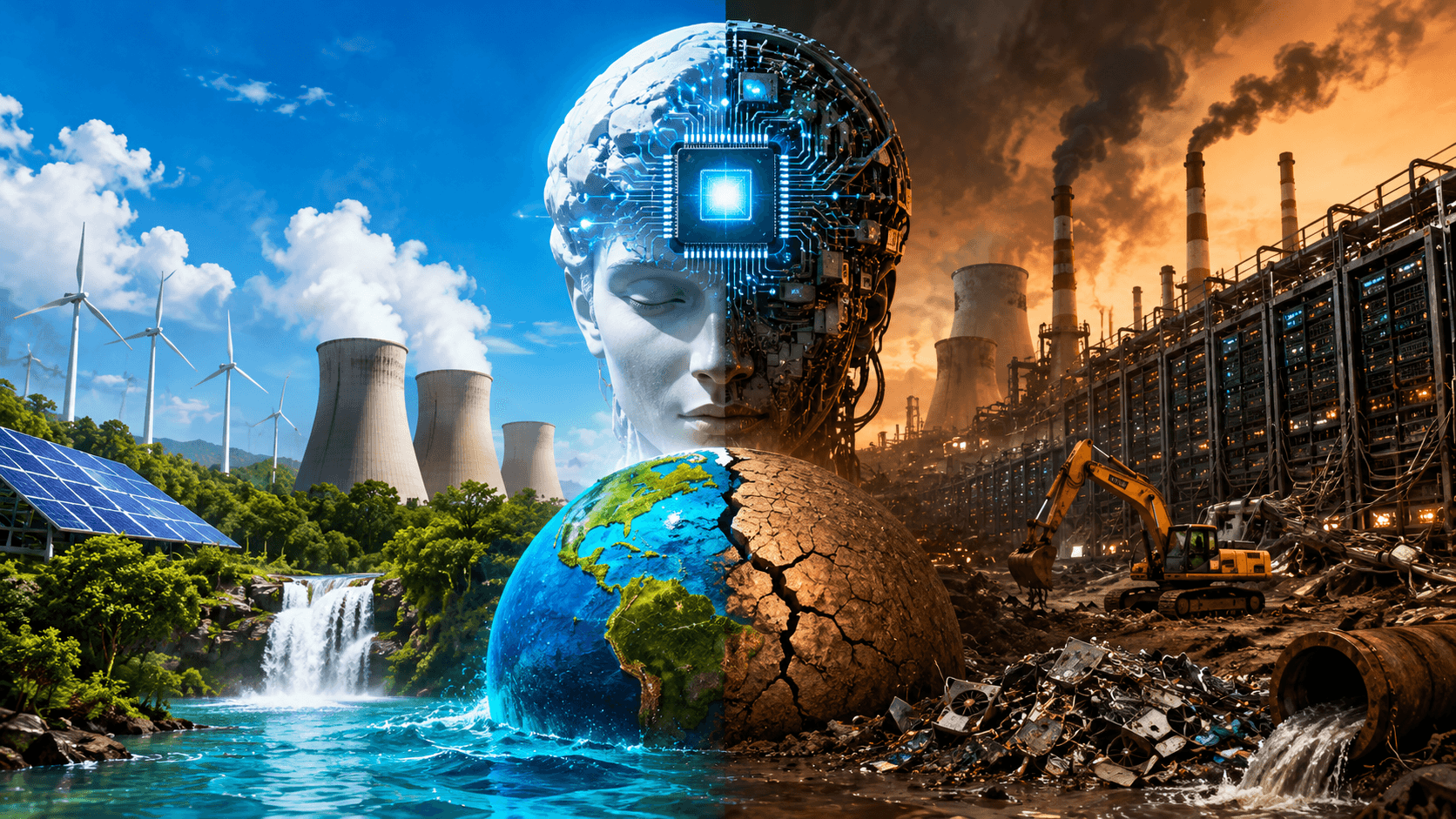
Artificial intelligence is often portrayed as something magical—an invisible force living somewhere in “the cloud.”
Ask a chatbot a question, generate an image, create a video, or summarize a document, and the result appears almost instantly on your screen.
But AI is not just software.
It is concrete, copper, silicon, electricity grids, cooling systems, water pipelines, and vast warehouses filled with powerful computers running around the clock.
Behind every AI-generated response lies a growing physical infrastructure that consumes enormous amounts of energy and natural resources. As AI adoption accelerates worldwide, questions about its environmental footprint are becoming impossible to ignore.
AI’s Massive Appetite for Electricity
One of the biggest hidden costs of modern AI is energy consumption.
According to estimates, training GPT-4 consumed up to 70 gigawatt-hours (GWh) of electricity. That is roughly 40 to 55 times more energy than GPT-3 required during training.
To put that into perspective, a single GPT-4 training run reportedly used as much electricity as the annual residential consumption of approximately 460,000 people in Sub-Saharan Africa.
While AI companies continue improving efficiency, the scale of computing required to train frontier models is growing rapidly as models become larger and more sophisticated.
The reality is simple: every breakthrough in AI requires more chips, more servers, and more electricity.
The Water Behind Every AI Query
Most people rarely associate AI with water consumption.
Yet water has become one of the most critical resources supporting the AI revolution.
Training a large model such as GPT-4 reportedly consumed up to 600 million liters of water. That amount is enough to fill approximately 237 Olympic-sized swimming pools.
Why does AI need so much water?
The answer lies in cooling.
Modern AI servers generate enormous amounts of heat. Data centers rely on cooling systems that often use significant quantities of water to prevent hardware from overheating.
As AI systems become larger, water demand grows alongside computing demand.
The Carbon Footprint of Frontier AI
Energy consumption translates directly into carbon emissions.
According to estimates, offsetting the carbon emissions associated with GPT-4’s training would require planting approximately 420,000 tree seedlings and allowing them to grow for a decade.
The land area required for such an offset has been compared to roughly 105 Hyde Parks in London.
Although technology companies are increasingly investing in renewable energy, the environmental challenge remains substantial because AI workloads continue expanding faster than efficiency improvements.
AI Videos Could Be Even More Resource Intensive
AI-generated videos represent one of the fastest-growing segments of generative AI.
However, video generation requires significantly more computing power than generating text.
Estimates suggest that a single high-complexity AI-generated video can consume as much electricity as 200,000 spam-filtering operations.
The environmental cost extends beyond electricity.
Generating that same video reportedly requires approximately 4.1 liters of water for cooling and power generation.
For comparison, that amount represents roughly two days of drinking water for one person.
As AI video tools become mainstream, their cumulative resource demands could become a significant sustainability challenge.
The Coming E-Waste Problem
The environmental impact of AI is not limited to energy and water.
The hardware powering AI systems eventually becomes obsolete.
By 2030, AI infrastructure is projected to generate approximately 2.5 million metric tons of electronic waste every year.
To visualize that scale, it has been compared to the weight of roughly 250 Eiffel Towers annually.
Servers, processors, networking equipment, storage systems, and cooling infrastructure all have finite lifespans. As newer and more powerful hardware arrives, older systems are replaced, creating an increasingly large stream of electronic waste.
Managing this waste responsibly will become a major challenge for governments and technology companies alike.
Data Centers Are Becoming Global Power Giants
The AI boom is fueling an unprecedented expansion of data centers worldwide.
These facilities serve as the backbone of modern artificial intelligence, cloud computing, and digital services.
The scale of their energy consumption is staggering.
If the world’s data centers were considered a country, they would already rank as the 11th-largest electricity consumer on Earth.
As companies race to build larger AI systems, data center construction is accelerating across North America, Europe, Asia, and the Middle East.
This growth is placing increasing pressure on power grids and local resources.
Even AI Images Have an Environmental Cost
Many users generate AI images without considering the resources involved.
Yet every generated image requires computing power.
Estimates suggest that generating a single AI image consumes enough energy to power a 10-watt LED bulb for approximately 17 minutes.
While one image may seem insignificant, billions of images generated globally each year can create a substantial cumulative impact.
The challenge lies not in a single request but in the sheer scale of worldwide AI usage.
The Land Footprint of the AI Revolution
Electricity generation itself requires infrastructure.
By 2030, projections indicate that data centers could require an electricity-related land footprint equal to 10 times the size of Mexico City.
New substations, transmission lines, power plants, renewable energy facilities, and supporting infrastructure will all be needed to meet rising AI demand.
The AI revolution is therefore not only transforming software but also reshaping physical landscapes.
The Bigger Question
Artificial intelligence offers extraordinary benefits.
It can accelerate scientific research, improve healthcare, enhance productivity, and unlock new forms of creativity.
However, AI is not free.
Every chatbot response, image generation request, and AI-created video relies on real-world resources: electricity, water, minerals, land, and hardware.
The debate is no longer whether AI will transform society.
The question is whether the industry can make AI significantly more efficient before its resource demands outpace sustainability efforts.
As AI becomes deeply embedded in everyday life, transparency, accountability, and efficiency-by-design may become just as important as intelligence itself.
The future of AI will depend not only on what these systems can do—but also on how responsibly humanity powers them.
Source: United Nations University
Institute for Water, Environment and Health