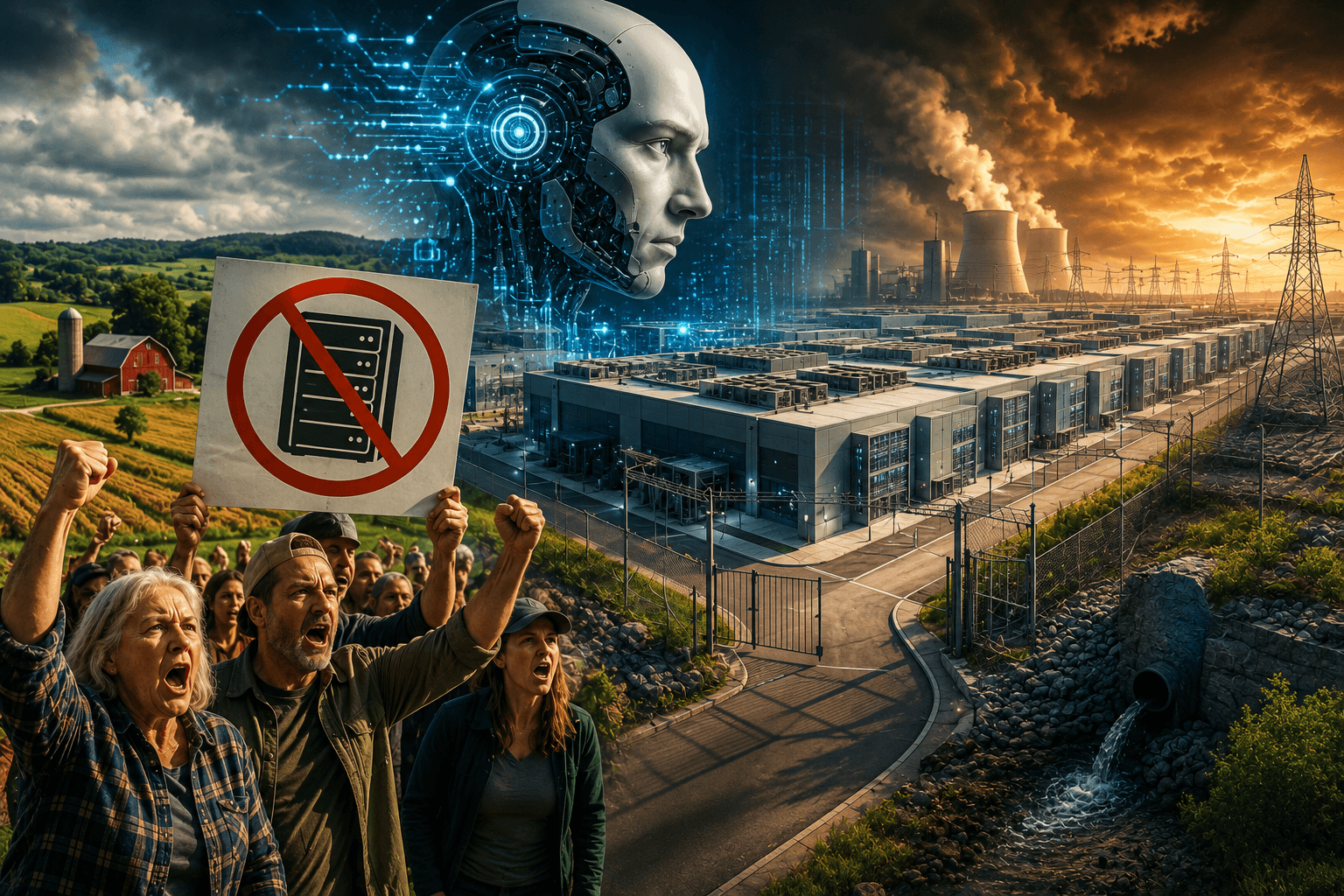
As the AI boom accelerates, a fierce grassroots backlash against data centers is reshaping local politics and challenging the rapid expansion plans of Big Tech. From rural Michigan farmlands to communities in multiple states, residents are mobilizing against what they see as noisy, power-hungry industrial complexes that threaten their way of life—often with a level of intensity that surpasses traditional Not In My Backyard (NIMBY) disputes.
Recent surveys underscore the depth of public discontent. Only about one-third of Americans approve of the current pace of data-center construction, and just 14% would welcome one in their own community. Some polls even suggest many would rather live near a nuclear reactor than a data center. This sentiment has already derailed projects worth nearly $100 billion through protests, legal challenges, and local moratoriums in states including Texas, Michigan, and Virginia.
Flashpoint in Saline Township
One of the most visible battles is unfolding in Saline Township, Michigan, a small farming community of about 2,400 people. A massive $16 billion “Stargate” data center project—backed by a consortium including Oracle, OpenAI, Related Digital, Blackstone, and Walbridge—is pushing forward on 250 acres despite strong local opposition. Cranes and towering fences now dominate the landscape near corn and soybean fields.
Residents like Tammie Bruneau, who has led pushback efforts, argue the development threatens farmland, water supplies, and the township’s rural character. “Most people aren’t interested in some massive development here,” she said. Construction began in June after a contentious rezoning battle, a township board denial, a lawsuit from developers, and an eventual consent judgment that included community benefits like farmland preservation funds and noise restrictions. Opponents continue to challenge the agreement in court.
Similar fights have played out elsewhere in Michigan. Developers withdrew a project in Washington Township after resident mobilization, while petitioners in Augusta forced a public rezoning vote. At least 13 data centers are in various planning stages across the state.
Why the Anger Runs So Deep
Opposition stems from multiple, overlapping concerns:
- Noise and Visual Impact: Residents describe constant generator roar, cooling system hum, and sprawling new transmission infrastructure as turning peaceful areas into an “eyesore” or construction “war zone.”
- Water and Environment: Fears over groundwater contamination and heavy industrial water use for cooling remain central, even as some developers commit to closed-loop air cooling systems.
- Electricity Costs and Grid Strain: Data centers are accused of “hogging” power, raising worries about higher utility bills for families. In response, some states like Ohio have required operators to cover most of their power capacity costs upfront.
- Broader AI Anxieties: Many view the facilities as symbols of a disruptive future—potential mass unemployment driven by AI, and unchecked power concentrated among a small group of tech leaders.
Opposition crosses party lines. In Saline, activists report support from voters across the ideological spectrum, united by a sense that “big money” is overriding local wishes.
Political Pressure Mounts
The issue is now influencing higher-stakes races. In Michigan’s August 4 Democratic U.S. Senate primary, candidates are navigating voter anger carefully. Rep. Haley Stevens positions herself as a tech optimist, linking data centers to job creation and innovation while insisting companies pay their fair share for water and utilities. Her rival, Abdul El-Sayed, calls for stronger oversight, suggesting AI companies operate as public-benefit corporations and that local moratoriums may sometimes be necessary. Many residents feel neither goes far enough.
Nationally, the Trump administration—while prioritizing AI competitiveness with China—has engaged with utilities and developers on a voluntary pledge to shield taxpayers from infrastructure costs. Politicians across the spectrum are scrambling to respond as the debate moves beyond town halls to state and federal arenas.
Developers highlight economic upsides. The Saline project promises thousands of construction and permanent jobs, plus significant tax revenue. Companies emphasize responsible practices, such as funding their own energy infrastructure and preserving surrounding lands.
Yet for many locals, the unknowns outweigh the promises. As one resident put it, the fight feels like citizens being “steamrolled” by corporate interests in a polarized nation where data center resistance has become a rare unifying issue.
The coming months will test whether communities can slow the AI infrastructure wave or if economic and technological momentum will prevail. For now, the message from places like Saline Township is clear: “We just don’t want it.”