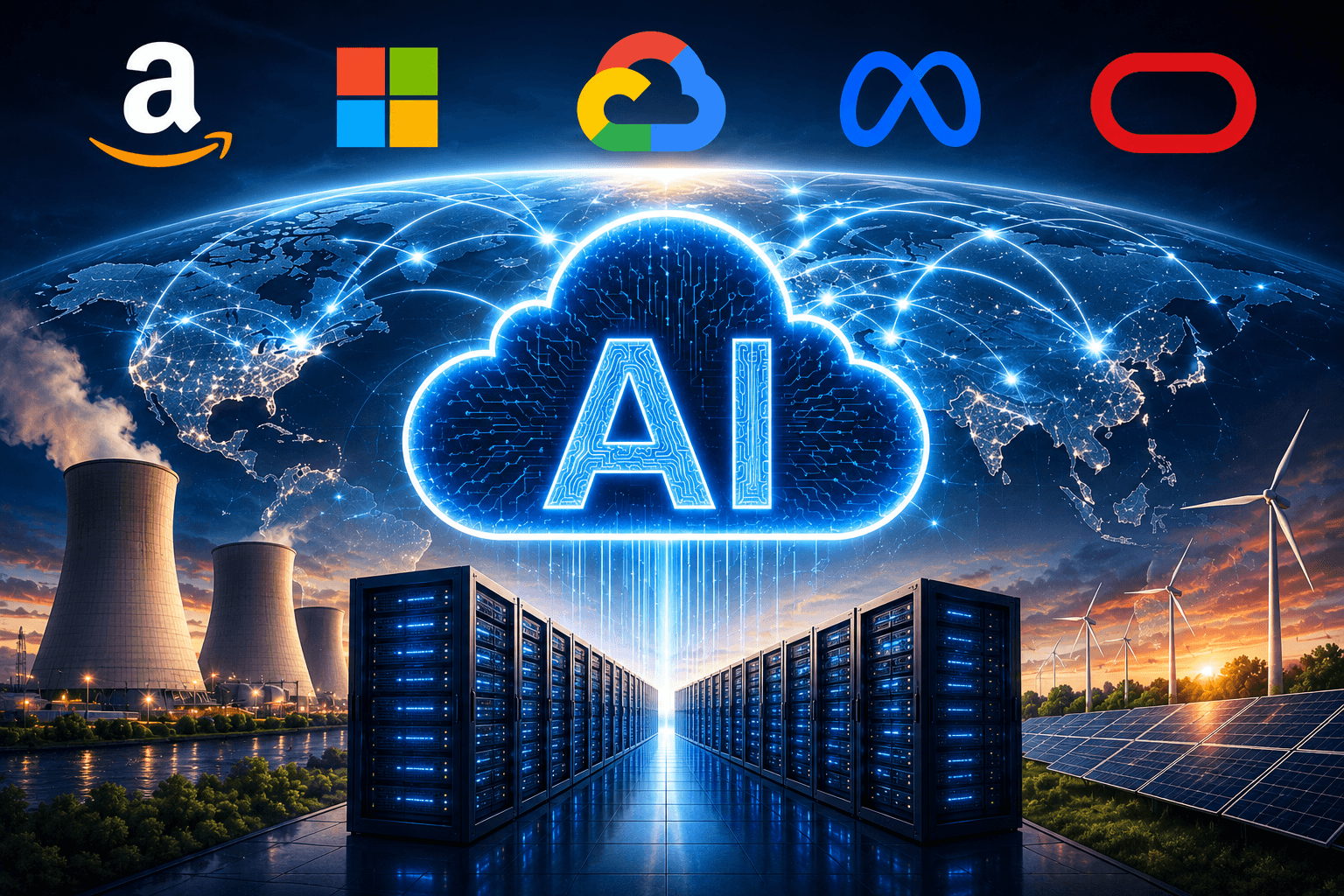
Hyperscalersare the world’s largest cloud computing companies that build and operate massive global data center networkscapable of serving millions of users and businesses simultaneously. They earn the name “hyperscalers” because they can scale computing infrastructure at unprecedented speed—adding thousands of servers, GPUs, custom AI chips, and storage systems in response to surging demand, particularly from the AI boom.
Major Hyperscalers (2026)
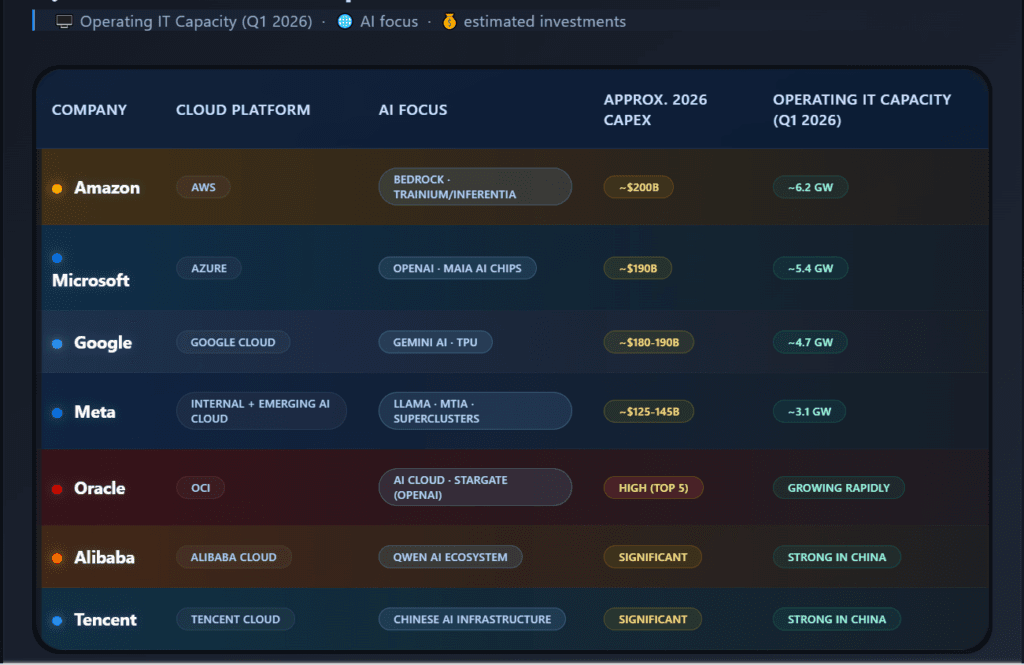
Market context (Q1 2026 approx.): AWS ~28-30%, Azure ~20-21%, Google Cloud ~13-14%. The top three control a dominant share of global hyperscale capacity.
Why Are They Called Hyperscalers?
Unlike traditional data centers, hyperscalers operate at enormous scale:
- Hundreds to over 1,000 data centers worldwide (the number has nearly tripled since 2018).
- Millions of servers and hundreds of thousands to millions of AI accelerators.
- Exabytes of data storage and global fiber-optic/undersea cable networks.
- Power consumption comparable to small countries; a single large AI campus can draw as much as a nuclear reactor (hundreds of MW to 1+ GW).
- Rapid expansion pipelines: AWS, Microsoft, and Google alone have gigawatts of additional capacity in various stages.
Microsoft, Google, and Amazon’s platforms serve millions of customers across nearly every country, powering everything from consumer apps to enterprise workloads.
Role in the AI Boom
Today’s AI revolution depends heavily on hyperscalers. They provide:
- Massive AI training and inference infrastructure.
- Access to NVIDIA/AMD GPUs plus their own custom silicon.
- Vast storage for trillion-token datasets.
- Managed AI services and foundation model hosting.
- Enterprise AI platforms with security, compliance, and integration tools.
Startups and labs like OpenAI, Anthropic, and xAI rely on them for frontier model training and deployment. Hyperscalers are also becoming direct AI competitors (e.g., Meta’s Llama, Google’s Gemini).
2026 Scale: Combined capex for the top hyperscalers is projected in the $660-830 billion range (with top 5 around $700B+), a massive increase from prior years, driven almost entirely by AI.
Why Hyperscalers Matter Geopolitically
Hyperscalers are now treated as strategic national infrastructure, influencing:
- AI leadership and technological sovereignty.
- Semiconductor demand and supply chains.
- Electricity and water usage at national-grid scale.
- Cybersecurity and data sovereignty.
- Economic competitiveness and job creation.
Governments view AI data centers like critical assets (ports, power grids, or highways). This has sparked U.S.-China tensions, export controls, and efforts to build domestic capacity. U.S. hyperscalers dominate globally, but Chinese players lead domestically.
Current Trends (Mid-2026)
- Explosive AI-first expansion: Hundreds of billions poured into AI data centers. The top players are capacity-constrained and monetizing as fast as they build.
- Custom AI chips to reduce NVIDIA reliance:
- Google TPUs (mature, high efficiency for its workloads).
- AWS Trainium/Inferentia.
- Microsoft Maia (strong inference claims).
- Meta MTIA (newer generations entering production; modular chiplet designs).
- Power and energy crunch: Many projects require dedicated power solutions. Hyperscalers are signing major nuclear deals (e.g., Microsoft restarting Three Mile Island, Meta up to 6.6 GW, Amazon and Google SMR commitments) alongside gas, renewables, and grid upgrades. Total committed nuclear capacity across deals exceeds 9 GW.
- Public and regulatory resistance: Growing opposition in the U.S. and Europe over land use, electricity rates, water consumption for cooling, noise, and aesthetics. Surveys show 57-71% of Americans oppose local data centers. This has delayed or blocked billions in projects, influencing elections and prompting moratoriums.
- Emerging dynamics: Some hyperscalers (e.g., Meta) exploring monetizing excess capacity. “Neoclouds” like CoreWeave challenge on specialized AI compute. Sustainability pressures and efficiency gains from custom silicon are key focus areas.
In Simple Terms
Think of hyperscalers as the digital utilities of the AI era—the invisible backbone powering modern life.
Just as electricity companies supply power, hyperscalers supply the computing power that runs:
- ChatGPT, Google Gemini, Claude, and Llama
- Netflix, Spotify, and social media
- Microsoft 365 and enterprise tools
- Scientific research, finance, healthcare, and government systems
Without them, large-scale AI at global reach would be impossible. Their 2026 investments represent one of the largest infrastructure buildouts in history, but success hinges on overcoming power constraints, public acceptance, and delivering returns on these enormous bets.
This enhanced version adds 2026-specific data (capex, capacity, market shares), deeper context on custom chips and nuclear power, geopolitical nuance, and balanced coverage of challenges like opposition—making it more informative, timely, and valuable while preserving the original structure and accessibility.