One organism. Six clues. 3.5 billion years old. Making headlines across four continents in 2026. All real.
It is invisible to the naked eye. It created the air you are breathing right now. Scientists are engineering it to grow food on Mars, make rocket fuel without oil, replace plastic from CO₂, and now — transform one of Asia’s most brutal deserts into fertile farmland in just ten months. Can you name it before the final clue?
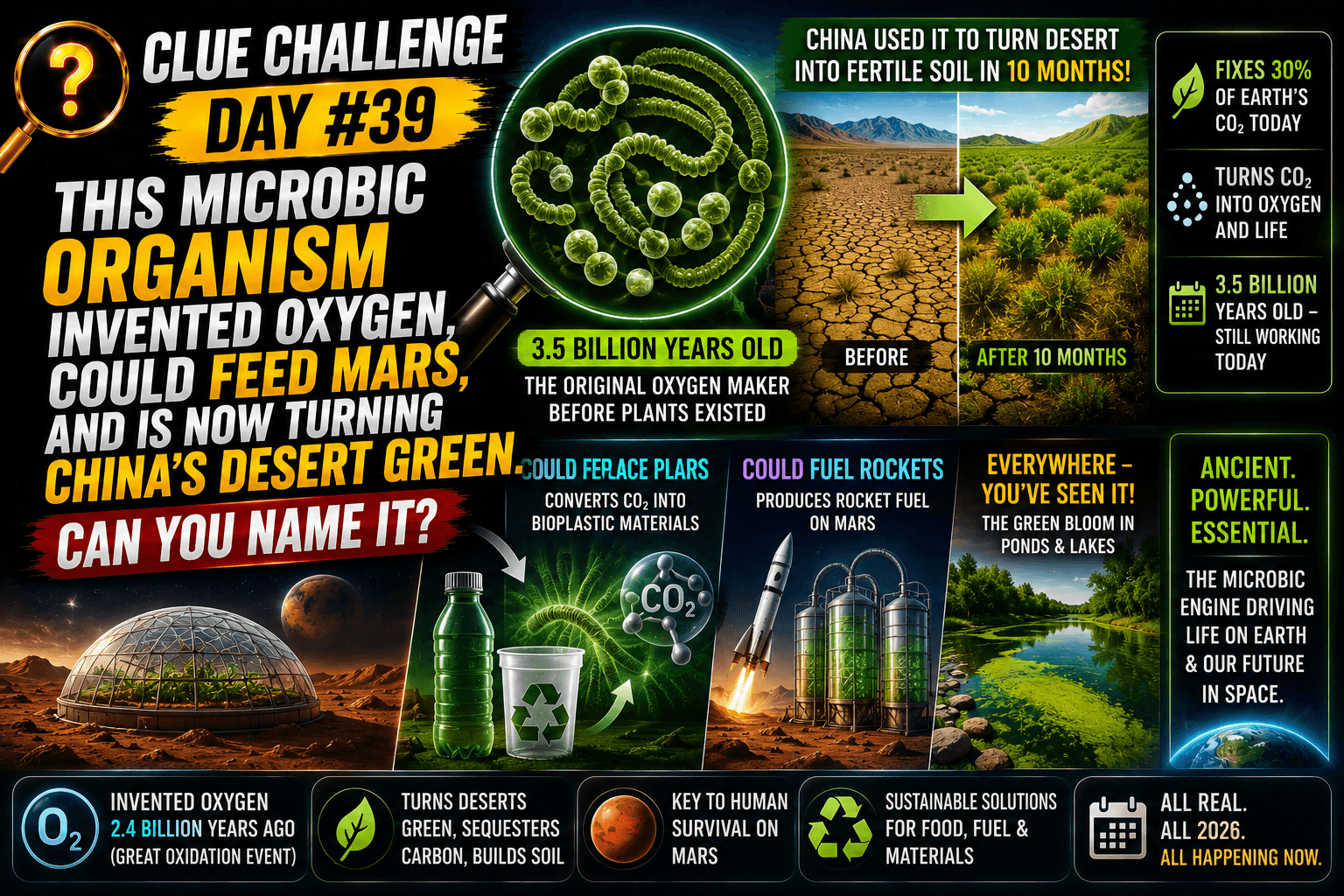
Clue #1 — It invented oxygen. Before plants even existed.
Long before plants and algae, this ancient microorganism was already performing photosynthesis — filling Earth’s skies with oxygen and setting the stage for all complex life as we know it.
This event — called the Great Oxidation Event — happened 2.4 billion years ago. Without it: no humans, no animals, no trees. Nothing breathing.
These ultra-prevalent microorganisms are critical to the global carbon cycle today — responsible for fixing as much as 20-30% of the world’s carbon dioxide and converting it into the oxygen we breathe.
The oldest living oxygen factory on Earth. Still operating. Right now. In every lake, ocean, and damp surface on the planet.
Clue #2 — China used it to turn a desert into fertile soil — in just 10 months
One of 2026’s most remarkable environmental breakthroughs came from China’s Taklamakan Desert.
Researchers in China relied on this ancient photosynthetic microorganism — which has existed for around 3.5 billion years — to to create living ‘biological soil crusts’ that bind sand, retain moisture, and boost nutrient levels, paving the way for vegetation growth. It also performs nitrogen fixation, converting atmospheric nitrogen gas into nutrients that plants can absorb. Within the first year of treatment, the sand’s top layer began retaining essential nutrients such as nitrogen and phosphorus. As the microbes lived and died, they added organic matter to the soil, gradually forming a basic micro-ecosystem.
Researchers from the Chinese Academy of Sciences conducted trials in the Taklamakan Desert — one of Asia’s most brutal and driest environments — where stabilisation occurred within 10 to 16 months. Laboratory tests showed the artificial crust reduced sand erosion by more than 90%.
The technique has now been used across the Three-North Shelterbelt Programme (widely known as China’s “Great Green Wall,” is a massive 72-year afforestation project (1978–2050)) and is expected to rehabilitate between 5,300 and 6,660 hectares of desert over the next five years.
A 3.5-billion-year-old organism. A 10-month timeline. An ancient desert turning green.
Clue #3 — Scientists engineered it to grow food on Mars — confirmed March 2026
A fertiliser produced solely from Martian resources using this organism enabled the cultivation of edible duckweed biomass — achieving a yield of 27 grams of fresh plant mass per just 1 gram of dry organism — published in Chemical Engineering Journal in March 2026.
Separate research confirmed that far-red light-acclimating strains can grow under Martian light conditions — transforming minerals, CO₂, and even crew urine into biomass for food and materials production on Mars.
CO₂ from the Martian atmosphere. Sunlight. Crew waste. Food on your plate. No supply ship from Earth required.
Clue #4 — It could replace plastic — by eating CO₂ and producing it simultaneously
Scientists at the University of Manchester achieved a 23-fold increase in the production of citramalate — a precursor for renewable plastics like Perspex — from this organism. Their work could accelerate sustainable alternatives to fossil fuel-derived plastics.
Separately, newly discovered strains found in volcanic plumes in Colorado’s Rocky Mountains outperform all previously known carbon-capture microbes — consuming CO₂ so efficiently they can simultaneously convert it into biodegradable bioplastic.
A plastic factory that runs on sunlight and pulls pollution from the air as it works.
Clue #5 — It could fuel the rocket that brings astronauts home from Mars
Scientists designed a process using this organism to produce rocket fuel on Mars — growing it in photobioreactors the size of four football fields, using only CO₂, sunlight, and frozen Martian water. It converts CO₂ into sugars via photosynthesis, which are then converted by engineered E. coli into 2,3-butanediol — a viable rocket propellant using 32% less power than shipping methane from Earth.
The fuel for humanity’s return journey from Mars. Made from thin Martian air. By an organism that has been doing chemistry for 3.5 billion years.
Clue #6 — It is also known by a common name — and you have definitely seen it
You have seen it coating the surface of ponds in summer. Turning lakes vivid green or blue-green in warm weather. Triggering pollution warnings on rivers worldwide.
Long before forests existed, this sunlight-powered organism — that thrives in some of Earth’s harshest environments — likely appeared about 3.5 billion years ago. Using sunlight and air, many strains pull carbon dioxide into their cells and convert it into the building blocks of life itself.
Two identities. One ancient organism. A nuisance in your local lake. The most important microorganism in the history of life on Earth — and now, the engine of humanity’s survival plans on two planets simultaneously.
So — what is this organism?
It is a photosynthetic microorganism. It created Earth’s oxygen 2.4 billion years ago. It fixes 30% of the world’s CO₂ today. China used it to green the Taklamakan Desert in 10 months. Scientists are engineering it to grow food, make bioplastic, and produce rocket fuel on Mars. It is visible as blue-green blooms on ponds and lakes worldwide. Its technical name combines the Greek word for deep blue pigment with the word for a type of living cell.
Bonus — can you name:
- The event it triggered 2.4 billion years ago that made complex life possible
- The Chinese desert where it stabilised sand within 10 months in 2026
- The UK university that achieved a 23-fold increase in its plastic output
- The journal that published its Mars fertiliser breakthrough in March 2026
Drop your answer below. Unlike Wordle, this one has been keeping you alive since before the dinosaurs — and may keep humanity alive on Mars. Day #40 arrives tomorrow.
Missed yesterday’s challenge?

Clue Challenge Day #38: Ukraine’s Secret AI War Room Was Just Revealed on CNN
Answer to Yesterday’s Challenge: DAY #38
(Click above to reveal)