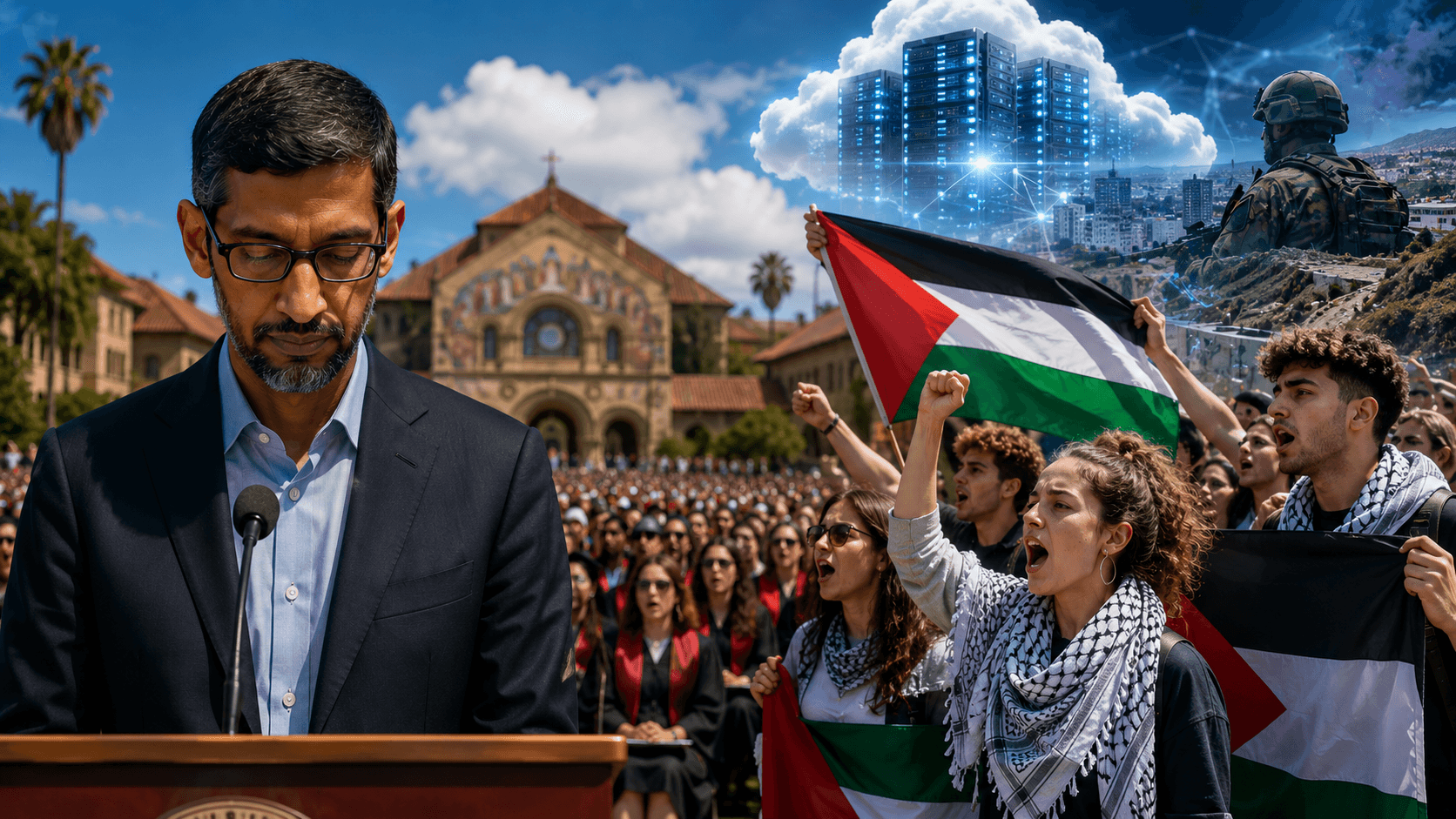
Google CEO Sundar Pichai expected to deliver a message of optimism to Stanford University’s Class of 2026.
Instead, he was met with boos, Palestinian flags, and a highly publicized student walkout.
On June 15, 2026, more than 100 Stanford graduates left their seats during Pichai’s commencement address, protesting Google’s involvement in Project Nimbus—a controversial $1.2 billion cloud-computing and artificial-intelligence contract between Google, Amazon, and the Israeli government. Protesters chanted “Free Palestine” and accused Google of enabling Israeli government operations through its technology infrastructure.
The dramatic scene transformed what should have been a celebratory graduation ceremony into one of the latest flashpoints in the global debate over artificial intelligence, corporate responsibility, and the role of Big Tech in modern conflicts.
What Is Project Nimbus?
Project Nimbus is a cloud-computing initiative signed in 2021 between the Israeli government and two of the world’s largest technology companies: Google and Amazon.
The contract, valued at approximately $1.2 billion, provides cloud infrastructure, artificial intelligence capabilities, machine learning tools, data storage, and related digital services to Israeli government agencies. The project’s stated goal is to modernize government technology systems and move critical workloads into advanced cloud environments.
Supporters argue that Nimbus is a standard government cloud contract similar to agreements that technology companies maintain with governments worldwide.
Critics see it differently.
They argue that advanced cloud infrastructure and AI tools can be used for surveillance, intelligence gathering, predictive analytics, and military-related operations, making technology providers indirectly involved in geopolitical conflicts.
Why Are Activists Opposing It?
The controversy surrounding Project Nimbus intensified after the Israel-Gaza war.
Pro-Palestinian activists, human-rights groups, and some Google employees have questioned whether cloud infrastructure provided through Nimbus could support Israeli government activities during the conflict.
While Google has repeatedly maintained that Nimbus supports government cloud services and commercial workloads, activists argue that the company should be more transparent about how the technology is ultimately used.
The issue has become one of the most significant examples of how AI and cloud computing are no longer viewed as politically neutral technologies.
Instead, they are increasingly seen as strategic assets with real-world consequences.
Stanford’s Walkout Sends a Message
The latest controversy erupted at Stanford University’s commencement ceremony.
Student organizers had reportedly planned the protest weeks in advance.
As Sundar Pichai stepped onto the stage, more than 100 graduates stood up and walked out while chanting slogans in support of Palestine. Some carried Palestinian flags while others displayed banners criticizing Google’s involvement in Project Nimbus.
Several reports described the demonstration as one of the most visible protests against a Big Tech executive at a major university graduation this year.
Pichai continued his speech despite the disruption and focused on themes of optimism, resilience, and personal growth. He avoided discussing Project Nimbus directly and later declined to comment publicly on the protest.
Why This Matters Beyond Google
The Stanford protest is about much more than a single contract.
It reflects a broader shift occurring across universities, technology companies, and society.
For years, cloud computing was viewed as neutral infrastructure—similar to electricity or internet connectivity.
Artificial intelligence is changing that perception.
As AI becomes deeply integrated into government systems, military operations, cybersecurity networks, and intelligence platforms, technology contracts increasingly carry ethical and political implications.
Project Nimbus has become a symbol of that transformation.
The question is no longer whether cloud providers supply technology to governments.
The question is whether companies should be held responsible for how those technologies are used.
Employee Revolts and Internal Resistance
The controversy has also sparked significant internal opposition within Google.
Over the past several years, employee activist groups have campaigned against Project Nimbus, arguing that workers should have a voice in determining how the technologies they build are deployed.
The issue gained international attention in 2024 when Google dismissed multiple employees following office protests linked to Project Nimbus. The incident highlighted growing tensions between corporate leadership and employee activism inside Silicon Valley.
The movement has continued to evolve, drawing support from student organizations, labor activists, and advocacy groups around the world.
The Future of AI Contracts
Project Nimbus may ultimately be remembered as one of the first major controversies of the AI era.
Governments increasingly depend on cloud providers for:
- Artificial intelligence systems
- National cybersecurity
- Public-sector digital services
- Data analytics
- Critical infrastructure management
As AI capabilities become more powerful, scrutiny over these partnerships is likely to intensify.
The Stanford walkout demonstrated that opposition to Project Nimbus is no longer confined to Google offices or activist circles. It has entered mainstream public discourse.
A Defining Debate for the AI Age
Whether one supports or opposes Project Nimbus, the controversy highlights a larger reality:
Artificial intelligence is no longer just a technology story.
It is now a political, ethical, and geopolitical story.
The protests that greeted Sundar Pichai at Stanford illustrate how younger generations increasingly view AI infrastructure through the lens of accountability, transparency, and human rights.
Project Nimbus began as a cloud-computing contract.
Five years later, it has become one of the defining debates about the future relationship between technology companies, governments, and society.
And judging by the events at Stanford, that debate is only becoming louder.