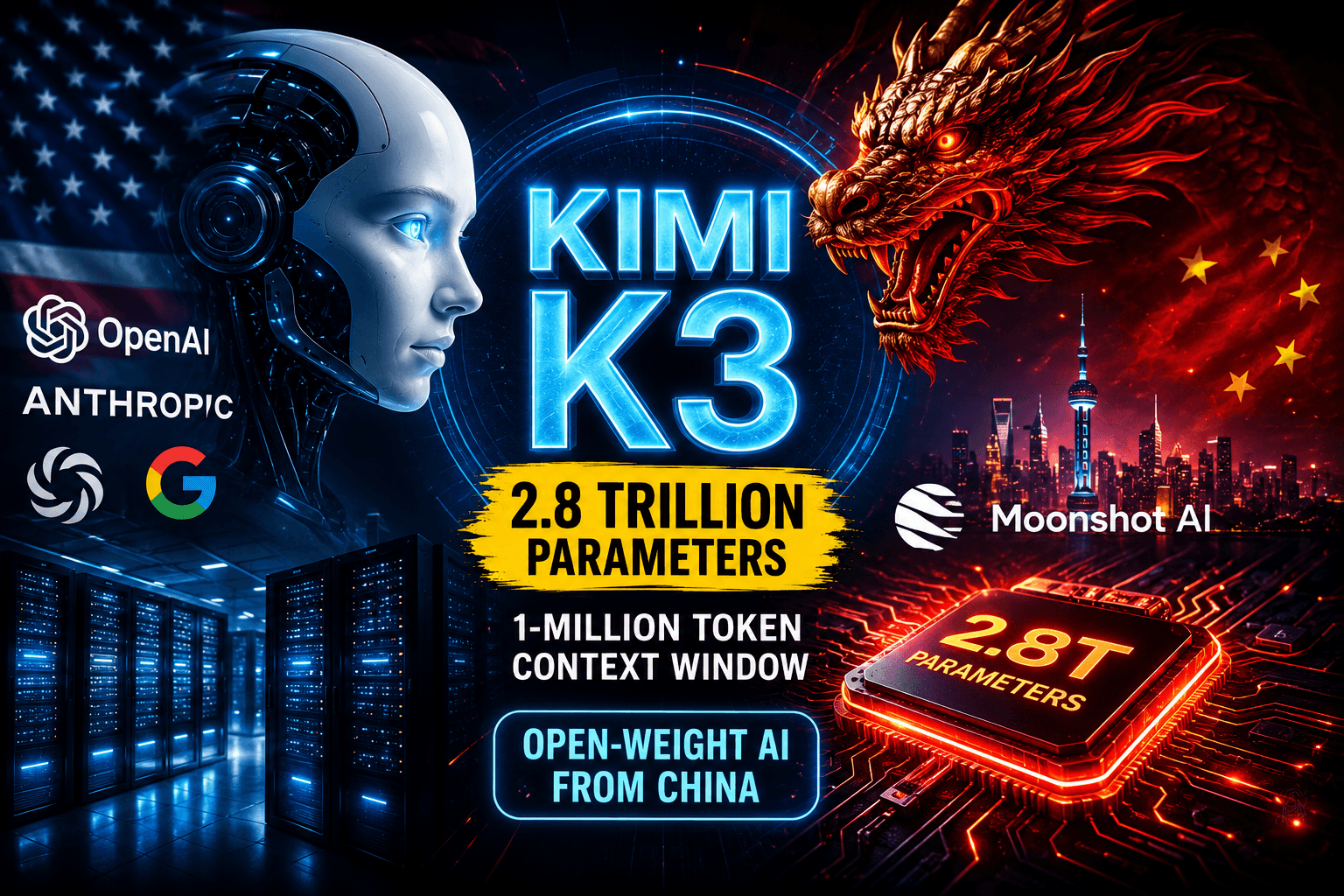
China’s AI race has entered a new phase. Moonshot AI has officially unveiled Kimi K3, describing it as the world’s first open-weight AI model to reach the 3-trillion-class, with 2.8 trillion parameters, a 1-million-token context window, and native multimodal capabilities.
Although Moonshot admits Kimi K3 still trails leading proprietary models such as OpenAI’s GPT-5.6 Sol and Anthropic’s Claude Fable 5, its release marks another milestone in China’s push to build frontier AI independent of U.S. technology.
What is Kimi K3?
Kimi K3 is Moonshot AI’s latest large language model designed for reasoning, software development, long-context understanding, knowledge work, and multimedia creation.
Key Specifications
- 2.8 trillion parameters
- 1-million-token context window
- Native vision (multimodal) support
- Built using Kimi Delta Attention and Attention Residuals
- Approximately 2.5× higher scaling efficiency than Kimi K2
- Open-weight release (weights scheduled for public release)
Rather than chasing chatbot popularity alone, Moonshot says K3 is optimized for “frontier intelligence” across long-horizon reasoning and complex enterprise workflows.
Why 2.8 Trillion Parameters Matter
Parameter count is no longer the only measure of AI capability, but it remains an indicator of a model’s potential capacity.
At 2.8 trillion parameters, Kimi K3 enters the same ultra-large class occupied by only a handful of frontier systems.
Combined with its 1-million-token context window, the model can theoretically process:
- Entire software repositories
- Large legal archives
- Scientific literature
- Massive financial reports
- Multi-book documents
- Long coding sessions
This makes it particularly attractive for enterprise applications rather than casual chatbot use.
Open-Weight vs Closed AI
Kimi K3 also reflects a growing philosophical divide in AI development.
Closed Models
Examples include:
- GPT-5.6
- Claude Fable 5
- Gemini
These systems keep their model weights private while charging users through APIs or subscriptions.
Open-Weight Models
Examples include:
- Kimi K3
- DeepSeek
- Qwen
- Llama
Although not fully open source, developers can download model weights and deploy them on their own infrastructure, allowing greater customization, privacy, and lower operating costs.
This approach has become increasingly attractive for governments and enterprises concerned about data sovereignty and vendor lock-in.
China’s AI Strategy Is Becoming Clear
Kimi K3 is not an isolated release.
Over the past year, China has steadily built an integrated AI ecosystem:
- DeepSeek demonstrated frontier reasoning using comparatively inexpensive training methods.
- Huawei introduced LogicFolding architecture and the Tau (τ) Scaling Law, aiming to improve chip performance without relying on ASML’s EUV lithography.
- Domestic AI accelerators from Huawei are increasingly replacing imported GPUs in Chinese data centers.
- Chinese companies are emphasizing efficient open-weight models instead of expensive proprietary ecosystems.
Together, these developments show China pursuing technological self-reliance across chips, compute infrastructure, and foundation models.
Moonshot Admits the Gap Still Exists
Unlike many AI announcements, Moonshot has openly acknowledged that Kimi K3 does not yet outperform the strongest proprietary U.S. models.
The company states that Claude Fable 5 and GPT-5.6 Sol still lead overall performance. However, Kimi K3 reportedly delivers frontier-level results across coding, reasoning, mathematics, multilingual tasks, and knowledge-intensive benchmarks while outperforming several previous-generation Western models.
That transparency has been viewed by many analysts as a sign of growing confidence rather than weakness.
The AI Competition Is Also a Political Competition
Kimi K3 arrives amid rising geopolitical tensions over AI.
U.S. companies have accused several Chinese AI firms—including DeepSeek, Moonshot AI, and MiniMax—of attempting to distill capabilities from proprietary models. Earlier this year, Anthropic alleged that millions of Claude interactions were generated through thousands of fraudulent accounts in violation of its terms of service.
Chinese firms reject the broader narrative that they depend solely on Western models, arguing that their rapid progress stems from advances in architecture, engineering efficiency, and domestic computing infrastructure.
Meanwhile, Washington continues tightening export controls on advanced AI chips, while Beijing is accelerating investment in indigenous semiconductors, open-weight AI models, and sovereign AI ecosystems.
Why Kimi K3 Matters
Kimi K3 is unlikely to dethrone GPT-5.6 or Claude overnight. Its significance lies elsewhere.
It demonstrates that frontier AI is no longer the exclusive domain of a handful of American companies. By combining 2.8 trillion parameters, million-token memory, multimodal reasoning, and an open-weight licensing model, Moonshot AI is challenging the assumption that cutting-edge AI must remain proprietary.
As China continues pairing models like Kimi K3 with homegrown semiconductor innovations and expanding AI infrastructure, the global race is shifting from a battle of individual chatbots to a competition between entire AI ecosystems. The next chapter of artificial intelligence may be decided not only by who builds the smartest model—but by who builds the most accessible, scalable, and strategically independent AI platform.