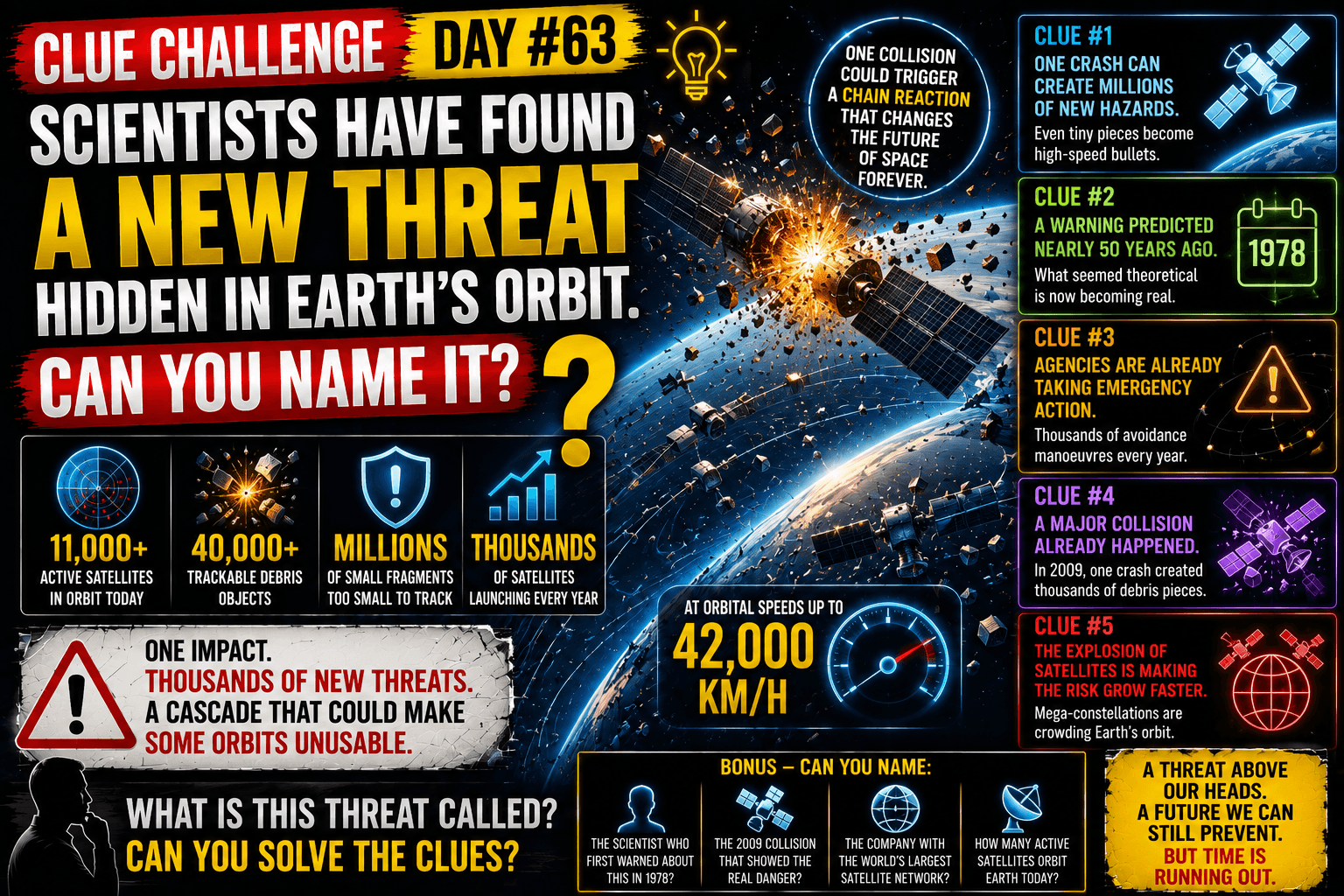
One threat. Five clues. Millions of debris fragments. Thousands of satellites. A single collision could trigger a chain reaction that changes the future of space forever. All real.
Humanity has filled Earth’s orbit with satellites that power GPS, weather forecasts, internet services, banking systems, military communications, and disaster warnings. But scientists warn that a hidden danger is growing above our heads. It doesn’t come from an asteroid, a solar storm, or an enemy nation. It comes from our own success in space. Can you name it before the final clue?
Clue #1 — A single crash could create millions of new hazards
More than 11,000 active satellites now orbit Earth, with tens of thousands more planned through mega-constellations such as Starlink, Kuiper, and other national space programs.
The problem is not the satellites themselves. It is what happens when one collides with another.
Even a small object travelling at orbital speeds can shatter a spacecraft into thousands of fragments. Each fragment then becomes a high-speed projectile capable of causing further collisions.
One impact. Thousands of new threats.
Clue #2 — The warning was first proposed nearly five decades ago
In 1978, a NASA scientist predicted that Earth’s orbital environment could eventually become so crowded that collisions would create more debris than humanity could remove.
At first, the idea seemed theoretical.
Today, many experts believe the risk is no longer hypothetical. Several low-Earth orbits are becoming increasingly congested as governments and private companies launch satellites at record rates.
A prediction from the 1970s is beginning to look uncomfortably modern.
Clue #3 — Space agencies are already performing emergency avoidance manoeuvres
In recent years, satellite operators have carried out thousands of collision-avoidance manoeuvres annually.
The European Space Agency has repeatedly warned that tracking centres are monitoring more than 40,000 large debris objects and millions of smaller fragments that are too tiny to track reliably but still large enough to destroy a spacecraft.
The more objects launched, the harder it becomes to avoid them.
Traffic jams are no longer limited to roads.
Clue #4 — A major collision has already shown what can happen
In 2009, an inactive Russian satellite collided with an operational communications satellite at nearly 42,000 km/h.
The crash generated thousands of trackable debris fragments and many more smaller pieces.
Scientists still monitor debris from that event today.
The lesson was simple: orbital debris does not disappear. It remains a threat for years, sometimes decades.
One collision. Consequences lasting generations.
Clue #5 — The AI era is accelerating the risk
The demand for global connectivity, cloud computing, autonomous systems, and AI-powered services is driving an unprecedented satellite boom.
Starlink alone has launched thousands of satellites. Amazon’s Project Kuiper is expanding rapidly. China, Europe, and several emerging space powers are planning their own mega-constellations.
In 2026, experts increasingly warn that orbital sustainability is becoming one of the most important infrastructure challenges of the century.
The more satellites humanity launches, the more important this warning becomes.
So — what is this threat called?
It was proposed by a NASA scientist in 1978. It describes a scenario in which collisions create debris, which causes more collisions, which creates even more debris in a self-sustaining cascade. It threatens satellites, navigation systems, weather forecasting, communications, scientific missions, and future space exploration itself.
Its name combines the surname of the scientist who first described the phenomenon with a word meaning a collection of symptoms or interconnected effects.
Bonus — can you name:
- The NASA scientist who first proposed this idea in 1978?
- The 2009 satellite collision that became its most famous real-world example?
- The company operating the world’s largest satellite constellation today?
- Approximately how many active satellites are currently orbiting Earth?
Drop your answer below. Unlike Wordle, this puzzle is orbiting above your head right now — and humanity may have only one chance to prevent it from becoming reality. Day #64 arrives tomorrow.
Missed yesterday’s challenge?
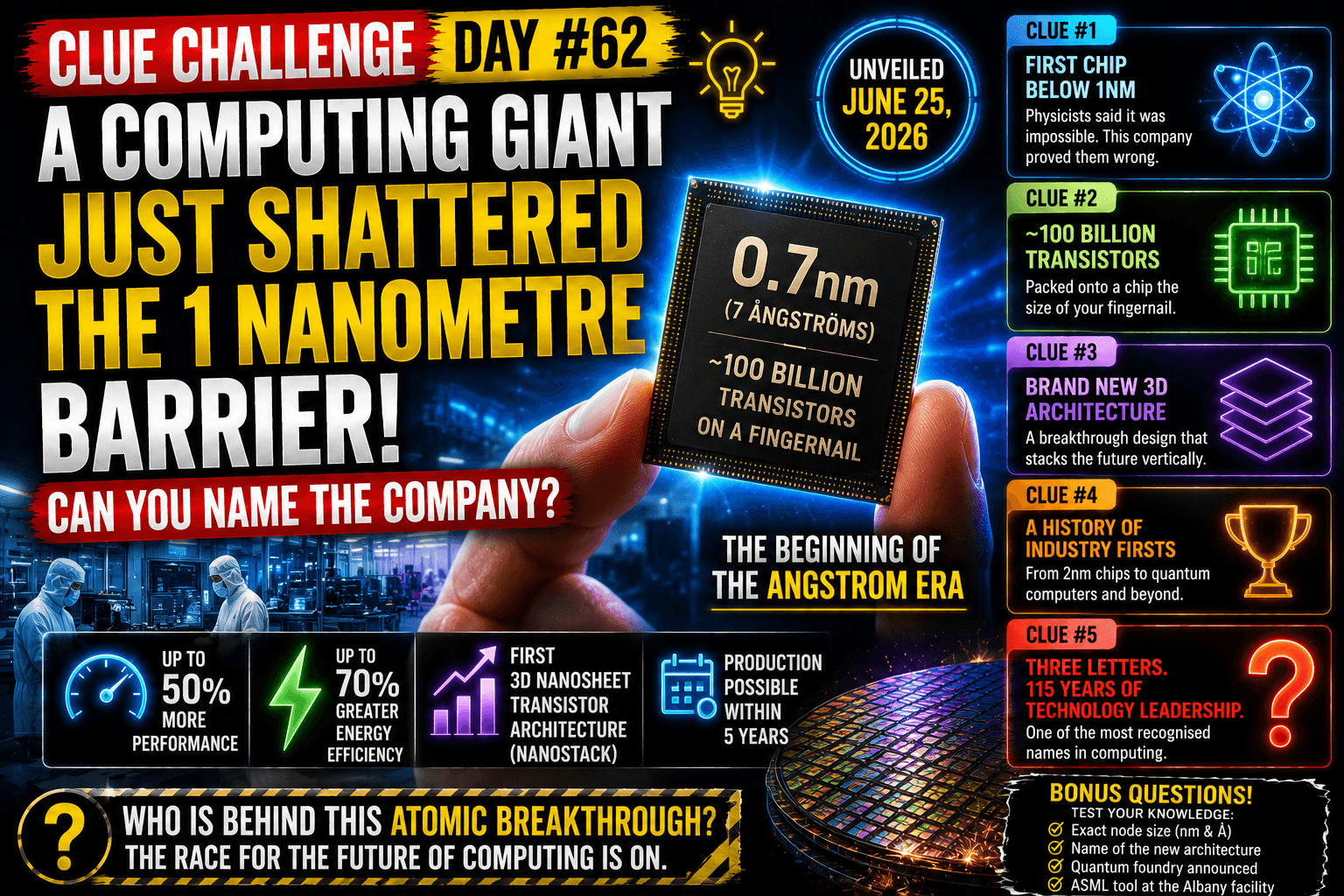
Answer to Yesterday’s Challenge: DAY #62
(Click above to reveal)