
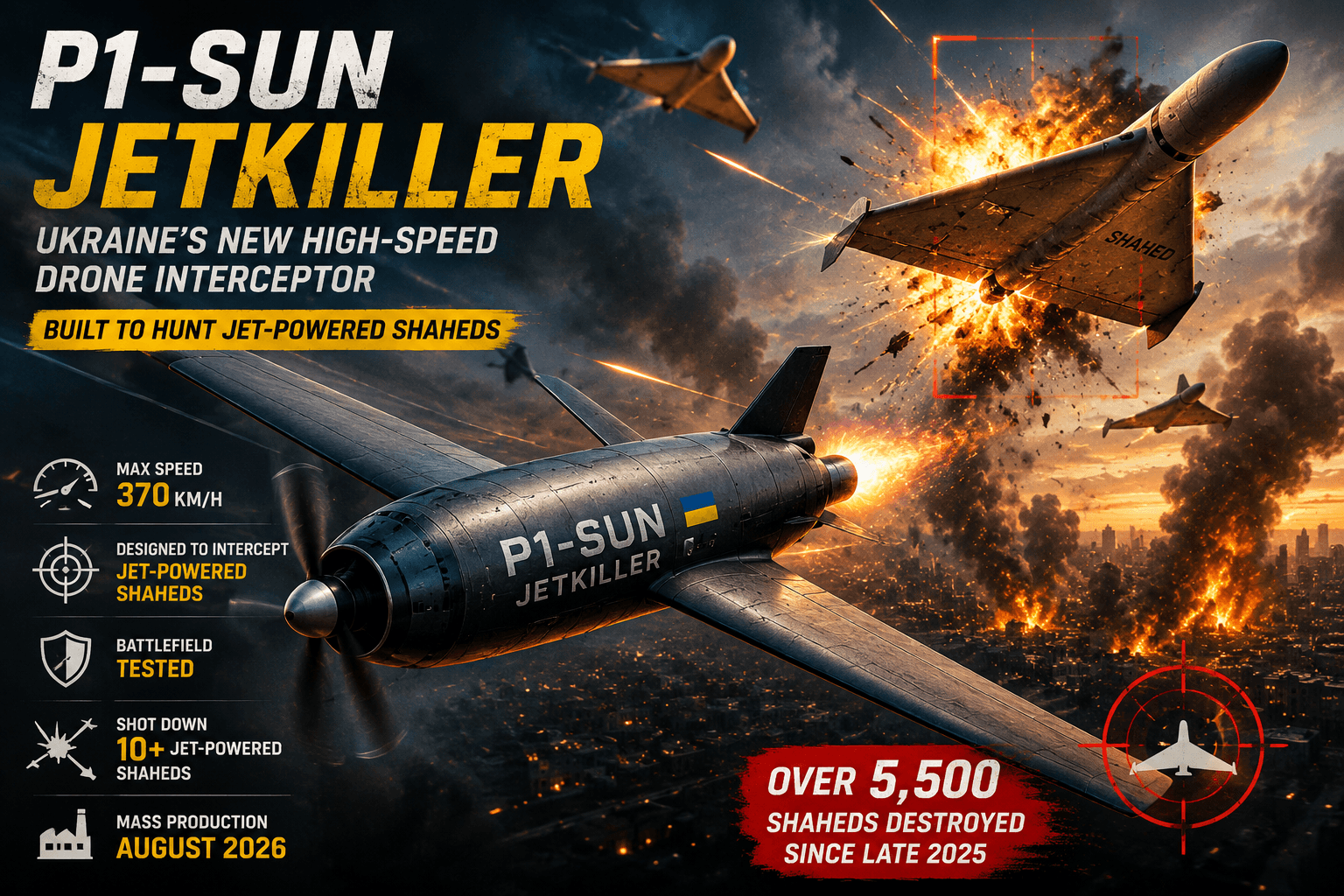
As drone warfare evolves at unprecedented speed, Ukraine has unveiled one of its most significant counter-drone weapons yet—the SkyFall P1-SUN Jetkiller. Revealed at the 2026 Farnborough International Airshow, the new interceptor is designed specifically to destroy Russia’s increasingly fast jet-powered Shahed attack drones, which have become a growing threat to Ukrainian cities and military infrastructure.
The launch highlights a new phase in the global drone race, where speed, affordability, and mass production are becoming as important as traditional missile defence systems.
Why Was the Jetkiller Developed?
Russia has begun deploying upgraded jet-powered Shahed (Geran) drones that can fly at speeds of up to 500 km/h, significantly faster than the earlier propeller-driven variants.
These drones reduce the warning time available to air defence units, making interception far more difficult. Traditional interceptor drones and even some missile systems struggle to respond quickly enough without incurring enormous costs.
To address this challenge, Ukrainian manufacturer SkyFall developed the P1-SUN Jetkiller, a faster evolution of its already successful P1-SUN interceptor.
Key Specifications
- Country: Ukraine
- Manufacturer: SkyFall
- Role: High-speed interceptor drone
- Maximum speed: 370 km/h
- Primary target: Jet-powered Shahed attack drones
- Operational status: Battlefield tested
- Mass production: Expected from August 2026
According to the company, the Jetkiller has already shot down more than a dozen jet-powered Shaheds during combat testing in Ukraine.
Proven Success of the Original P1-SUN
The Jetkiller builds upon the original P1-SUN interceptor, which has become one of Ukraine’s most widely used anti-drone systems.
SkyFall claims the earlier model has:
- Destroyed over 5,500 Russian Shahed drones
- Been operational since late 2025
- Achieved this using relatively inexpensive interceptor drones instead of costly surface-to-air missiles
While these battlefield figures have not been independently verified, they underline Ukraine’s growing emphasis on low-cost drone-versus-drone warfare.
The Rise of Interceptor Drones
The unveiling of Jetkiller reflects a broader shift in modern air defence.
Instead of relying solely on expensive missile interceptors that can cost hundreds of thousands—or even millions—of dollars per launch, countries are investing in disposable interceptor drones costing only a fraction of that amount.
At the 2026 Farnborough Airshow, several companies showcased similar concepts:
- General Cherry is developing a new Bullet interceptor capable of exceeding 400 km/h, with a target speed of 500 km/h.
- Firebolt Engineering introduced its Griffen jet-powered interceptor and is working on faster propulsion systems.
- MBDA announced new low-cost counter-drone interceptors for mass drone attacks.
- Lockheed Martin also revealed a more affordable Patriot interceptor concept.
The common goal is clear: defeat large numbers of low-cost drones without exhausting expensive missile inventories.
Why It Matters
The P1-SUN Jetkiller represents more than just another drone—it signals how warfare is changing.
Future conflicts are increasingly defined by autonomous systems battling autonomous systems, where rapid production, AI-assisted targeting, electronic warfare, and affordability matter as much as firepower.
If SkyFall’s battlefield claims continue to hold true, the Jetkiller could become one of the most influential interceptor drones of the Russia–Ukraine war and a model for future air defence strategies worldwide.
As attack drones become faster and more sophisticated, interceptor drones like the SkyFall P1-SUN Jetkiller may become the frontline guardians of modern airspace.