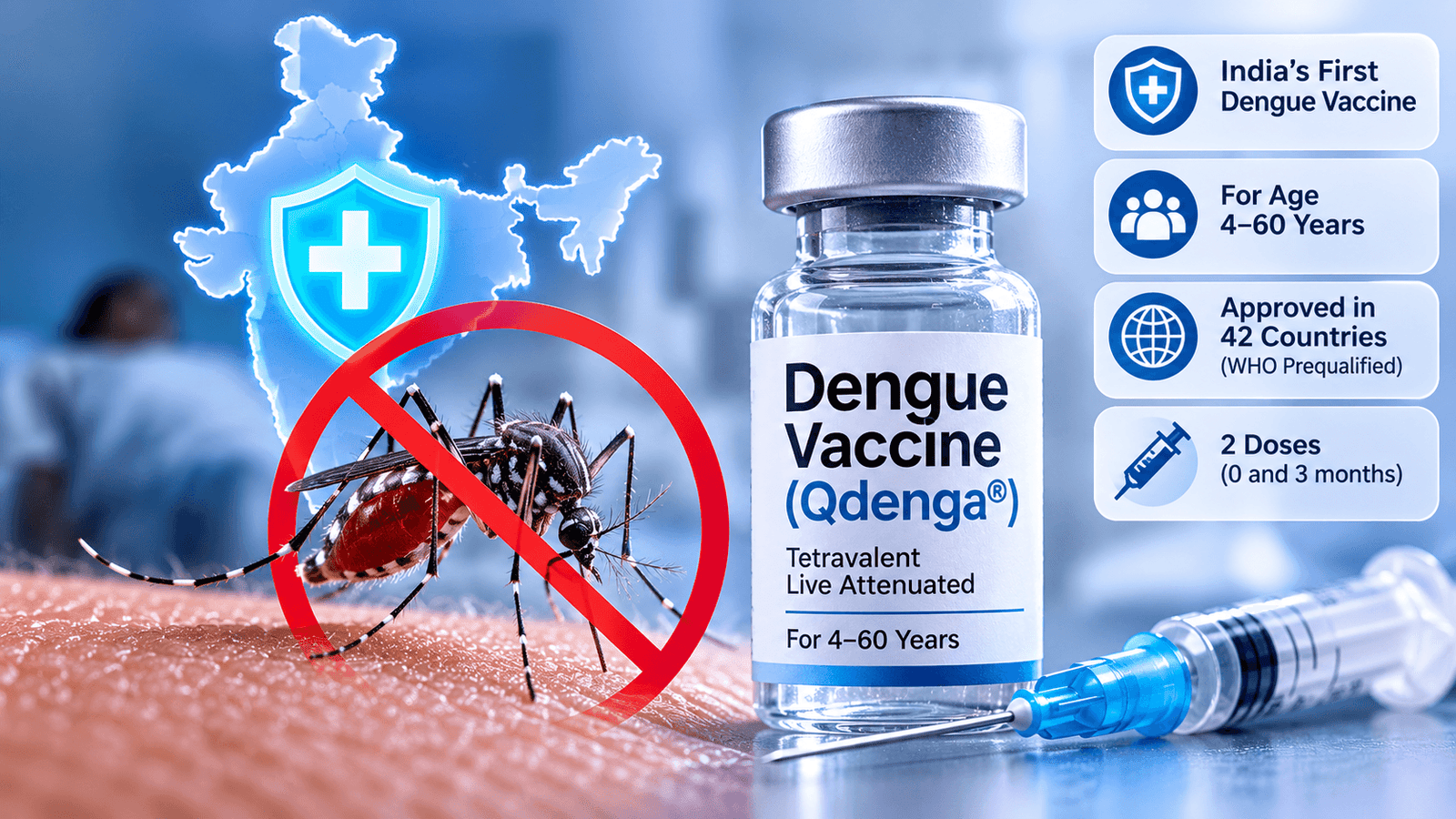
India has taken a major step in combating one of its fastest-growing mosquito-borne diseases. The Central Drugs Standard Control Organisation (CDSCO) has approved Qdenga, the country’s first dengue vaccine, for people aged 4 to 60 years.
Developed by Takeda GmbH (Germany), the vaccine is expected to complement India’s existing dengue control strategy, which currently relies on mosquito control, surveillance, early diagnosis, and supportive treatment.
What is Qdenga?
Qdenga is a live attenuated tetravalent dengue vaccine developed using recombinant DNA technology. It is designed to provide protection against all four dengue virus serotypes (DENV-1, DENV-2, DENV-3, and DENV-4).
The vaccine is administered through two subcutaneous doses, given three months apart (0 and 3 months).
It has been approved in India for individuals between 4 and 60 years of age after CDSCO reviewed its quality, safety, and efficacy data.
Strong Global Track Record
India’s approval is backed by extensive international evidence.
- Approved in 42 countries, including the European Union, UK, Switzerland, Indonesia, Malaysia, Thailand, and Brazil.
- Received World Health Organization (WHO) prequalification.
- More than 24 million doses have already been distributed globally.
- Post-marketing surveillance has reported a favourable safety profile with no major safety concerns.
Clinical trials included participants from multiple dengue-endemic countries, while a dedicated Phase III trial in India evaluated safety and immune response among Indian volunteers aged 4-60 years.
Why This Matters for India
India records lakhs of dengue infections every year, with outbreaks becoming more frequent due to rapid urbanisation, climate change, changing rainfall patterns, and expanding mosquito habitats.
Unlike many viral diseases, there is no specific antiviral treatment for dengue. Management mainly involves hydration, monitoring, and supportive care, making prevention crucial.
The availability of a licensed vaccine adds a new layer of protection, especially in high-risk urban and semi-urban regions.
Not a Replacement for Mosquito Control
Health experts stress that vaccination alone will not eliminate dengue.
The vaccine is expected to complement—not replace—existing measures such as:
- Eliminating mosquito breeding sites
- Vector surveillance
- Fogging and larval control
- Early diagnosis and clinical management
- Public awareness campaigns
An integrated strategy remains essential because Aedes mosquitoes continue to spread dengue, chikungunya, and Zika viruses.
What Happens Next?
Although CDSCO has granted marketing authorisation, broader rollout decisions—including inclusion in government immunisation programmes, pricing, procurement, and state-level deployment—will depend on future recommendations from India’s public health authorities.
Initial availability is likely to begin through private healthcare channels before any wider public-sector expansion.
The Bottom Line
The approval of Qdenga marks a historic milestone for India’s public health system. As the country’s first licensed dengue vaccine, it offers a promising new tool to reduce severe disease and strengthen dengue prevention.
Combined with continued mosquito control, surveillance, and public awareness, vaccination could significantly improve India’s long-term response to one of its most persistent seasonal health threats.