
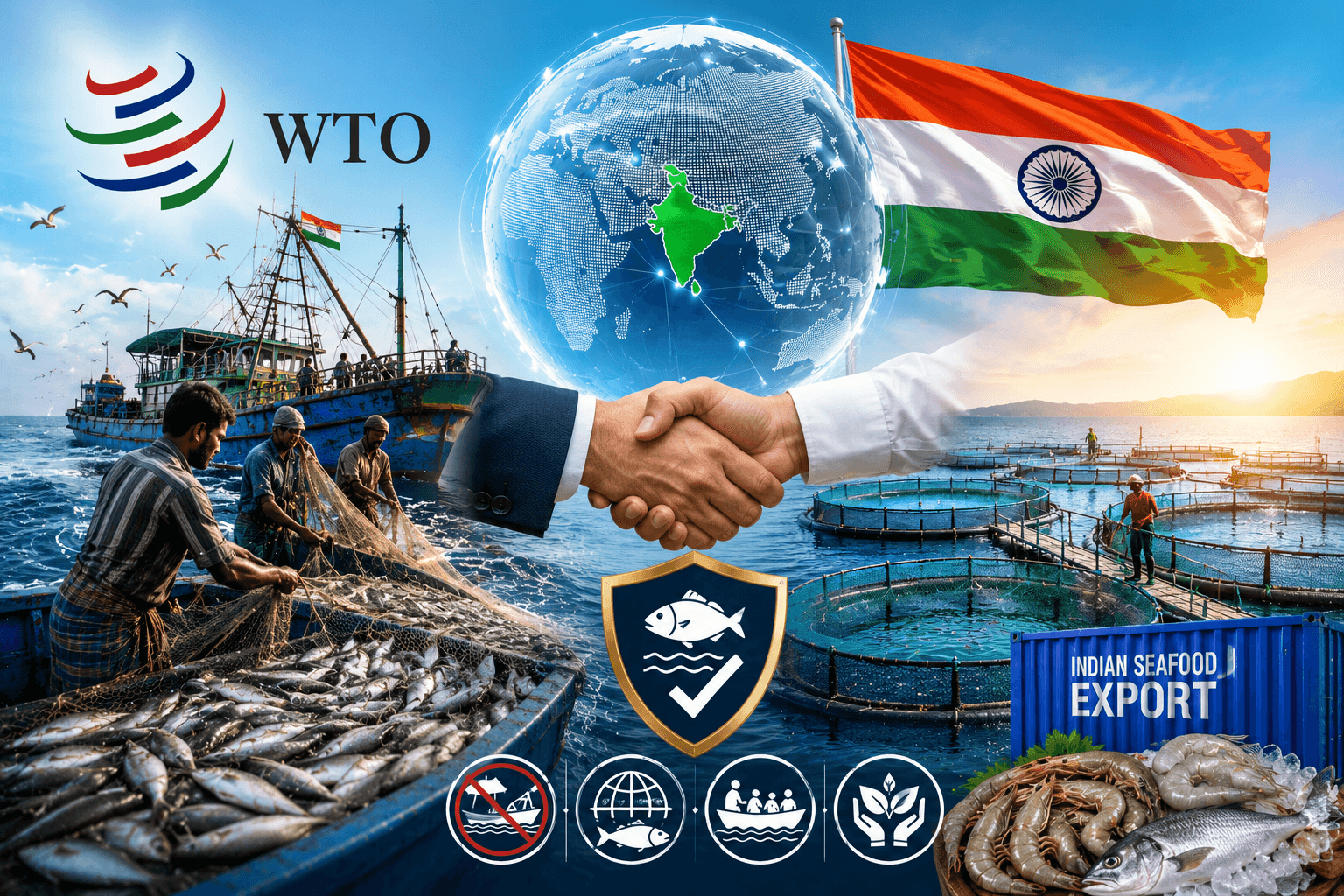
India has officially become a party to the World Trade Organization (WTO) Agreement on Fisheries Subsidies (AFS) after depositing its Instrument of Acceptance on July 20, 2026. The move makes India the 123rd WTO member to ratify the landmark agreement, reinforcing its commitment to sustainable marine fisheries while protecting the interests of millions of traditional fishers.
The agreement is the first WTO treaty with an environmental sustainability objective, aiming to curb harmful government subsidies that contribute to overfishing and the depletion of global fish stocks.
What is the WTO Fisheries Subsidies Agreement?
Adopted during the 12th WTO Ministerial Conference (MC12) in Geneva in 2022, the agreement entered into force in September 2025 after receiving acceptance from two-thirds of WTO members.
Its primary objective is to eliminate subsidies that encourage:
- Illegal, Unreported and Unregulated (IUU) fishing
- Fishing of already overfished stocks
- Unsustainable exploitation of marine resources
The agreement supports the global commitment under UN Sustainable Development Goal (SDG) 14.6, which seeks to end harmful fisheries subsidies.
Why India’s Decision Matters
India’s fisheries sector supports the livelihoods of nearly 30 million people, most of whom depend on small-scale and traditional coastal fishing rather than large industrial fleets.
By joining the agreement, India signals that economic growth and environmental conservation can coexist.
Unlike several distant-water fishing nations that provide massive subsidies to industrial fleets operating across oceans, India’s marine fishing sector is largely artisanal. The WTO agreement therefore places greater discipline on heavily subsidized industrial fishing while giving developing countries policy flexibility.
Good News for India’s Seafood Exports
The agreement is expected to strengthen India’s image as a responsible and sustainable seafood exporter.
International buyers—especially in Europe, North America and premium global markets—are increasingly demanding products that meet sustainability and traceability standards. Ratifying the agreement enhances confidence in Indian seafood exports.
An important advantage is that India’s aquaculture sector remains outside the scope of the agreement.
Since a significant share of India’s seafood exports consists of farm-raised shrimp, the country’s export competitiveness is unlikely to be adversely affected.
What Is Not Covered?
One of the most important aspects of the agreement is what it excludes.
The WTO rules do not apply to:
- Aquaculture (fish farming)
- Inland fisheries in rivers, lakes and reservoirs
The agreement focuses only on marine wild-capture fishing and fishing-related activities at sea.
This exclusion is particularly beneficial for India because aquaculture has become one of the fastest-growing segments of its seafood industry.
India Is Already Strengthening Fisheries Governance
India has recently introduced several reforms that complement the WTO agreement.
These include:
- Sustainable Harnessing of Fisheries in the Exclusive Economic Zone (EEZ) Rules, 2025
- Guidelines for Sustainable Harnessing of Fisheries in the High Seas, 2025
- Continued investments under the Pradhan Mantri Matsya Sampada Yojana (PMMSY) for modern infrastructure, conservation and capacity building.
These initiatives improve monitoring, promote sustainable harvesting and help preserve marine biodiversity while protecting fisher livelihoods.
Why This Matters Globally
According to the Food and Agriculture Organization (FAO), over one-third of the world’s marine fish stocks are already being exploited beyond biologically sustainable levels. Harmful subsidies worth billions of dollars have long been blamed for encouraging excessive fishing capacity.
The WTO agreement seeks to level the playing field by discouraging environmentally damaging subsidies while allowing developing nations sufficient flexibility to support genuine livelihood-based fisheries.
The Bottom Line
India’s acceptance of the WTO Fisheries Subsidies Agreement is more than a trade milestone. It strengthens the country’s position as a responsible maritime nation, supports sustainable ocean governance, and improves the credibility of Indian seafood in global markets.
Perhaps most importantly, the agreement balances environmental conservation with livelihood protection. By keeping aquaculture and inland fisheries outside its scope while targeting harmful marine subsidies, India has managed to align global sustainability commitments with the needs of its millions of small-scale fishers—a model that many developing countries may closely watch in the years ahead.