One mission. Five clues. Built to end US mineral dependency. Named after creation itself. All real. All 2026.
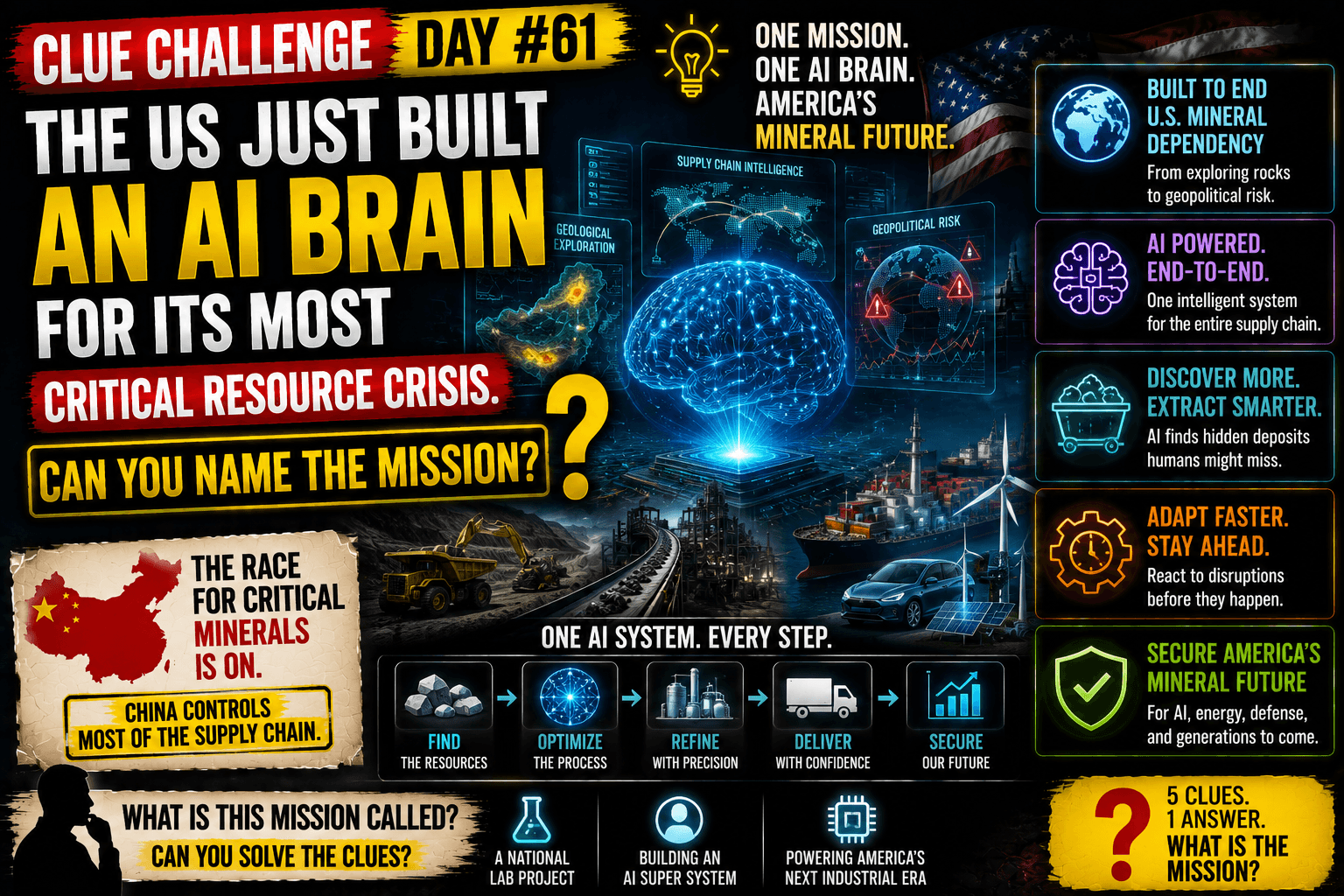
The United States is dangerously dependent on foreign nations for the minerals inside every EV battery, every AI chip, every fighter jet, and every solar panel it makes. A national laboratory just unveiled an AI system designed to fix that — from the moment a geologist walks into a field, all the way to the moment a manufacturer receives finished material. Can you name the mission before the final clue?
Clue #1 — The US is losing the critical minerals race — and an AI brain is the answer
The modern world runs on a handful of minerals: lithium, cobalt, nickel, graphite, copper, and rare earth elements. Without them, there are no EV batteries, no AI chips, no wind turbines, no fighter jets, no smartphones.
Supplies of these minerals are vulnerable to disruption from export restrictions, natural disasters, wars, and shifting geopolitical priorities.
China controls processing for most of them. In December 2024, it banned gallium exports to the United States entirely. In 2026, it extended that ban to several other critical elements. The US has one active rare earth mine on its entire territory — a single facility in the California desert. The vulnerability is existential. And a national laboratory just decided AI is the solution.
Clue #2 — Researchers are building a single AI “brain” to run the entire US mining and supply chain industry
Researchers at a national laboratory in the Rocky Mountains are developing what they describe as an AI brain for the entire critical minerals industry — a system designed to coordinate every step of the supply chain, from geological exploration to final material delivery.
“Ultimately, we want to be able to go from exploring rocks in the ground all the way to understanding geopolitical events on their impact on the supply chain. Using AI can help us make all the intermediate connections that are difficult for humans to optimise,” said Ryan King, computational science researcher at the National Laboratory of the Rockies.
One AI system. The entire minerals supply chain. From geology to geopolitics — in a single connected loop.
Clue #3 — It will replace human geologists, optimise ore processing in real time, and match output to individual customers
The AI system will work across three distinct phases — each one previously dependent on decades of human expertise and slow-moving industrial equipment.
On the exploration side, the AI will combine large volumes of data points to identify potential mineral deposits rather than relying solely on human geological interpretation. During ore processing, it will automatically change how ore is processed based on its real-time composition to get the best yields possible. It could even match processed ore to specific customers’ requirements dynamically — altering processing parameters to deliver, for example, 68% iron concentrate for one customer and 72% for another.
“AI can plug in anywhere. It can play a big role in exploration and extraction. Then, once you get minerals out of the ground, we can use AI to optimise the design and controls of key processing steps like milling, separation, and reduction to achieve desired feedstock characteristics,” King said.
Clue #4 — It was designed specifically because mines cannot react quickly — and supply chains now change overnight
“In these slow-moving industries, you install processing equipment, and it stays the same for generations. But supply chains evolve rapidly, and technological or materials innovation can change the type of feedstocks that are needed,” King said.
“At the same time, higher-grade resources may be used up, and we need to then make use of lower-grade resources, or we need to account for geopolitical supply shocks. This means we’re looking for AI solutions in mineral processing that can create output flexibility or absorb input volatility.”
A mine takes a decade to build. A geopolitical ban takes a signature. AI is the only thing that can bridge that gap at speed.
Clue #5 — Its name contains three distinct clues hidden inside it
The mission’s title contains three distinct ideas.
One represents a beginning.
The second word is the word for the overarching goal — a task or assignment of strategic national importance.
The third part — a long acronym hidden inside the full name — spells out exactly what it does: it handles critical minerals and materials, and it unlocks supply.
Put the first word, second word, and acronym together — and you have a mission name that describes both what it is and what it is trying to build.
So — what is this mission called?
Developed by the National Laboratory of the Rockies. Designed to build an AI brain for the entire US critical minerals supply chain — from geological exploration to geopolitical risk modelling to real-time ore processing optimisation. Its name combines a biblical word for creation, the word for a strategic assignment, and a six-word acronym describing its exact function. The acronym within its name spells CM2US.
Bonus — can you name:
- The national laboratory developing it
- The researcher leading the computational science work
- The six words that the acronym CM2US stands for
- The only active rare earth mine currently operating in the entire United States
Drop your answer below. Unlike Wordle, this one could determine whether the US wins the critical minerals race — or loses it to China. Day #62 arrives tomorrow.
Missed yesterday’s challenge?

Answer to Yesterday’s Challenge: DAY #60
(Click above to reveal)