
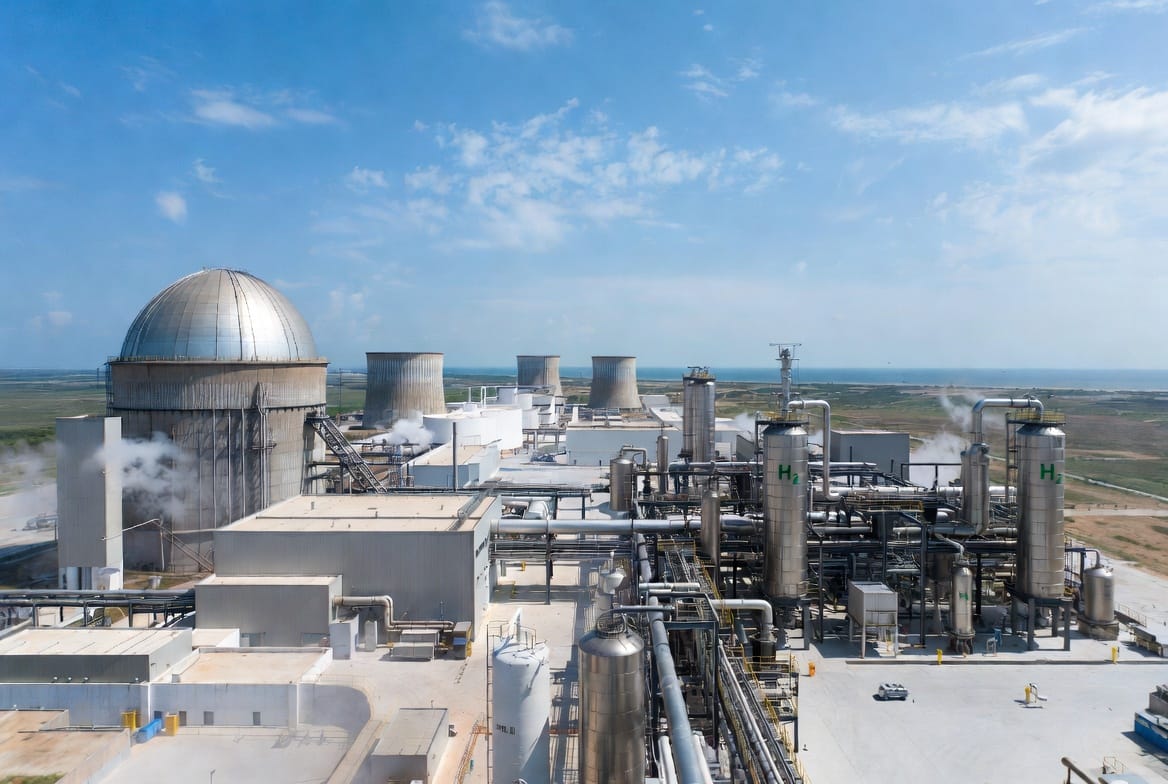
Major Achievement
- India inaugurated the world’s first hydrogen production facility based on the Copper–Chlorine (Cu–Cl) Thermochemical Cycle.
- Uses nuclear process heat from the Fast Breeder Test Reactor (FBTR).
- Located at Indira Gandhi Centre for Atomic Research (IGCAR), Kalpakkam, Tamil Nadu.
What Makes it Unique?
- World’s first facility to integrate:
- Nuclear reactor heat
- Cu–Cl thermochemical hydrogen production
- Demonstrates carbon-free hydrogen production using nuclear energy.
- Moves nuclear energy beyond electricity generation.
Technology Used
Copper–Chlorine (Cu–Cl) Thermochemical Cycle
- Developed indigenously by Bhabha Atomic Research Centre (BARC).
- Produces hydrogen using:
- Nuclear heat
- Chemical reactions
- Water
Advantages
- Operates at lower temperatures than many other thermochemical cycles.
- Higher thermodynamic efficiency.
- Eliminates greenhouse gas emissions.
- Reduces dependence on fossil fuels.
Role of FBTR
Fast Breeder Test Reactor (FBTR)
- Located at IGCAR, Kalpakkam.
- India’s only operating fast reactor research facility.
- Provides the high-temperature process heat required for hydrogen production.
Institutions Involved
Department of Atomic Energy (DAE)
Indira Gandhi Centre for Atomic Research (IGCAR)
- Established: 1971
- Leads India’s Fast Breeder Reactor Programme.
Bhabha Atomic Research Centre (BARC)
- Developed the indigenous Cu–Cl hydrogen production technology.
Significance
- Demonstrates non-electric applications of nuclear energy.
- Supports:
- Green Hydrogen Mission
- Energy security
- Decarbonisation
- Atmanirbhar Bharat
- Opens pathway for commercial-scale nuclear-assisted hydrogen production.
Link with India’s Three-Stage Nuclear Programme
Stage 1
- Pressurised Heavy Water Reactors (PHWRs)
Stage 2
- Fast Breeder Reactors (FBRs) ✔
- FBTR and 500 MWe Prototype Fast Breeder Reactor (PFBR) belong here.
Stage 3
- Thorium-based reactors
The new hydrogen facility expands the role of the second stage beyond electricity generation.
About FBTR
- Operational for over four decades.
- Helped develop:
- Advanced fuels
- Reactor materials
- Sodium cooling technology
- Technological foundation for the 500 MWe Prototype Fast Breeder Reactor (PFBR).
Applications of Nuclear Hydrogen
- Clean transportation (fuel cells)
- Fertilizer industry (green ammonia)
- Steel manufacturing
- Chemical industry
- Energy storage
- Industrial decarbonisation
Why Nuclear Hydrogen?
Compared with conventional hydrogen:
| Conventional Hydrogen | Nuclear Hydrogen |
|---|---|
| Uses fossil fuels | Uses nuclear heat |
| CO₂ emissions | Near-zero emissions |
| Fuel dependent | Energy secure |
| Carbon intensive | Carbon-free |
Key Takeaways
- 🌍 World’s first Cu–Cl thermochemical hydrogen facility using nuclear heat.
- 🏢 Located at IGCAR, Kalpakkam.
- ⚛️ Uses heat from Fast Breeder Test Reactor (FBTR).
- 🔬 Cu–Cl technology developed by BARC.
- 🇮🇳 Strengthens India’s three-stage nuclear programme, green hydrogen mission, and clean energy transition.
- 🚀 Demonstrates how advanced nuclear reactors can produce both electricity and carbon-free hydrogen.
Source: PIB