
For more than a century, particle physics has faced a paradox.
The universe is filled with particles that shape reality, yet many of them are effectively invisible. Neutrinos pass through Earth by the trillions every second. Dark matter may account for nearly 85% of the universe’s matter, but no one has directly observed it. The challenge has never been proving these particles exist—it has been finding better ways to see them.
A new breakthrough from researchers at ETH Zurich and EPFL suggests that the next leap may not come from building larger machines, but from giving detectors something remarkably human: vision.
From Building Bigger Detectors to Building Smarter Ones
Modern particle detectors are engineering marvels.
They rely on scintillators—special materials that emit tiny flashes of light whenever a charged particle passes through them. Scientists reconstruct a particle’s journey by measuring these microscopic flashes.
The problem is scale.
Today’s most advanced detectors often consist of millions of tiny detector elements, optical fibers and photon sensors painstakingly assembled together. Japan’s T2K neutrino experiment, for example, uses around two million scintillator cubes connected by tens of thousands of optical fibers. These systems deliver remarkable precision but are becoming increasingly expensive and difficult to build.
Researchers began asking a different question:
What if the detector didn’t need millions of pieces at all?
Meet PLATON: A Camera That Doesn’t Photograph Objects—It Photographs Physics
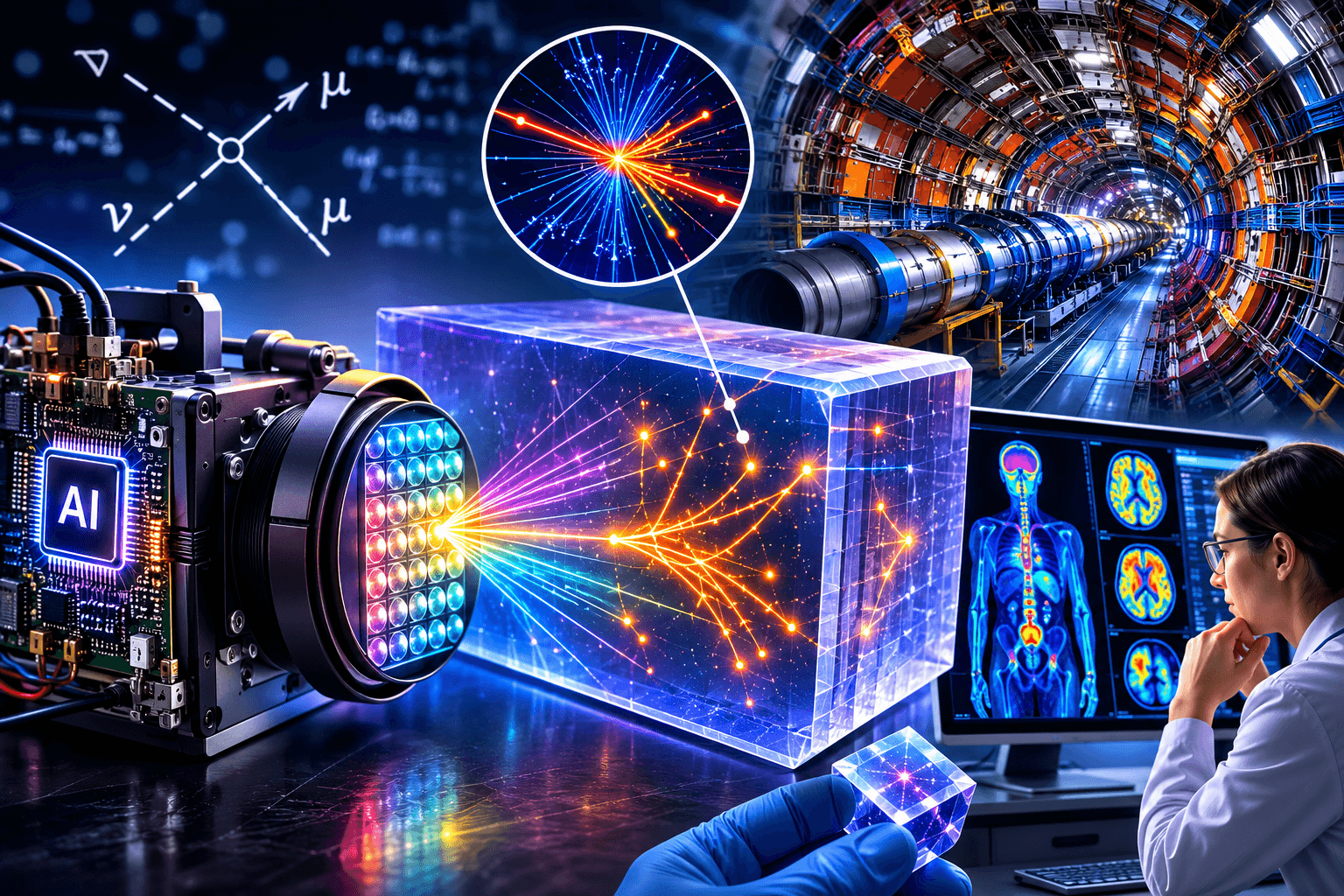
The answer is PLATON, an experimental detector that replaces millions of detector components with one solid block of scintillating material.
Instead of tracking particles directly, PLATON watches the tiny flashes of light they leave behind.
Its secret lies in borrowing technology from an unexpected field—light-field photography.
Unlike ordinary cameras that record only brightness, light-field cameras also capture the direction from which every photon arrives. This extra information allows software to reconstruct scenes in full three dimensions.
PLATON applies this concept to particle physics.
A micro-lens array, an ultra-sensitive SwissSPAD2 single-photon sensor, and advanced reconstruction algorithms work together to determine exactly where each photon originated inside the detector. Even extremely faint flashes can be localized with remarkable precision.
AI Is the Real Engine Behind the Discovery
The hardware alone is only half the story.
PLATON uses a Transformer-based neural network—the same family of AI architectures that powers modern large language models—to reconstruct particle interactions.
Instead of processing words, however, the AI analyzes patterns in when photons arrive, where they appear, and how they relate to one another.
The result is something remarkable:
Rather than seeing light, the system infers the invisible particle that created it.
In other words, AI is learning to reverse-engineer events that happened inside a block of transparent material only billionths of a second earlier.
Why Scientists Are Excited
Early simulations suggest that an upgraded PLATON detector could achieve sub-millimeter spatial resolution while using a single unsegmented detector block.
If successfully scaled, even cubic-meter-sized detectors could perform on par with today’s state-of-the-art segmented systems—without millions of individual components.
This could dramatically simplify future experiments searching for:
- Neutrinos
- Dark matter candidates
- Rare particle interactions
- Next-generation collider events
Instead of making detectors mechanically more complicated, researchers are making them computationally more intelligent.
Beyond CERN: A Future in Hospitals
The implications extend well beyond particle physics.
The research team has already filed patents applying PLATON technology to Positron Emission Tomography (PET) scanners.
PET imaging detects radioactive tracers inside the human body to diagnose cancers, neurological disorders and heart disease. Better localization of photons could produce sharper images, faster scans and more accurate diagnoses, potentially reducing radiation exposure while improving clinical outcomes.
This follows a familiar pattern in science.
Particle physics once gave the world the World Wide Web, superconducting technologies and proton therapy. PLATON may become the next example of a laboratory innovation finding everyday medical use.
A Shift in Scientific Thinking
PLATON represents more than a new detector.
It reflects a broader transformation in scientific instrumentation.
For decades, researchers improved experiments by adding more sensors, more electronics and more complexity.
The next generation may instead rely on better algorithms.
As AI becomes capable of reconstructing reality from fewer measurements, the boundary between hardware and software begins to blur. Precision increasingly depends not only on what an instrument records, but on how intelligently it interprets the data.
That may ultimately be PLATON’s greatest contribution.
It suggests that the future of scientific discovery will belong not only to bigger machines, but to smarter ways of seeing what was always there—yet remained invisible.
Reference: SD