One glacier. Five clues. 500 hidden earthquakes. AI-powered discovery. A frozen giant now making headlines worldwide.
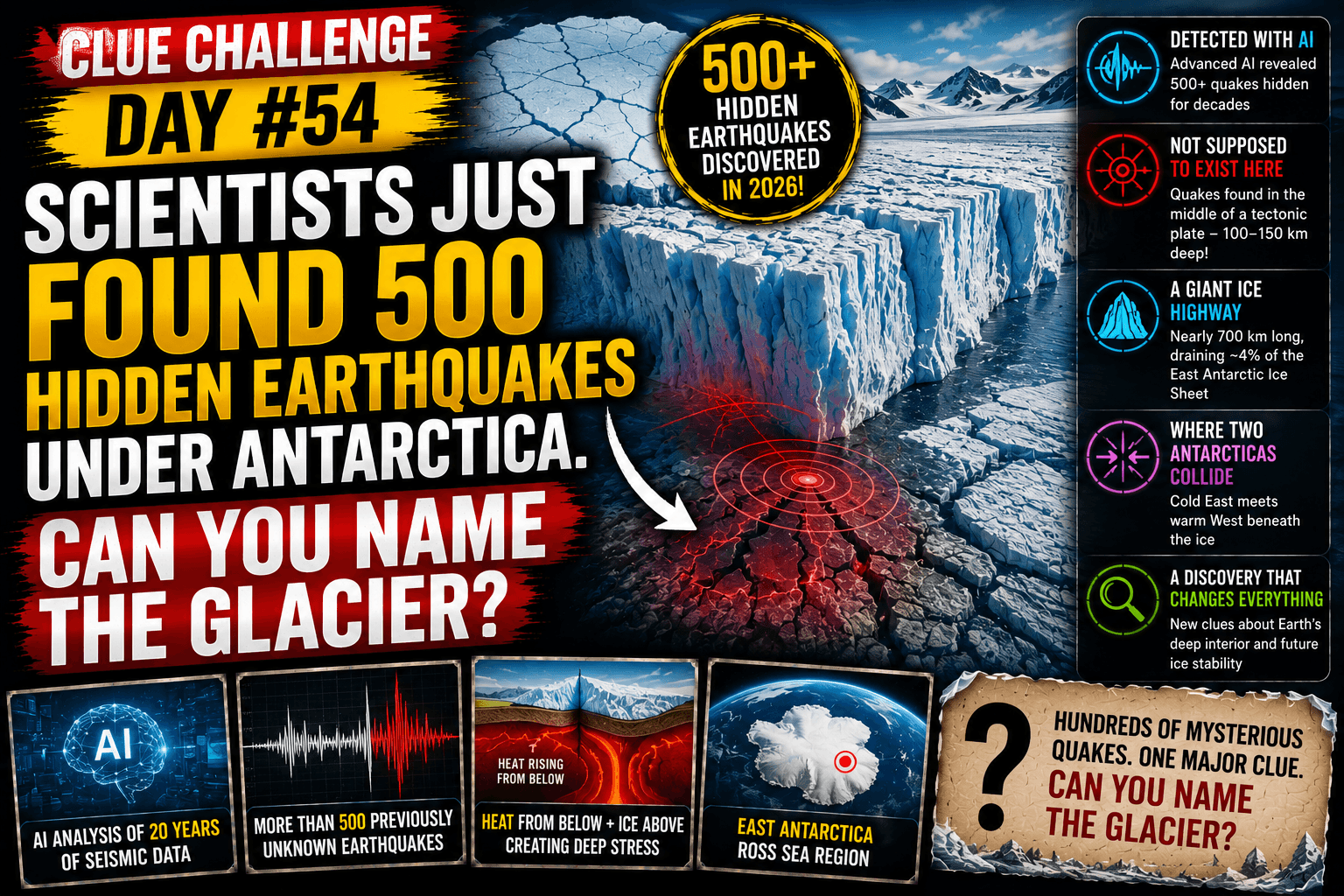
Scientists recently uncovered more than 500 previously unknown earthquakes deep beneath Antarctica. The discovery was so unexpected that researchers initially struggled to explain it. The earthquakes are occurring where they theoretically should not exist — beneath a glacier that helps drain one of Earth’s largest ice sheets. Can you name it before the final clue?
Clue #1 — AI uncovered 500 earthquakes hidden beneath it
For decades, Antarctica was considered one of the quietest seismic regions on Earth.
Then, in June 2026, researchers published a study in Science revealing something astonishing: more than 500 previously undetected earthquakes had been hiding beneath East Antarctica.
The earthquakes were not discovered using new instruments. Instead, scientists trained artificial intelligence to re-analyse decades-old seismic records collected from 49 monitoring stations across the continent.
The result: a hidden earthquake swarm that nobody knew existed.
A mystery buried under ice for 20 years.
Clue #2 — The earthquakes occur where earthquakes are not supposed to happen
Most deep earthquakes occur near tectonic plate boundaries where one plate dives beneath another.
This glacier sits nowhere near such a boundary.
Instead, the newly discovered earthquakes occur 100–150 kilometres below the surface, directly beneath the middle of a tectonic plate.
Researchers call these intraplate intermediate-depth earthquakes — among the rarest and least understood types on Earth.
The discovery challenges one of geology’s oldest assumptions:
That the interiors of tectonic plates are mostly quiet.
Clue #3 — It is one of Antarctica’s most important ice highways
This glacier stretches for nearly 700 kilometres (430 miles) through the Transantarctic Mountains.
It acts as a massive conveyor belt, channeling approximately 4% of the entire East Antarctic Ice Sheet toward the ocean.
East Antarctica contains enough ice to raise global sea levels by tens of metres if fully melted.
Understanding what happens beneath this glacier matters far beyond Antarctica.
What happens here eventually affects coastlines everywhere.
Clue #4 — Scientists think two Antarcticas are colliding beneath it
The earthquakes appear to occur where two very different underground worlds meet.
To one side lies the thick, ancient, cold lithosphere of East Antarctica.
To the other lies the warmer, thinner, geologically younger lithosphere of West Antarctica.
Researchers believe heat rising from below and pressure from the overlying ice may be bending the crust and concentrating stress beneath the glacier.
The result?
Hundreds of tiny earthquakes in a place that was never expected to host them.
A hidden geological fault line between two Antarcticas.
Clue #5 — It was named after a prominent geologist/ explorer
This glacier was named after a geologist and explorer who played a major role in Antarctic expeditions during the Heroic Age of Antarctic Exploration.
Today, it remains one of the largest outlet glaciers on the continent.
Scientists are now investigating whether changes in the ice sheet caused by climate change could eventually alter the seismic activity occurring beneath it.
The earthquakes themselves are small — magnitudes between 1.6 and 3.5 — but the discovery may transform how scientists search for hidden earthquakes across the planet.
Antarctica may be far less silent than we thought.
So — which glacier is this?
More than 500 newly discovered earthquakes. Found using artificial intelligence. Located deep beneath East Antarctica. Nearly 700 kilometres long. Drains roughly 4% of the East Antarctic Ice Sheet. Sitting where warm West Antarctica meets cold East Antarctica. Quiet for decades — until 2026.
Bonus — can you name:
- The journal that published the discovery in May/June 2026?
- The AI technique researchers used to uncover the hidden earthquakes?
- The depth range where most of the quakes occurred?
- The mountain range through which this glacier flows?
Drop your answer below. Unlike Wordle, this mystery was hidden beneath a kilometre of Antarctic ice for decades.
Missed yesterday’s challenge?
Answer to Yesterday’s Challenge: DAY #53
(Click above to reveal)