
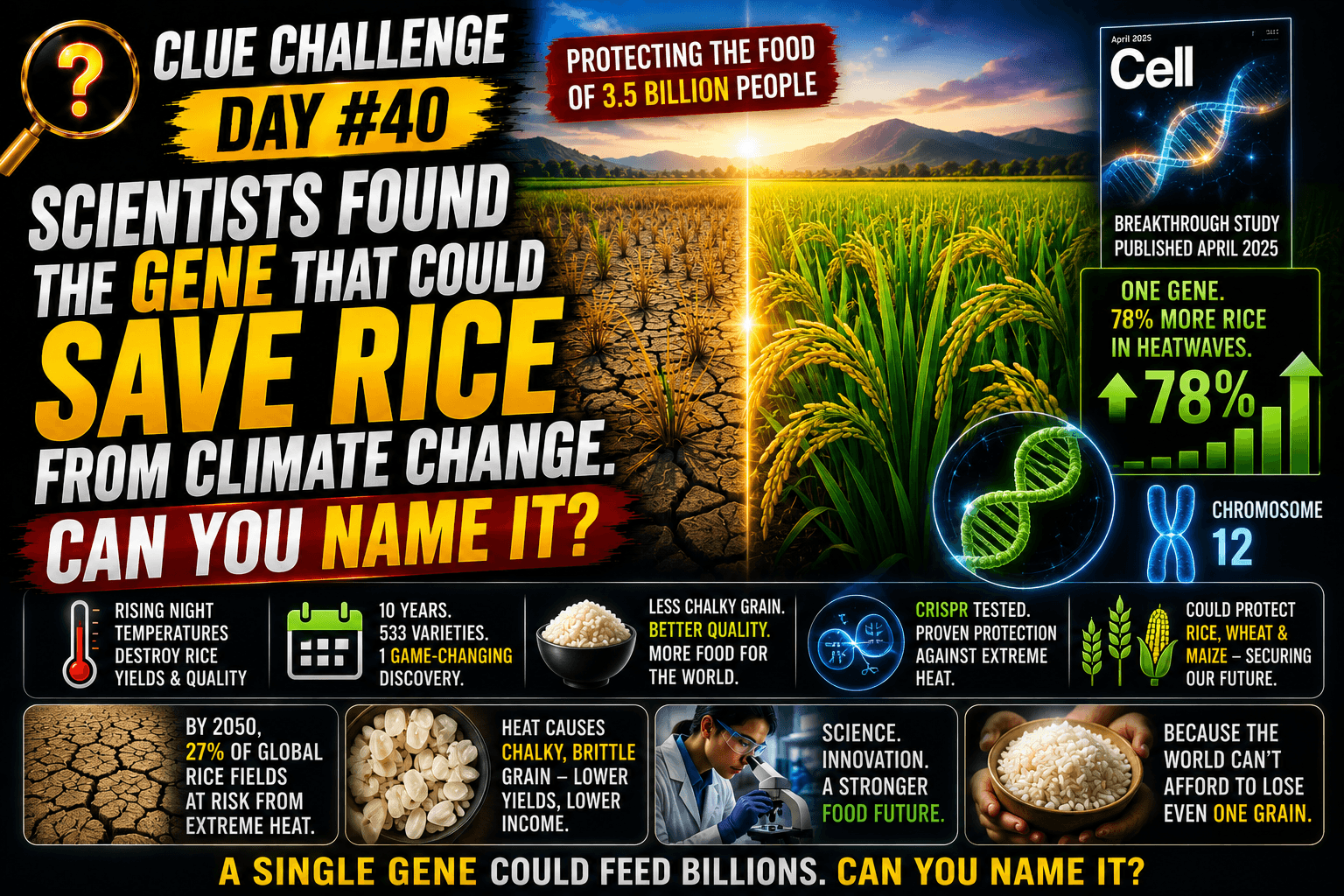
One gene. Five clues. Published in Cell. Discovered after a decade-long search. Potentially protecting the staple food of more than 3.5 billion people.
Rice feeds nearly half the planet.
But climate change is attacking it in an unexpected way.
Not through floods. Not through droughts.
Through hotter nights.
Scientists have spent years trying to understand why rising nighttime temperatures are quietly damaging rice harvests across Asia and Africa. Now, after testing hundreds of rice varieties over a decade, researchers believe they have found a single gene that could help crops withstand the heat.
Can you identify it before the final clue?
Clue #1 — Heat is breaking rice in a way most people don’t know about
When temperatures rise at night, rice does something deadly — it breathes faster. That metabolic acceleration during darkness disrupts grain formation at a critical molecular level.
Rice is already growing in agricultural areas where temperatures have reached optimal limits. A further increase in day or night temperatures during heat-sensitive growth stages could significantly reduce rice yield across large parts of Asia and Africa.
By 2030, approximately 16% of rice-growing areas will encounter at least five reproductive days with temperatures surpassing the critical physiological threshold — rising to 27% of all global rice fields by 2050.
The result on your plate: chalky, brittle, pasty grain. Or no grain at all.
Clue #2 — A team in China tested 533 rice varieties over a decade — and found it
The research team grew 533 varieties of rice across parts of China that have become unusually hot. Over ten years. In real fields. Through real heatwaves.
By crossbreeding the varieties that performed best, they identified a single key gene on chromosome 12 of the rice genome — named for exactly what it does. Its name contains the number of that chromosome. Its abbreviation is four characters: two letters + two digits. That abbreviation is your answer.
Clue #3 — When this gene switches on in the heat, it destroys the grain
Varieties that struggled in heat had a version of this gene that activated during high temperatures — causing starch molecules inside the grain to catastrophically misalign.
Under elevated temperatures, the heat-induced activation of this gene inhibits the phosphorylation of starch synthase SSIIIa — disrupting enzymatic activity while triggering endoplasmic reticulum stress, which reduces protein accumulation and increases grain chalkiness.
Chalky grain. Brittle texture. Unappetising paste. Unsellable harvest. All from a single gene switching on.
But the reverse is equally powerful.
Clue #4 — Varieties with a protective version of this gene produced 78% more rice in a heatwave
When researchers bred the protective version of this gene into a commercial rice variety called Huazhan, the results were extraordinary.
It produced up to 78% more rice — and dramatically lower proportions of chalky grain — compared to the current version of Huazhan when exposed to high heat. Researchers also showed that disabling the gene entirely using CRISPR gene editing produced similar protective benefits in research varieties.
Recent applications of CRISPR/Cas9 genome editing, multi-omics integration, marker-assisted selection, and rational design breeding are now being applied to scale heat-tolerant varieties carrying this gene into commercial production.
78% more rice. From one protective gene. Already being scaled.
Clue #5 — It could also protect wheat and maize — covering the entire global grain supply
In heat-sensitive japonica rice varieties — grown in cooler regions and now threatened by warming — the protective version of this gene is entirely absent. Conventional breeding can add it without gene editing.
The researchers suggest wheat and maize could be equipped with a similar gene to guard them against rising temperatures. Three staple crops. One genetic discovery. The potential to protect the caloric foundation of human civilisation from the heat already baked into our climate future.
So — what is this gene?
It was identified in China. Published in Cell in April 2025. Found on chromosome 12 of the rice genome. Named after what it protects: grain quality under heat. Its abbreviation combines two letters describing that function with the number of the chromosome it sits on. Two letters. Two digits.
Bonus — can you name:
- The chromosome it sits on
- The commercial rice variety it was bred into — producing 78% more grain
- The gene-editing technology used to validate its protective effects
- The proportion of global rice fields projected to face critical heat stress by 2050
Drop your answer below. Unlike Wordle, this one could determine whether 3.5 billion people eat tomorrow. Day #41 arrives tomorrow.
Missed yesterday’s challenge?
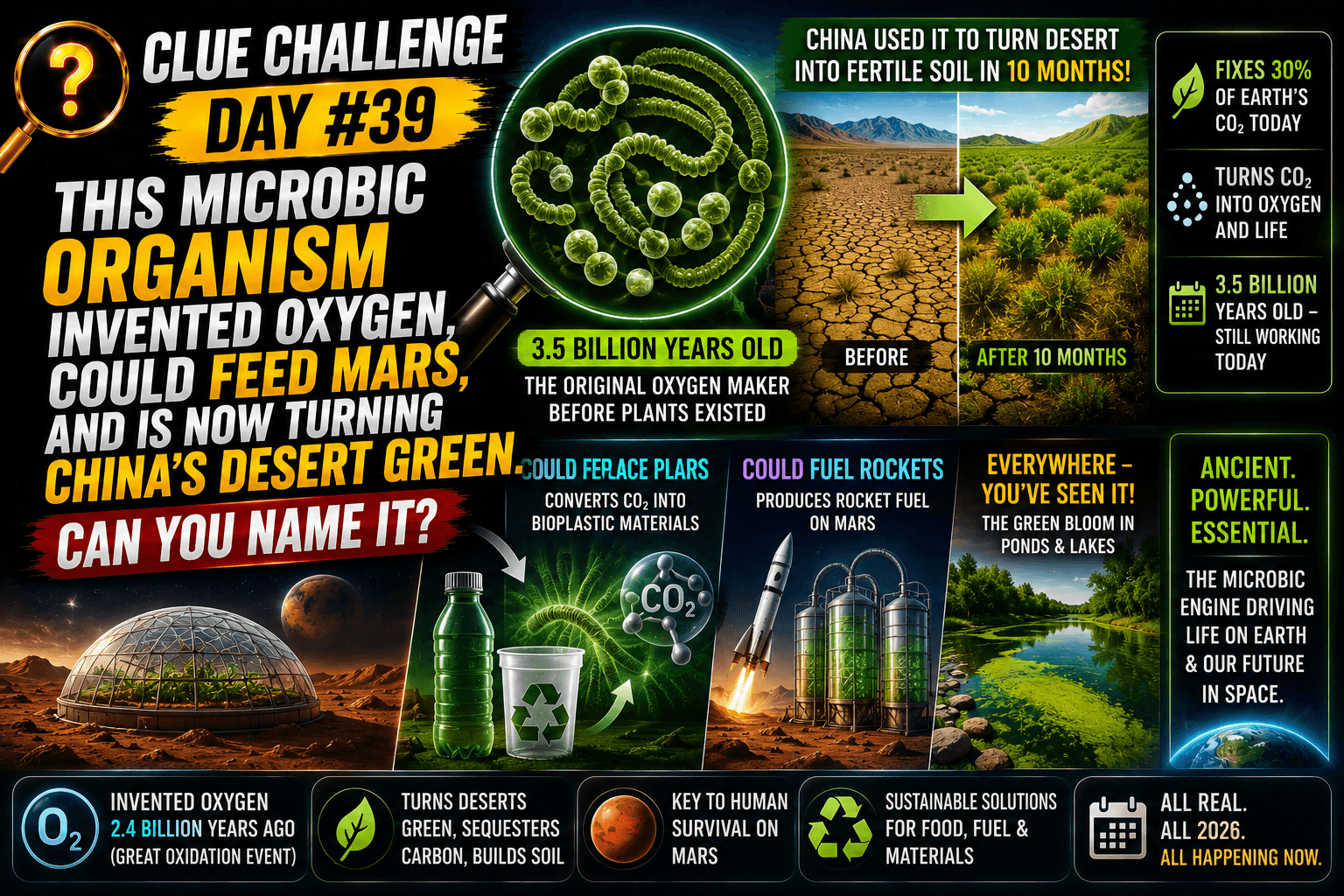
Answer to Yesterday’s Challenge: DAY #39
(Click above to reveal)