
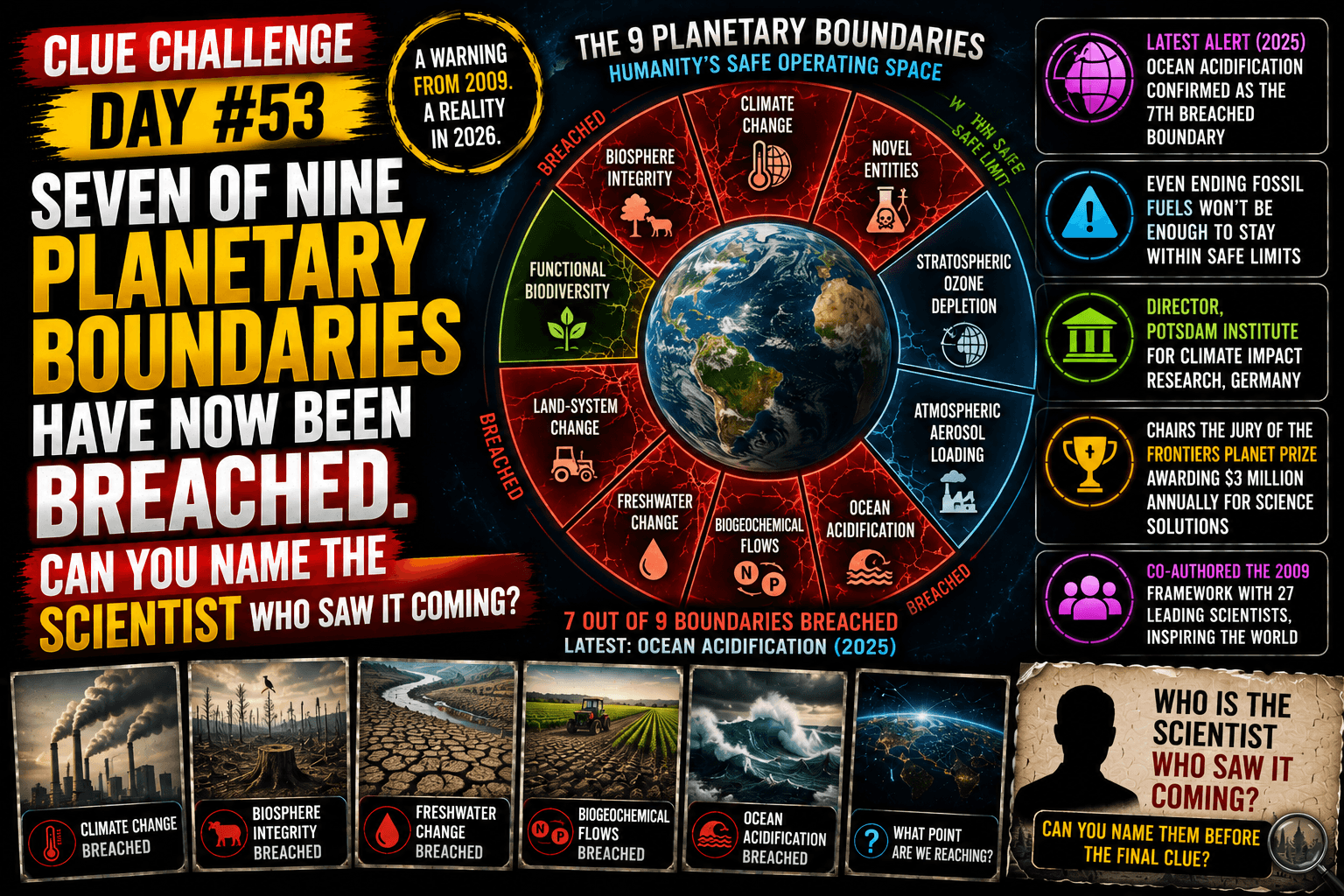
One scientist. Five clues. Nine planetary boundaries. Seven already breached. A warning issued in 2009 that is becoming reality in 2026.
Seventeen years ago, a scientist helped create a framework designed to answer a simple question: How far can humanity push Earth before the planet starts pushing back? This year, scientists confirmed that humanity has crossed a seventh planetary boundary. Can you identify the scientist who first helped draw the line?
Clue #1 — His framework measures the limits of Earth’s life-support system
Imagine Earth as a spaceship.
It has operating limits.
Cross too many of them and the systems keeping humans alive begin to destabilise.
In 2025, scientists confirmed that humanity has now breached seven of the nine planetary boundaries identified by this framework.
Among the boundaries already exceeded are climate change, biosphere integrity, freshwater change, land-system change, novel entities, biogeochemical flows, and now ocean acidification.
A warning created in 2009.
A scorecard becoming increasingly difficult to ignore.
Clue #2 — The newest breach was confirmed only recently
For years, ocean acidification remained one of the few boundaries still considered within the safe zone.
That changed in 2025.
Researchers concluded that rising carbon dioxide concentrations have altered ocean chemistry enough to push the planet beyond another critical threshold.
Seven boundaries crossed.
Only two remain globally within safe limits.
The scientist behind the framework has spent much of the last year warning that the Earth system may be approaching dangerous tipping points.
Clue #3 — He argues that solving climate change alone will not be enough
Most environmental discussions focus on fossil fuels.
His warning is broader.
In a widely discussed 2025 lecture, he argued that even a rapid transition away from fossil fuels would not guarantee planetary stability if ecosystems continue collapsing.
Forests, wetlands, soils, freshwater systems, and biodiversity all perform essential functions that keep Earth resilient.
Lose those systems and the planet’s natural buffering capacity begins to weaken.
His message is uncomfortable:
Climate change is only one part of the problem.
Clue #4 — He helped build one of the world’s most influential sustainability institutes
Before leading one of Germany’s most prominent climate research organisations, he helped establish a research centre in Sweden focused on resilience, sustainability, and Earth-system science.
It was there that the planetary boundaries framework was developed alongside an international team of researchers.
Today, governments, corporations, universities, and international organisations routinely use the framework to assess environmental risk.
What began as an academic paper became a global reference point.
Clue #5 — His surname sounds like two ordinary features of nature
He is Swedish.
He co-developed the planetary boundaries framework alongside Australian scientist Will Steffen.
Today he directs the Potsdam Institute for Climate Impact Research and chairs the jury of the Frontiers Planet Prize.
His surname combines two familiar landscape features:
one is solid and ancient.
the other is constantly flowing.
Put them together and you have the name of one of the most influential Earth-system scientists alive today.
So — who is this scientist?
A Swedish Earth-system scientist.
Co-creator of the Planetary Boundaries Framework.
Former leader of the Stockholm Resilience Centre.
Current Director of the Potsdam Institute for Climate Impact Research.
One of the leading voices warning that humanity has moved beyond seven of Earth’s nine safe operating limits.
Bonus — can you name:
- The Australian scientist who co-created the framework with him?
- The two planetary boundaries humanity has not yet fully crossed?
- The boundary officially added to the breached list in 2025?
- The German institute he currently directs?
Drop your answer below. Unlike Wordle, getting this one wrong could cost the planet more than a guess. Day #54 arrives tomorrow.
Missed yesterday’s challenge?
Clue Challenge Day #52: This Glacier Is Melting Faster Than Scientists Expected. Can You Name It?
Answer to Yesterday’s Challenge: DAY #52
(Click above to reveal)