“Growth is meaningful only when it improves the lives of all sections of society, not just the privileged few.”
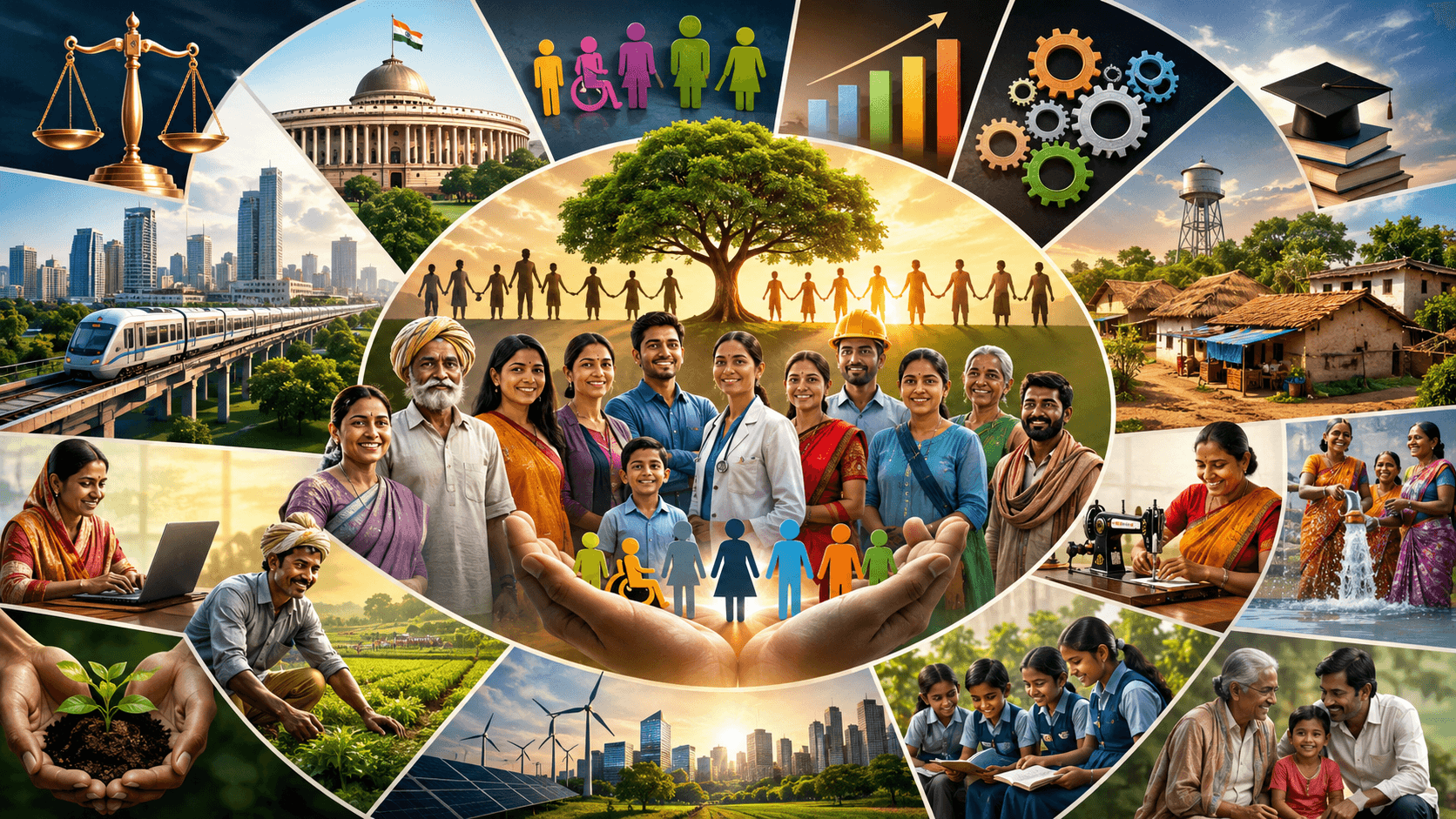
Economic growth alone does not guarantee equitable development. Many countries have achieved high GDP growth while witnessing rising inequality, unemployment, regional disparities, and social exclusion. Inclusive growth aims to ensure that the benefits of economic expansion are shared across all sections of society, creating opportunities and improving living standards for every citizen.
The World Bank defines inclusive growth as economic growth that creates opportunities for all and ensures equal access to these opportunities.
The Organisation for Economic Co-operation and Development defines it as growth that is distributed fairly across society while creating opportunities for everyone.
Why Inclusive Growth Matters: Current Reality
| Indicator | Latest Status | Significance |
|---|---|---|
| Oxfam Inequality Report | India’s richest 1% own around over 40% of total wealth, while the bottom 50% own only around 3%.(2023) | Reflects extreme wealth concentration |
| Income inequality | Top 10% earn nearly 57% of national income, bottom 50% get only 15%.(World Inequality Report 2026) | Benefits of growth remain uneven |
| United Nations Development Programme Human Development Index | India ranks 130th (2025 HDR) | Growth has not translated proportionately into human development |
| United Nations Development Programme Global Multidimensional Poverty Index | India has lifted over 400 million people out of multidimensional poverty since 2005-06, but pockets of deprivation persist | Poverty reduction remains uneven |
Example: Despite becoming the world’s fifth-largest economy, India continues to witness child malnutrition, informal employment, and unequal access to healthcare, demonstrating that GDP growth alone is insufficient.
Government Strategies to Achieve Inclusive Growth
1. Trickle-Down Theory
Idea
Higher economic growth benefits the rich first. Their investment, consumption, and entrepreneurship eventually generate employment and income for poorer sections.
Policy Focus
- Ease of doing business
- Industrialization
- Tax incentives
- Private investment
Example
Post-1991 economic reforms accelerated GDP growth and created new employment in IT, manufacturing, and services.
Limitation
Benefits often remain concentrated among skilled workers and urban regions.
Example
Rapid urban prosperity has not prevented persistent agrarian distress.
2. Kuznets Curve Hypothesis
Idea
Economist Simon Kuznets argued that inequality first rises during early industrialization but declines once economies mature and governments expand welfare measures.
Inverted-U Curve
Early Growth → High Inequality → Welfare Expansion → Lower Inequality
Example
Countries like South Korea experienced rising inequality during industrialization before expanding education and social security.
Criticism
Modern evidence shows inequality may persist despite sustained growth unless governments intervene.
3. Need-Based Approach
Principle
Government should first satisfy basic human needs.
Focus Areas:
- Food
- Shelter
- Education
- Healthcare
- Drinking water
- Nutrition
Examples
- Public Distribution System
- Integrated Child Development Services
- Ayushman Bharat
- Pradhan Mantri Awas Yojana
4. Rights-Based Approach
Principle
Development should not depend upon charity but upon legally enforceable rights.
Major Rights-Based Laws
| Law | Inclusive Objective |
|---|---|
| Mahatma Gandhi National Rural Employment Guarantee Act | Right to employment |
| Right of Children to Free and Compulsory Education Act | Right to education |
| National Food Security Act | Right to food |
| Forest Rights Act | Rights of tribal communities |
| Rights of Persons with Disabilities Act | Inclusion of persons with disabilities |
Example
MGNREGA provides legal employment guarantees rather than discretionary relief.
5. Amartya Sen’s Capability Approach
According to Amartya Sen,
Poverty is not merely low income but deprivation of capabilities.
Capabilities include
- Being educated
- Being healthy
- Living with dignity
- Participating in society
- Freedom of choice
Policy Implications
Government should invest in
- Education
- Healthcare
- Nutrition
- Women’s empowerment
- Skill development
Example
Kerala’s superior health and education indicators demonstrate capability expansion despite relatively modest income levels.
Challenges to Inclusive Growth
1. Low Tax-to-GDP Ratio
India’s tax-to-GDP ratio remains around 11–12% (Union taxes), lower than many OECD economies, limiting fiscal space for social spending.
Consequences
- Limited healthcare expenditure
- Poor education financing
- Inadequate social protection
Example
Public health expenditure remains significantly below many developed countries.
2. Policy Failure
Many welfare schemes suffer from
- Leakages and Corruption (India’s rank improved from 96th to 91st out of 182 countries and territories (with score of 39) on CPI 2025.)
- Poor targeting
- Bureaucratic delays
- Weak implementation
Example
Although Direct Benefit Transfer has reduced leakages, exclusion errors still affect eligible beneficiaries.
3. Jobless Growth
GDP has grown faster than employment generation.
Despite GDP expansion, nearly 90% of the workforce operates in informal, low-productivity, and unorganized sectors lacking adequate social security.
According to Periodic Labour Force Survey (PLFS) 2023–24, informal employment continues to dominate.
Example
Organized manufacturing increasingly uses automation while informal employment remains dominant.
4. Regional Inequalities
States such as Karnataka and Maharashtra attract greater investment than many eastern and central states.
Example
Per capita income differs sharply between Bihar and southern states.
5. Agricultural Distress
Nearly 45% of workers depend on agriculture, which contributes only around 16–18% of GDP, indicating low productivity.
6. Gender Inequality
- India’s Female Labour Force Participation Rate is just 41.7% (PLFS 2023–24), with most women in informal and undervalued roles, especially in agriculture.
- India ranked 131st out of 148 countries in the Global Gender Gap Report 2025 by the World Economic Forum, down from 129th in 2024, with a gender parity score of 64.1%,
7. Digital Divide
Limited internet connectivity and digital literacy restrict access to online education, banking, telemedicine, and e-governance.
8. Educational Inequality
Poor quality public schooling perpetuates unequal opportunities and skill gaps.
Recent government data confirms that India has over 1 lakh single-teacher schools, with exactly 1,00,843 operating with only one teacher.(ASER Report 2024)
9. Climate Change
Extreme weather disproportionately affects poor farmers, coastal populations, and informal workers.
According to the World Bank, over 80% of the Indian population resides in districts highly vulnerable to climate-induced disasters such as prolonged heatwaves, erratic monsoons, droughts, and cyclones.
The Germanwatch Climate Risk Index (CRI) 2026 report ranks India ninth among countries most affected by extreme weather events (1995–2024).
10. Social Exclusion
Marginalized communities continue to face discrimination affecting access to education, jobs, credit, and markets.
Impact of Non-Inclusive Growth
1. Intra-generational Inequity
Unequal distribution of opportunities among people living today.
Example
Urban professionals benefit from digital jobs while rural labourers remain trapped in low-productivity work.
2. Inter-generational Inequity
Future generations inherit environmental degradation, public debt, and unequal access to education and resources.
Example
Overexploitation of groundwater reduces agricultural prospects for future generations.
3. Rising Inequality
Economic gains become concentrated among a small elite.
Example
Rapid increase in billionaire wealth alongside persistent malnutrition.
4. Poverty Trap
Poor households remain unable to invest in education, health, or productive assets, perpetuating deprivation across generations.
5. Social Unrest
Persistent exclusion fuels protests, crime, migration, and social tensions.
6. Weak Human Capital
Underinvestment in nutrition, health, and education lowers productivity and innovation.
7. Slower Long-Term Growth
High inequality suppresses consumption, weakens demand, and limits sustainable economic expansion.
8. Democratic Deficit
Extreme economic concentration can distort political influence and reduce trust in institutions.
9. Environmental Degradation
The poor often rely on fragile natural resources, while unsustainable growth intensifies ecological damage.
Solutions and Way Forward
1. Shift from “Income Redistribution” to “Opportunity Redistribution”
Approach: Pre-distribution Model
Instead of redistributing income after growth, equalize access to quality education, healthcare, digital connectivity, credit, and skills before individuals enter the labour market.
Keyword: Equality of Opportunity > Equality of Outcome
2. Build an AI-Augmented Human Capital Economy
Approach: Human + AI Model
Focus on AI-assisted workers, not AI replacing workers. Integrate AI literacy, reskilling, and multilingual AI tools for farmers, MSMEs, teachers, and healthcare workers. The Economic Survey 2025–26 advocates an application-driven, decentralized AI ecosystem aligned with India’s labour abundance.
Formula: AI + Human Skills = Inclusive Productivity
3. Adopt a Productivity-Led Inclusion Strategy
Approach: Economic Survey 2025–26
Move beyond subsidies to raising productivity through:
- MSME technology adoption
- Precision agriculture
- Logistics efficiency
- Formalisation
- Industrial clusters
New Mantra: Productivity is the new welfare.
4. Mission-Oriented Development State
Approach: Mission Economy (Mariana Mazzucato)
Government should create new markets in:
- Green Hydrogen
- Semiconductors
- AI
- Quantum Technologies
- Circular Economy
This generates high-quality employment rather than short-term transfers.
Keyword: Market Creation, not merely Market Correction.
5. Localised Inclusive Growth through District Competitiveness
Approach: Place-Based Development
Prepare a District Inclusive Growth Index combining:
- Employment
- Learning outcomes
- Women’s participation
- Climate resilience
- MSME density
Move from “One Nation, One Scheme” to “One District, One Growth Strategy.”
6. Green Inclusion Model
Approach: Just Transition Framework
Every climate policy should simultaneously create:
- Green jobs
- Climate-resilient agriculture
- Renewable energy livelihoods
- Nature-based enterprises
Climate Action = Employment Generation
7. Social Protection 2.0 for the Gig and Platform Economy
Approach: Portable Social Security
Extend:
- Pension
- Health insurance
- Accident cover
- Skill vouchers
- Unemployment support
to gig workers using digital labour platforms, as the gig workforce expands.
Keyword: Universal Social Protection
8. Financial Inclusion 2.0: From Bank Accounts to Productive Credit
Approach: Credit-Led Inclusion
Success should be measured not by bank accounts opened, but by:
- Credit accessed
- Enterprises created
- Women entrepreneurs financed
- Farmer investments
New Metric: Financial Capability, not Financial Access.
9. Capability-Based Governance
Approach: Amartya Sen + Human Development 2.0
Measure development using:
- Learning outcomes
- Nutrition
- Digital literacy
- Employability
- Social mobility
rather than welfare expenditure alone.
Development = Expansion of Capabilities, not Expansion of Schemes.
10. Inclusive Growth Dashboard using Real-Time Data
Approach: Data-Driven Governance
Create a National Inclusive Growth Dashboard tracking:
- Employment quality
- Wage growth
- Gender parity
- Learning levels
- Air quality
- Digital access
- Regional disparities
Use AI and Digital Public Infrastructure for continuous policy correction, consistent with the Economic Survey’s emphasis on evidence-based governance and application-led digital systems.
Policy Formula: Measure → Monitor → Modify.
Inclusive Growth 2.0
“From distributing benefits to democratizing opportunities; from welfare dependence to capability creation; from GDP growth to productivity-led human development.”
The 5P Model of Inclusive Growth
People → Productivity → Participation → Prosperity → Planet
Inclusive growth is not simply about expanding GDP; it is about ensuring that every citizen has the opportunity to participate in and benefit from economic progress. For a country as diverse as India, sustainable development requires balancing efficiency with equity, growth with justice, and prosperity with dignity. As India advances toward becoming a developed nation, the focus must shift from “growth for a few” to “growth for all,” in line with the constitutional vision of social, economic, and political justice and the commitment to Sabka Saath, Sabka Vikas, Sabka Vishwas, Sabka Prayas.