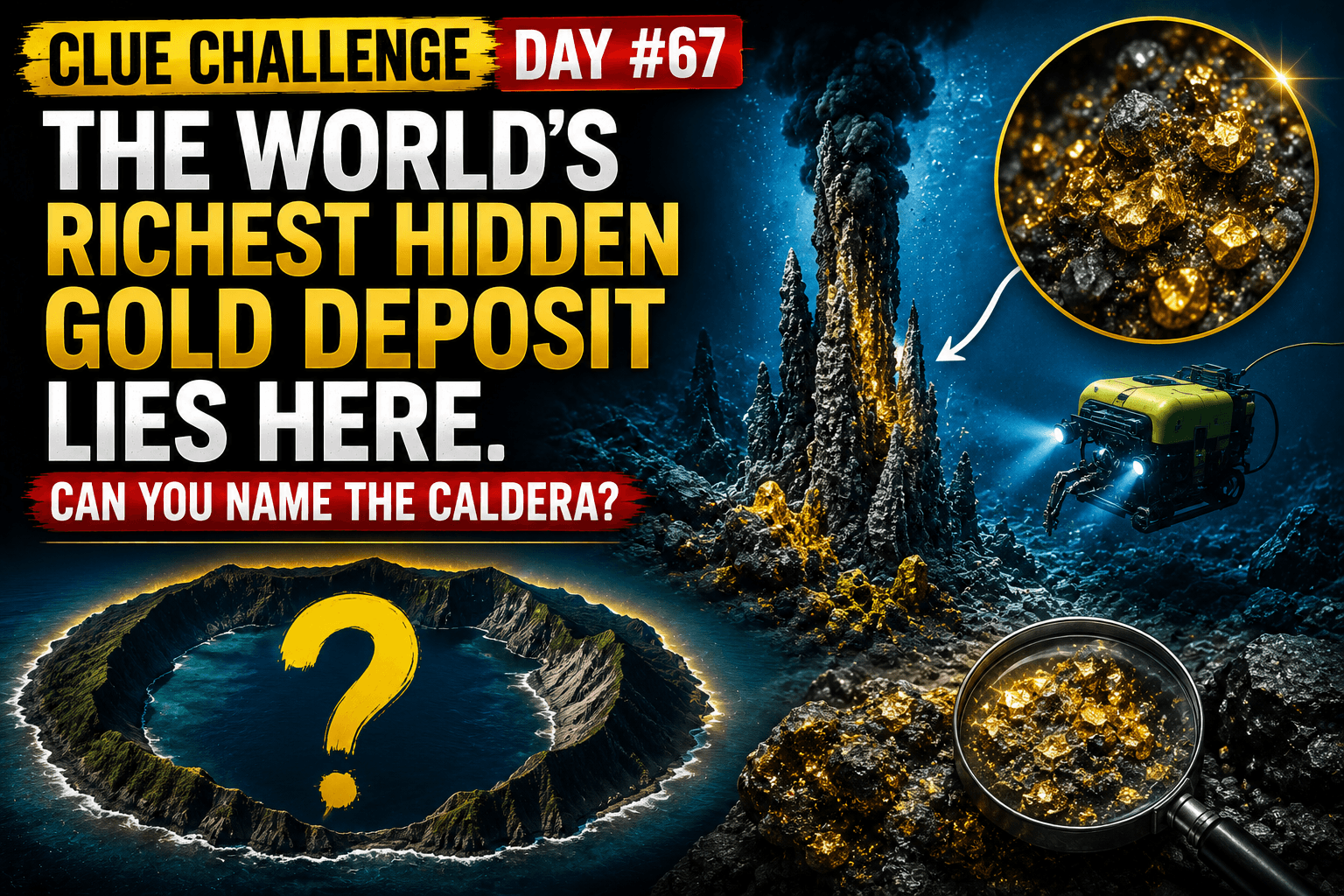
One place. Five clues. Invisible gold. A volcanic crater beneath the Pacific. A discovery that could reshape the future of deep-sea mining.
For decades, humanity searched for the next great gold rush on land. This month, scientists announced that the highest concentration of gold ever measured isn’t inside a mountain—it lies thousands of metres beneath the Pacific Ocean, hidden inside volcanic rocks where almost nobody has ever been. Can you identify the caldera before the final clue?
Clue #1 — The richest gold deposit on Earth isn’t in a mine
In July 2026, Japanese scientists reported record-breaking concentrations of gold hidden inside rocks collected from an underwater volcanic crater. The discovery was published in Scientific Reports and immediately reignited the global debate over deep-sea mining.
The remarkable part? The gold is almost completely invisible.
Instead of glittering veins, it exists as microscopic nanoparticles and even individual atoms trapped inside iron sulphide minerals. Standard microscopes cannot detect it. Researchers had to use one of the world’s most sensitive analytical techniques to reveal its presence.
This deposit now represents the highest gold concentration ever recorded in seafloor hydrothermal sulphides.
Clue #2 — The treasure is being created naturally, every single day
Unlike conventional gold mines formed millions of years ago, this deposit is still growing.
Superheated water—often exceeding 300°C—rises through cracks in the ocean floor, carrying dissolved metals from deep inside Earth’s crust. When the hot fluid meets freezing seawater, minerals rapidly solidify, building towering hydrothermal chimneys often called black smokers.
These underwater “factories” continuously manufacture new mineral deposits rich in gold, copper, zinc and silver.
Scientists say the process has been operating for thousands of years beneath this submerged volcanic crater.
Clue #3 — It lies inside one of the world’s most active volcanic regions
The location sits roughly 350 kilometres south of Tokyo, within Japan’s Exclusive Economic Zone.
It belongs to a volcanic island chain created where the Pacific Plate dives beneath another tectonic plate—a region famous for frequent earthquakes, volcanoes and submarine hydrothermal activity.
The site remained unknown until researchers discovered active vent fields there in 2015.
Since then, robotic submarines have collected mineral samples that continue to surprise geologists.
Clue #4 — Its discovery could trigger the next global resource race
The timing is significant.
Gold is no longer valued only for jewellery. It is essential for semiconductors, advanced electronics, medical devices, satellites and defence technologies.
Meanwhile, nations worldwide are scrambling to secure supplies of critical minerals for AI infrastructure, electric vehicles and renewable energy.
Japan has emerged as one of the strongest supporters of responsible deep-sea resource exploration, while several Pacific nations—including Papua New Guinea—continue to support a moratorium on commercial seabed mining due to ecological concerns.
Scientists warn that active hydrothermal vents also host unique ecosystems found nowhere else on Earth.
The question is becoming increasingly urgent:
Should humanity mine the ocean—or protect it?
Clue #5 — Its name combines an island with the language of volcanoes
This is your strongest clue.
The answer is not a country.
It is not a hydrothermal vent.
It is not a black smoker.
It is a submerged volcanic caldera named after a remote Japanese island.
Inside this caldera, researchers found the world’s richest concentration of invisible gold locked inside pyrite—often called “fool’s gold.”
Its name contains two words joined by a hyphen, followed by a geological term.
That full name is your answer.
So… what is this caldera?
- World’s highest gold concentration ever found in seafloor sulphides
- Published in Scientific Reports (July 2026)
- Located around 350 km south of Tokyo
- Home to active hydrothermal vents and black smokers
- Gold exists as nanoparticles and atom-scale “invisible gold”
- At the centre of the growing global debate over deep-sea mining and marine conservation
Can you name the caldera before checking the answer?
Bonus Challenge
Can you also answer these?
- Which analytical technique revealed the invisible gold?
- What mineral is commonly known as “Fool’s Gold”?
- What are the chimney-like hydrothermal structures called?
- Which international body regulates mining in international seabed areas?
- Why do many scientists oppose commercial mining at active hydrothermal vents?
Drop your answer below. Sometimes the world’s greatest treasure isn’t buried beneath a mountain—it is hidden beneath kilometer’s of ocean, waiting for science to find it.
Missed Yesterday Challenge?

Answer to Yesterday’s Challenge: DAY #66
(Click above to reveal)