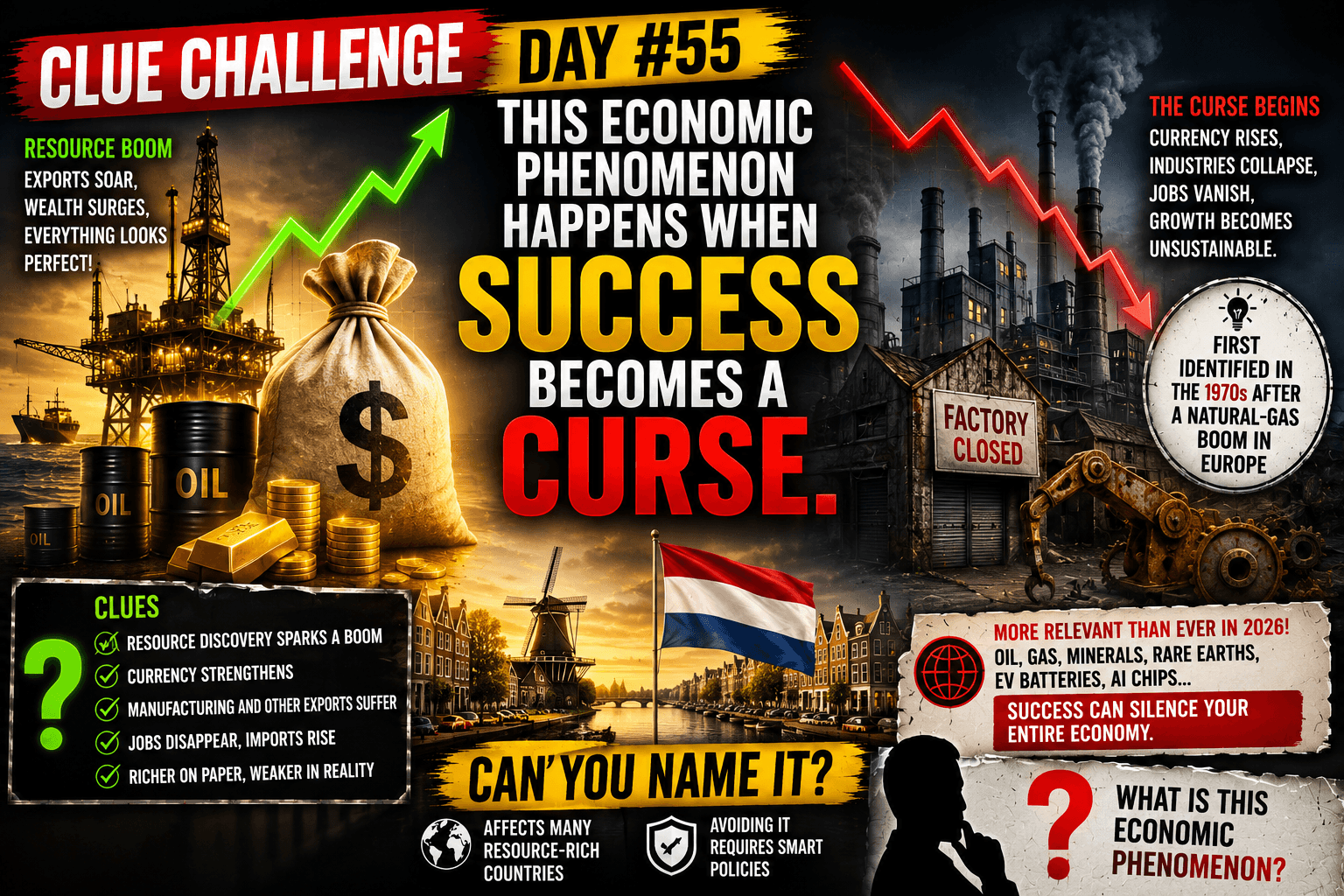
Five clues. Richer on paper. Poorer in reality. More relevant in 2026 than ever. All real.
A country discovers something valuable. Oil. Gas. Minerals. Rare earths. AI chips. Export revenues explode. Its currency strengthens. The world celebrates its success. Then factories start shutting down, exports become uncompetitive, jobs disappear, and economic diversification collapses. Economists have a name for this paradox. Can you name it before the final clue?
Clue #1 — It begins with a boom that every country dreams about
In 2025–26, countries rich in critical minerals, energy resources, and AI-related commodities have enjoyed record export revenues.
Indonesia benefited from the nickel boom powering electric vehicles. Guyana became one of the world’s fastest-growing economies thanks to offshore oil. Several Gulf states continue to generate enormous energy revenues.
At first, everything looks perfect.
Exports surge. Government revenues rise. Foreign investment floods in.
Then the problems begin.
A blessing starts behaving like a curse.
Clue #2 — Your currency becomes stronger, but your economy becomes weaker
When foreign buyers rush to purchase a country’s valuable exports, demand for its currency increases.
The currency appreciates.
That sounds good—until domestic manufacturers discover their products have become more expensive in global markets.
Suddenly, factories making machinery, textiles, electronics, and consumer goods struggle to compete against cheaper foreign rivals.
One booming sector starts quietly suffocating the rest of the economy.
Clue #3 — Economists are watching it closely in the age of critical minerals
The global race for lithium, cobalt, nickel, copper, rare earths, and advanced semiconductor materials has revived discussions around this phenomenon.
The IMF, World Bank, and OECD increasingly warn resource-rich nations that dependence on a single export sector can create long-term vulnerabilities.
Countries that rely too heavily on one lucrative resource often experience weaker industrial diversification, greater exposure to commodity price shocks, and slower productivity growth outside the dominant sector.
The more successful the resource sector becomes, the harder it can be for other sectors to survive.
Clue #4 — It was first identified after a natural-gas discovery in Europe
The term originated in the 1970s.
A European country discovered enormous natural-gas reserves in the North Sea.
Export earnings surged.
Its currency strengthened.
Manufacturing industries began losing competitiveness.
Economists noticed the pattern and gave the phenomenon a name based on that country’s nationality.
The name stuck—and is now taught in virtually every economics classroom in the world.
Clue #5 — Some of the world’s richest countries spent decades trying to avoid it
Norway is often cited as a country that largely avoided this problem through sovereign wealth funds and careful fiscal management.
Meanwhile, economists have studied versions of the same phenomenon in oil-rich economies across Africa, Latin America, the Middle East, and Central Asia.
In 2026, the debate has expanded beyond oil and gas.
Could AI infrastructure, rare-earth minerals, lithium, or semiconductor dominance create modern versions of the same problem?
The question is becoming increasingly relevant as the global economy reorganises around strategic resources.
So — what is this economic phenomenon?
A resource boom strengthens a country’s currency. Manufacturing weakens. Exports outside the dominant sector become less competitive. Economic diversification suffers. Success creates vulnerability.
First observed after a natural-gas boom in Europe during the 1970s. Still shaping economic policy in 2026.
Its name combines the nationality of the country where it was first identified with a word usually associated with illness.
Bonus — can you name:
- The European country where this phenomenon was first observed
- The natural resource that triggered it
- The sovereign wealth fund often cited as a successful defence against it
- One modern industry economists worry could trigger a new version of this phenomenon
Drop your answer below. Unlike Wordle, getting this one wrong can cost a nation an entire generation of industrial growth. Day #56 arrives tomorrow.
Missed yesterday’s challenge?
Answer to Yesterday’s Challenge: DAY #54
(Click above to reveal)