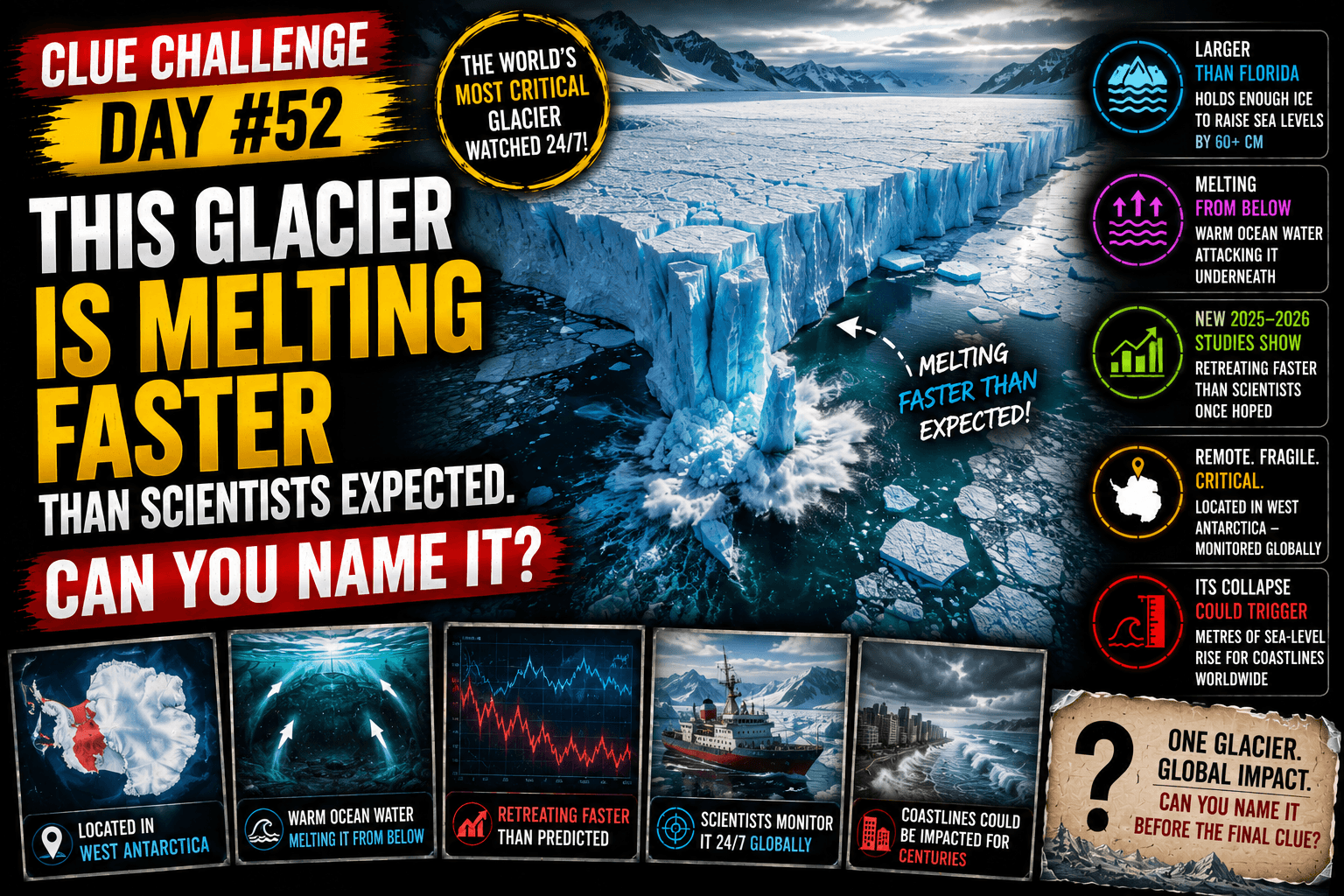
One glacier. Five clues. Enough ice to raise global sea levels by more than half a metre. Scientists call it the most important glacier on Earth.
It is larger than Florida. It is retreating from the ocean floor beneath it. Warm seawater is attacking it from below. If it collapses, it could destabilize an entire region of Antarctica and reshape coastlines across the world. Can you name it before the final clue?
Clue #1 — Scientists call it the “Doomsday Glacier”
Few places on Earth have earned a nickname this dramatic.
This glacier contains enough ice on its own to raise global sea levels by more than 60 centimetres. More importantly, it acts like a giant cork holding back neighboring ice across West Antarctica.
If that cork fails, the consequences extend far beyond a single glacier.
Millions of people living in coastal cities could eventually be affected.
Clue #2 — It is melting from below, not above
Most people imagine glaciers disappearing because warm air melts them from the surface.
Scientists studying this glacier found a different problem.
Relatively warm ocean water is flowing beneath the floating ice shelf, eroding it from underneath. Satellite observations and underwater measurements show that critical sections are thinning and losing stability faster than researchers once hoped.
The danger is largely invisible from above.
Clue #3 — New research suggests parts of it may be closer to collapse than expected
In 2025 and 2026, multiple studies continued to highlight concerns about rapid retreat along vulnerable sections of the glacier.
Researchers have identified fractures, grounding-line retreat, and accelerating ice loss in key areas where the glacier meets the ocean floor.
Scientists are particularly worried because once retreat passes certain thresholds, the process may become extremely difficult to stop.
In other words, this isn’t simply melting ice.
It may be a tipping point.
Clue #4 — It sits in one of the most remote places on Earth
This glacier lies in West Antarctica, thousands of kilometres from major population centres.
Yet what happens there affects everyone.
The glacier spans an area roughly comparable to the U.S. state of Florida and drains a massive portion of the Antarctic Ice Sheet.
Because of its strategic location, glaciologists from the United States, United Kingdom, and other nations have spent years monitoring it using satellites, aircraft, autonomous underwater vehicles, and ocean sensors.
A frozen wilderness has become one of the most watched places on the planet.
Clue #5 — Its collapse could trigger a chain reaction across Antarctica
Scientists are not concerned only about the ice contained within this glacier.
The larger fear is what comes next.
The glacier helps stabilize surrounding ice systems across West Antarctica. If it retreats far enough, neighboring glaciers could begin flowing into the ocean more rapidly as well.
That domino effect could contribute to several metres of long-term sea-level rise over coming centuries.
One glacier.
Potentially global consequences.
So — what is this glacier?
Larger than Florida. Located in West Antarctica. Nicknamed the “Doomsday Glacier.” Melting from below due to warm ocean water. Being monitored continuously by international research teams. Considered one of the most critical tipping points in the global climate system.
Bonus — can you name:
- The Antarctic region where it is located?
- The process by which warm seawater melts it from below?
- The international research collaboration that has spent years studying it?
- The amount of sea-level rise it could contribute if fully lost?
Drop your answer below. Unlike Wordle, this puzzle is changing the future of every coastline on Earth. Day #53 arrives tomorrow.
Missed yesterday’s challenge?
Clue Challenge Day #51: Scientists Say This Animal Could Help Fight Climate Change. Can You Name It?
Answer to Yesterday’s Challenge: DAY #51
(Click above to reveal)