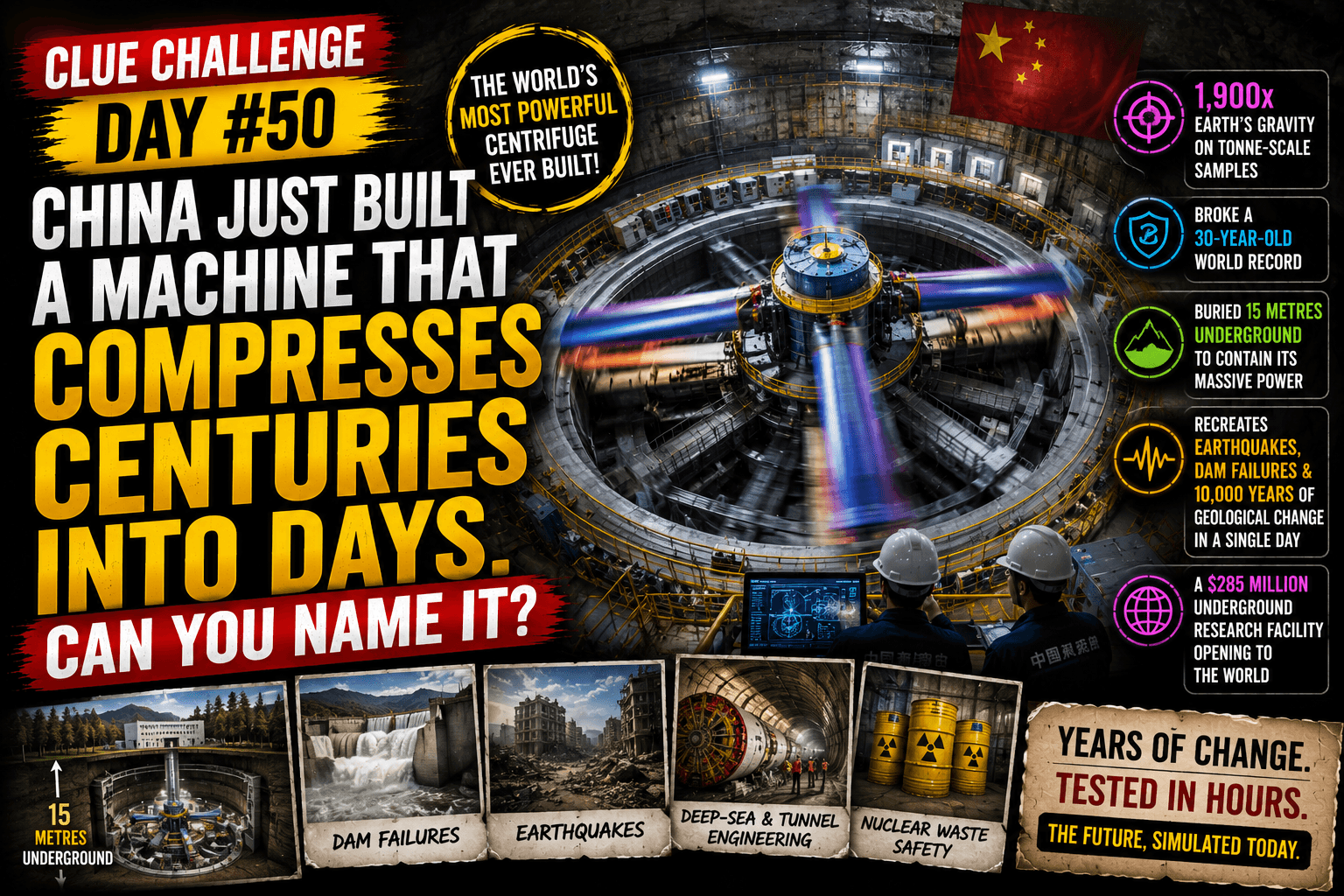
One machine. Five clues. Buried underground. Powerful enough to recreate earthquakes, dam failures, and geological processes that normally take centuries. All real. All 2025–2026.
A household washing machine spins clothes at roughly 2g. This machine can generate forces approaching 2,000 times Earth’s gravity on multi-tonne objects. China switched it on in late 2025. Scientists say it could transform everything from nuclear waste research to deep-sea engineering. Can you identify it before the final clue?
Clue #1 — It creates almost 2,000 times Earth’s gravity
Scientists use centrifuges to recreate extreme gravitational environments inside laboratories.
Most research centrifuges operate on relatively small samples. This new machine works on a completely different scale, generating nearly 2,000 times Earth’s gravity while testing structures weighing tonnes.
Imagine compressing decades of stress, pressure, and geological change into a single experiment.
That is exactly what this machine was built to do.
Clue #2 — China broke a world record that stood for nearly 30 years
For decades, the world’s most powerful geotechnical centrifuge operated in the United States.
In 2025, China surpassed that benchmark and then exceeded its own record again just months later.
The result is now the most powerful machine of its kind ever constructed.
One country.
One year.
Two world records.
Clue #3 — It had to be buried underground
The machine is located roughly 15 metres beneath a major Chinese university campus.
Why?
Because the vibrations generated during operation are so intense that engineers designed an underground facility specifically to isolate and contain them.
The complex includes multiple experimental chambers dedicated to earthquake science, dam engineering, deep-sea infrastructure, geological processes, and other large-scale simulations.
A machine so powerful that it needed its own underground world.
Clue #4 — It can simulate disasters before they happen
Researchers can use it to recreate landslides, dam failures, earthquakes, tunnel collapses, and long-term geological processes under controlled conditions.
Scientists also plan to study the behaviour of nuclear waste repositories over timescales that would otherwise be impossible to observe directly.
Instead of waiting decades—or centuries—for nature to reveal the outcome, researchers can accelerate the process inside a laboratory.
Years become weeks.
Centuries become days.
Clue #5 — It cost hundreds of millions of dollars and is opening to the world
The underground research facility represents an investment of roughly $285 million.
Developers intend for it to operate as an international scientific platform, allowing research teams from around the world to conduct experiments using capabilities unavailable anywhere else.
Its purpose is simple:
Understand how infrastructure, materials, and geological systems behave under extreme conditions before those conditions occur in the real world.
The machine’s official name reflects the extreme gravitational force it can generate—a number that currently stands as a world record.
So — what is this machine?
Installed beneath a university campus in eastern China.
Commissioned in late 2025.
The most powerful centrifuge ever built.
Capable of generating nearly 2,000 times Earth’s gravity.
Designed to simulate earthquakes, dam failures, deep-sea conditions, and geological processes that would normally unfold across centuries.
Its official name is tied directly to the record-breaking gravitational force it produces.
Bonus — can you name:
- The Chinese university where it is installed?
- The American facility that held the previous record for nearly three decades?
- The approximate depth below ground where the machine operates?
- The total investment required to build the underground research complex?
Drop your answer below. Unlike Wordle, this machine can fast-forward the future before it happens. Day #51 arrives tomorrow.
Missed yesterday’s challenge?
Answer to Yesterday’s Challenge: DAY #49
(Click above to reveal)