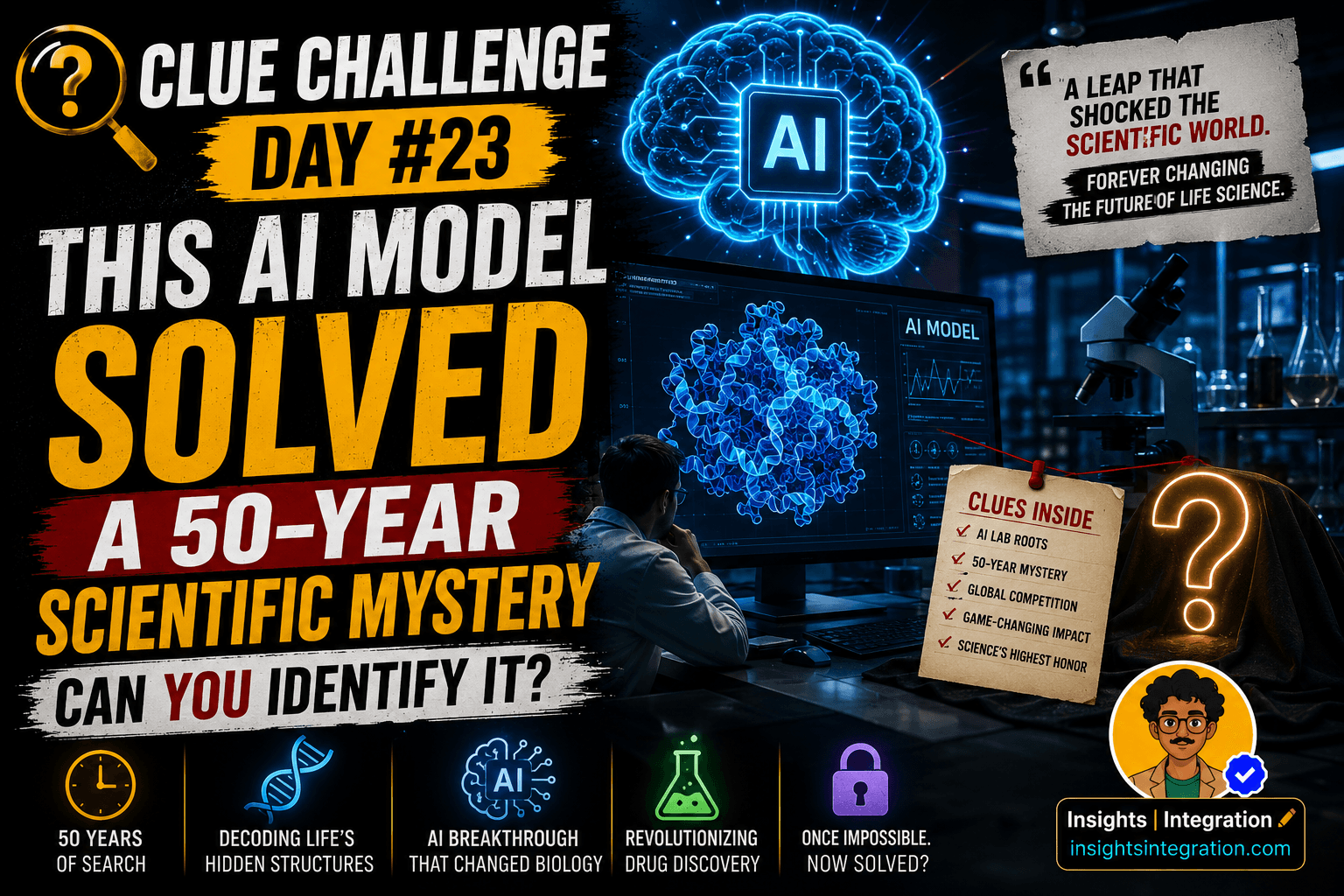
A daily puzzle for curious minds. Read the clues. Crack the Clue challenge. Drop your answer in the comments.
The Clue Challenge
For fifty years it defeated the brightest minds in science.
Billions spent. Careers dedicated. No solution.
Then one AI model cracked it.
Not in years. Not in months. In minutes.
And in doing so — it may have unlocked cures for cancer, Alzheimer’s and antibiotic-resistant infections that have killed hundreds of millions of people.
Can you identify it?
Your Clues
Clue 1 — It Came From a Lab Famous For Something Completely Different
This AI was not built by a pharmaceutical company or a biology research institution.
It was built by a lab originally famous for teaching machines to play games — better than any human alive.
That lab was later acquired by one of the world’s largest technology companies.
Then it turned its attention from entertainment to one of the hardest problems in science.
Which AI lab built both a legendary game-playing system AND a biology-changing model?
Clue 2 — It Solved a Problem Unsolved Since the 1970s
The question sounds simple:
Given a protein’s chain of amino acids — can you predict the exact 3D shape it folds into?
Proteins are the molecular machines of all life. Their shape determines everything they do. But predicting that shape from sequence alone had defeated every mathematical and experimental approach for fifty years.
Which AI finally cracked this half-century-old biological mystery?
Clue 3 — It Entered a Competition and Shocked the Entire Field
Every two years the world’s top research teams compete in a global protein prediction benchmark.
In 2020 this model entered — and did not just win.
It obliterated the competition. The gap between it and every other entry was so vast that observers described it not as progress but as a generational leap.
One scientist emailed colleagues immediately afterward with a subject line reading simply:
“Revolution.”
Which model won this global 2020 competition with scores no one had thought possible?
Clue 4 — Its Key Architect Cold-Applied For the Job
The scientist most responsible for the breakthrough version came from an unexpected background — theoretical physics, not biology.
In 2017 he heard a rumor that a secretive AI lab was quietly working on protein folding.
He sent an unsolicited job application.
He got the job. Was promoted. Co-led the project.
Seven years later he stood on a stage in Stockholm.
Which physicist turned computational biologist co-led this project to a Nobel Prize?
Clue 5 — It Won Science’s Ultimate Prize in 2024
In October 2024 — the same remarkable week two AI pioneers won the Nobel Prize in Physics — this model’s creators received the Nobel Prize in Chemistry.
The prize recognized two distinct achievements:
- Predicting protein structures (two researchers)
- Designing entirely new proteins (one researcher)
It was one of the very few Nobel Prizes awarded for work done primarily inside a commercial technology company rather than a university.
Which AI model’s creators won the 2024 Nobel Prize in Chemistry?
Clue 6 — It Mapped 200 Million Proteins and Gave Them Away
After validating the breakthrough the team made a decision that stunned the commercial world.
No patents. No paywall.
They predicted the structure of virtually every protein known to science — over 200 million — and released the entire database freely to any researcher anywhere on earth.
Used by over 3 million researchers across 190 countries including one million in low and middle income nations.
Which model released the world’s largest free protein structure database?
Clue 7 — It Evolved Through Three Distinct Generations
- Generation 1 — Introduced deep learning to the field. Promising. Limited.
- Generation 2 — Solved the problem. Changed biology forever.
- Generation 3 — Expanded beyond proteins to predict interactions involving DNA, RNA and small molecules simultaneously using a completely new architecture.
Each version was not an update. It was a reinvention.
Name all three generations of this model in sequence.
It Has Real World Applications That Could Save Millions of Lives
This is not theoretical science. The applications already in progress include:
- Antibiotic resistance — understanding how bacteria evolve resistance mechanisms
- Cancer drug design — identifying protein targets for new therapies
- Malaria vaccines — mapping parasite proteins to design immune responses
- Plastic-eating enzymes — designing proteins that break down environmental pollution
- Alzheimer’s research — understanding protein misfolding linked to neurodegeneration
- Pandemic preparedness — rapidly mapping viral proteins when new pathogens emerge
Over 30% of this model-related research is focused on better understanding disease, benefiting human welfare.
Which AI model has been applied to antibiotic resistance, cancer research, malaria vaccines and plastic degradation simultaneously?
Final Question?
Born inside a gaming lab. Built by a physicist who cold-applied for the job. Solved a 50-year mystery in minutes. Mapped 200 million proteins and gave them to the world for free. Won science’s highest honor in 2024. Now fighting cancer, Alzheimer’s and the next pandemic.
Name the model. Name the company. Name the version that won the Nobel Prize.
Drop your answer in the comments. No googling — honor system.
Missed yesterday’s challenge?
Check it here → Clue Challenge Day #22: Can You Identify the Conflict Drug or ‘Jihadi Drug’?
Answer to Yesterday’s Challenge: DAY #22
(Click above to reveal)
Clue Challenge Day #19: Can You Identify the Insurgency-Hit Gas-Rich Coastal Region?
Clue Challenge Day #17: Can You Identify Nation in Crisis?