One three-word term. Eight clues. All current. All real.
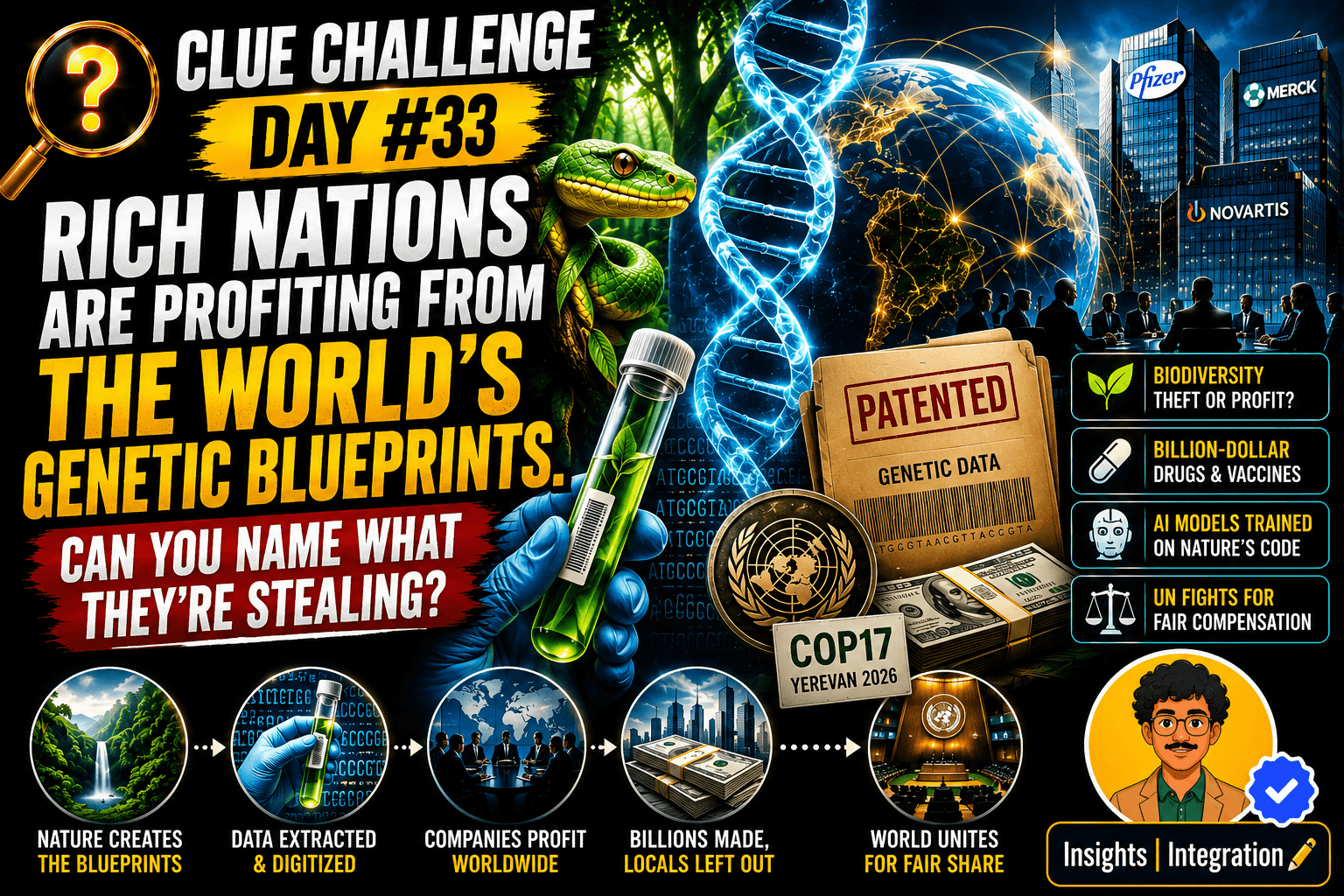
Something invisible is being extracted from the natural world — from rainforests, coral reefs, ancient seeds, and indigenous lands — and turned into billion-dollar vaccines, medicines, cosmetics, and AI training datasets. For decades, the countries being harvested got nothing in return. Now a global fight is erupting — in UN halls, in pharmaceutical boardrooms, and in biodiversity summits — to change that. The term at the centre of it all has three words.
Can you name it before the final clue?
Clue #1 — A snake in the Amazon holds the blueprint for a heart drug. Who owns that blueprint?
A pharmaceutical company travels to Brazil. It collects a rare Amazonian snake. Scientists decode the venom’s biological structure, upload it to a database in Europe, and build a blockbuster cardiac drug worth billions.
The snake lives in Brazil. The profits land in New York and London. Brazil receives nothing.
The invisible resource that was extracted, encoded, and uploaded — that is the term this puzzle is about. Three words. The world is finally fighting over who owns it.
Clue #2 — COVID vaccines were built on biological data from developing nations. With zero compensation.
The COVID-19 virus was sequenced, shared globally, and used by Western pharmaceutical companies to develop vaccines generating over $100 billion in revenue. The nations whose biological heritage powered those vaccines received no royalties, no formal recognition, and no legal share of the profits.
The pandemic made a decades-old injustice visible to the entire world overnight.
Clue #3 — A global fund to fix this launched in Rome — February 2025
On February 25, 2025, in Rome, a new global financial mechanism was formally launched under the United Nations Convention on Biological Diversity — named the Cali Fund, after the Colombian city where its framework was agreed.
Its mandate: collect payments from pharmaceutical, biotech, cosmetic, and agriculture companies that profit from biological blueprints sourced from biodiversity-rich nations — and return those benefits to the countries and communities they came from.
Fifty percent of the fund goes directly to indigenous and local communities. The other fifty percent supports global biodiversity conservation.
Clue #4 — The EU held an emergency dialogue about it in March 2026
In March 2026, the European Commission hosted an Informal Global Dialogue on the Cali Fund in Leuven, Belgium — bringing together governments, industry, and civil society to discuss how to mobilise contributions, allocate resources, and engage companies in biotechnology, pharmaceuticals, agriculture, and cosmetics.
The urgency: a decisive UN summit is now just months away — October 2026, in Yerevan, Armenia — where contribution rates for every major company on Earth will be locked in.
Clue #5 — AI companies are now being dragged into the payment system
Here is the clue that stunned policy circles in 2025.
Civil society groups and developing nations are insisting that AI companies be firmly kept within the scope of payment obligations — because AI drug-discovery models are trained on the same biological blueprints extracted from the Global South’s biodiversity.
Same extraction. New technology. Same zero compensation. That is now changing.
Clue #6 — It is the 21st century version of an old colonial crime
Scientists across lucrative industries — pharmaceuticals, biotechnology, and cosmetics — utilise biological blueprints derived from organisms to develop scientific advancements for profit. This has been called biopiracy: the colonial theft of natural material dressed in the language of science.
From Amazonian snake venom to Himalayan plant compounds to Pacific coral reefs — the same pattern repeated for decades. The blueprints leave. The profits never return.
Clue #7 — A 2024 WIPO treaty now forces companies to reveal where their biological data came from
In May 2024, a landmark WIPO Diplomatic Conference concluded a new international treaty on intellectual property and biological knowledge.
For the first time, patents built on biological blueprints sourced from another country must now disclose where that material originally came from — publicly, in the patent filing itself.
A drug company building a product from Amazonian snake venom data must now say so. In the patent. For the world to see.
Clue #8 — COP17 in Armenia — October 2026 — will set the rules for every pharma company on Earth
Indicative contribution rates of 1% of profits or 0.1% of revenue have been proposed for larger companies — those exceeding two of three financial thresholds: total assets above $20 million, sales above $50 million, or profit above $5 million. Final rates will be confirmed at COP17 in 2026.
One major unresolved issue is obligation stacking — Brazil, South Africa, and India each have their own national benefit-sharing regimes. It is unclear whether paying into the Cali Fund exempts companies from local requirements.
The UK, Chile, and Germany are pushing for one solution: “pay once, comply everywhere.”
So — what is the three-word term?
It is biological blueprint data — from plants, animals, fungi, and microbes — encoded and stored in digital databases, then used by global industry to generate billions. The countries that supplied the original organisms historically received nothing. A global fund launched in 2025 is finally changing that.
Bonus — name:
- The UN fund launched in Rome, February 2025
- The 2026 summit city where contribution rates are finalised
- The 2024 WIPO treaty requiring patent disclosure of biological origins
- The principle the UK, Chile, and Germany are pushing for corporate contributors
Drop your answer below. Unlike Wordle, this one is about who owns the code of life itself. Day #34 arrives tomorrow.
Missed yesterday’s challenge?
Check it here → Clue Challenge Day #32: One Molecule Is Quietly Rewriting All of Medicine
Answer to Yesterday’s Challenge: DAY #32
(Click above to reveal)