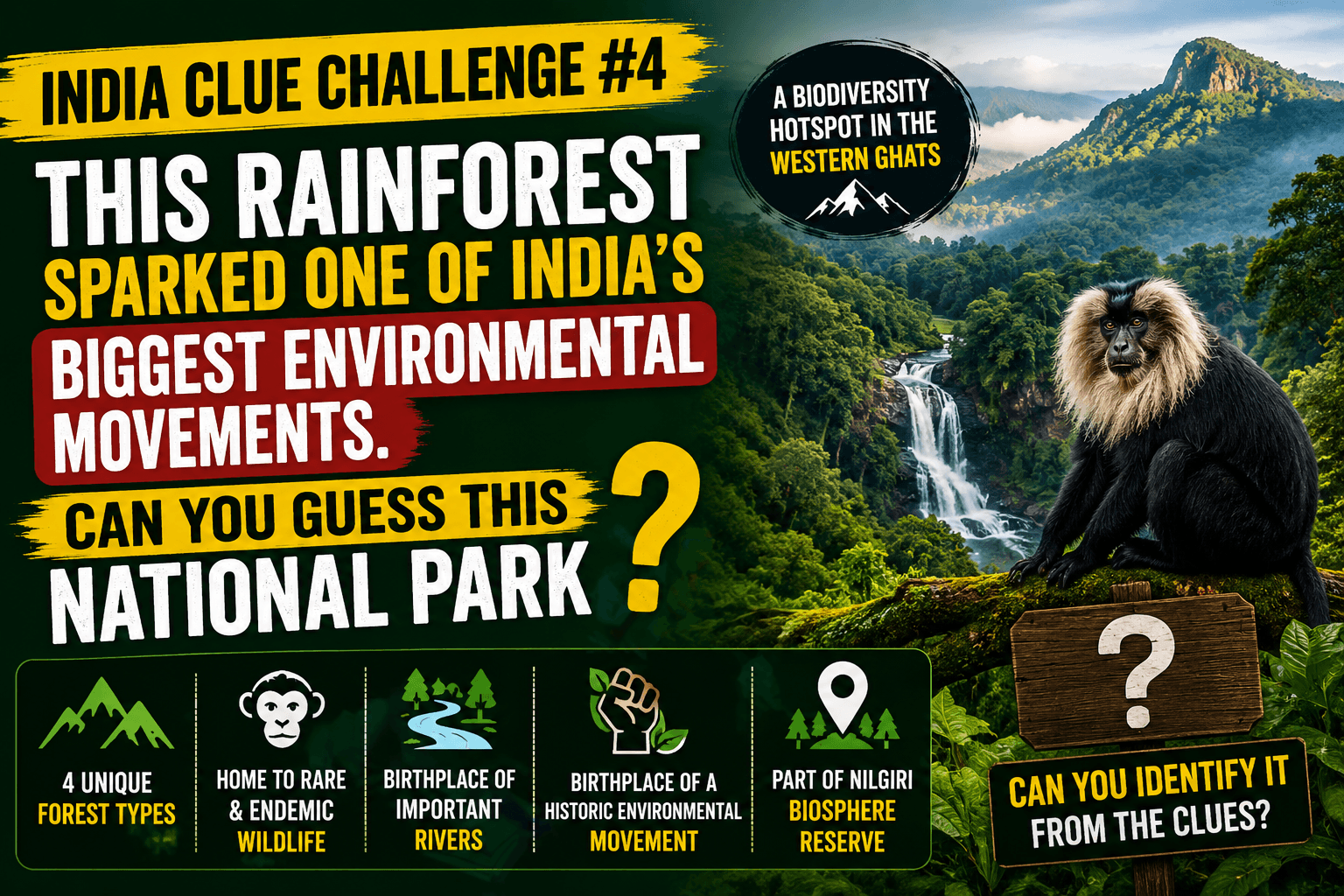
Six clues. One National Park. A biodiversity hotspot that changed India’s conservation history. Can you identify it?
India is home to more than 100 national parks, but only a few have influenced environmental policymaking across the country. Today’s mystery destination is one such place.
Hidden within the Western Ghats, this rainforest is a global biodiversity hotspot, home to rare wildlife, endemic species, and evergreen forests that have survived for millions of years. It also became the center of a historic conservation movement that demonstrated how public awareness could shape government policy.
Can you guess the National Park?
Clue #1: A UNESCO-Worthy Biodiversity Treasure
This National Park lies within the Nilgiri Biosphere Reserve, India’s first biosphere reserve and part of the globally recognized Western Ghats biodiversity hotspot. Dense tropical forests, high rainfall, and diverse elevations have created ideal conditions for thousands of plant and animal species. Many of them are endemic, meaning they are found nowhere else on Earth. Because of its exceptional ecological value, the region is considered one of the world’s most important centers of biodiversity.
Clue #2: Four Forests in One Landscape
Very few protected areas in India display such remarkable ecological diversity. The park contains four distinct forest types—West Coast Tropical Evergreen Forests, Southern Subtropical Broad-Leaved Hill Forests, Southern Montane Wet Temperate Forests, and Grasslands. This wide range of habitats supports an extraordinary variety of wildlife and allows numerous species to thrive across different altitudes. The changing vegetation also makes the park an important site for ecological and climate research.
Clue #3: A Paradise for Endemic Wildlife
This protected area shelters some of the Western Ghats’ most iconic species. Visitors may encounter the lion-tailed macaque, Nilgiri langur, Malabar giant squirrel, Nilgiri tahr, tiger, leopard, fishing cat, leopard cat, and several species of bats and reptiles. Many of these animals are threatened or endemic to the Western Ghats. The park is especially famous for protecting one of the largest remaining populations of the endangered lion-tailed macaque, making it a global conservation priority.
Clue #4: The Birthplace of Important Rivers
This National Park is not only rich in wildlife but also vital for water security. The Bhavani River, an important tributary of the Cauvery, originates in this landscape. The Kunthipuzha River, a major tributary of the Bharathapuzha, also begins here. Numerous streams emerging from these forests sustain ecosystems, agriculture, and communities far beyond the park boundaries, highlighting the close relationship between forests and freshwater resources.
Clue #5: A Historic Environmental Victory
During the late 1970s and early 1980s, this landscape became the focus of one of India’s most significant environmental campaigns. A proposed hydroelectric project threatened its pristine evergreen forests. Scientists, writers, students, environmentalists, and ordinary citizens joined together in a nationwide movement to protect the ecosystem. The campaign eventually succeeded, becoming a landmark example of conservation through democratic public participation and influencing India’s environmental policies for decades.
Clue #6: Surrounded by Protected Forests
The park shares ecological connections with the Karimpuzha Wildlife Sanctuary, New Amarambalam Reserved Forest, Nedumkayam Rainforest, and the Attappadi Reserved Forest. Nearby stand prominent peaks such as Mukurthi, one of South India’s highest mountains. Together, these protected landscapes form an important wildlife corridor across the Western Ghats, allowing animals to move freely while maintaining genetic diversity and ecological balance.
Final Hint
The name of this National Park comes from an unusual feature that early visitors noticed—a forest where the usual sounds of cicadas were remarkably absent, giving the landscape an impression of extraordinary silence.
Can you identify this National Park?