Artificial intelligence is no longer just a race to build the smartest model—it has become a race over who owns intelligence itself. One technical method, AI Distillation, has suddenly become one of the world’s hottest AI topics after the United States accused a leading Chinese AI company of using the technique to copy advanced American models.
The controversy has transformed a once-obscure machine learning concept into a geopolitical issue involving intellectual property, national security, export controls, and the future of AI leadership.
What Is AI Distillation?
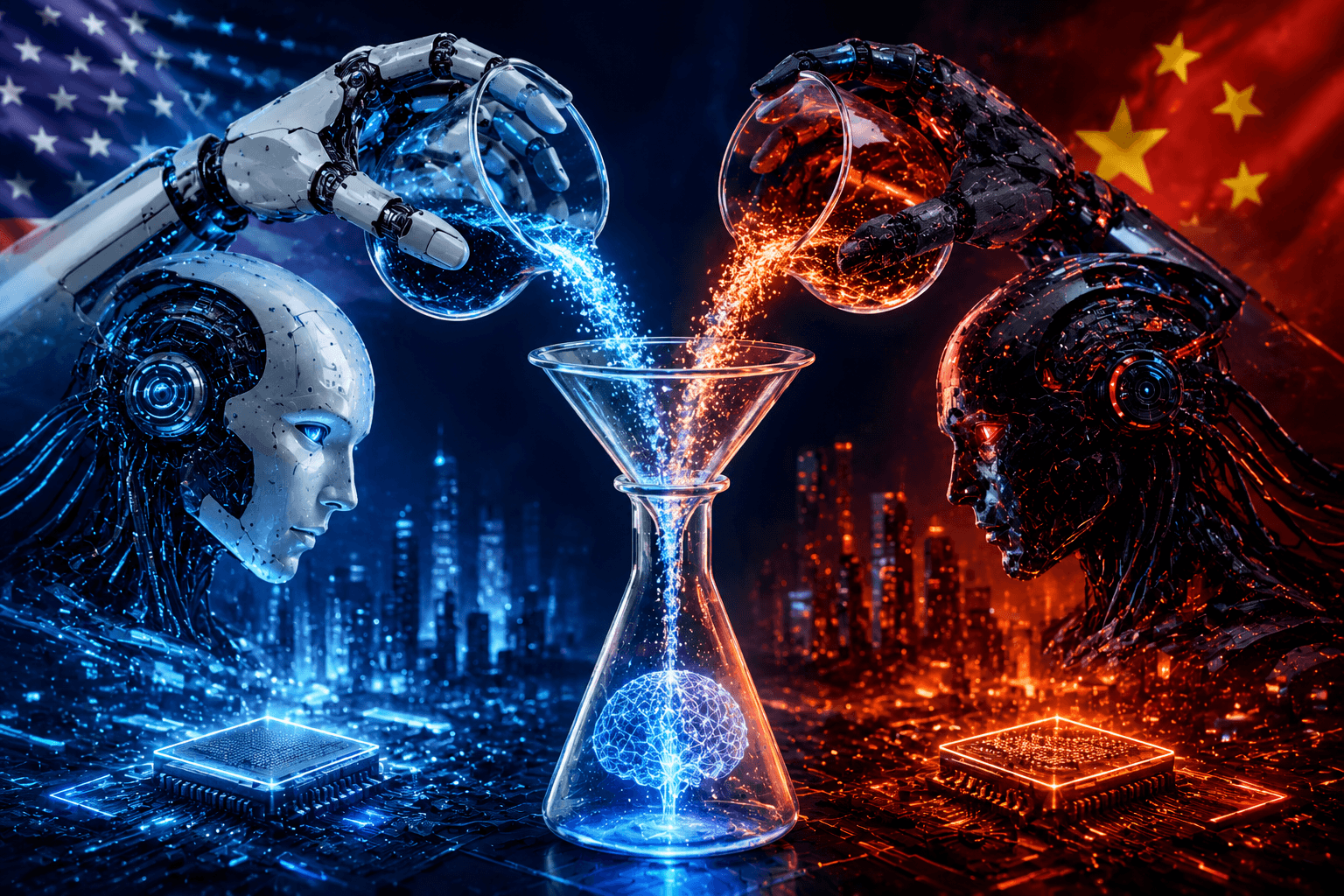
AI distillation is a machine-learning technique where a smaller “student” model learns from the outputs of a much larger “teacher” model.
Instead of spending billions of dollars training an AI from scratch using massive datasets, developers can query a powerful AI thousands or millions of times. The answers generated by the larger model become high-quality training data for the smaller system.
The result is an AI that delivers much of the larger model’s performance while requiring significantly less computing power, energy, and cost.
Distillation has long been accepted for optimizing models with authorization. The controversy begins when companies allegedly use another firm’s proprietary frontier AI without permission.
Why Is Distillation Suddenly in the News?
The issue escalated dramatically in July 2026 after White House Science and Technology Adviser Michael Kratsios publicly alleged that Chinese startup Moonshot AI conducted a “large-scale distillation” campaign using Anthropic’s Fable AI models.
According to the allegations, Moonshot’s newly unveiled Kimi K3 AI model may have extracted capabilities from Anthropic’s frontier system through repeated interactions instead of independently developing those capabilities.
Kratsios also claimed that Moonshot gained access to restricted Nvidia GB300 Grace Blackwell AI servers, raising additional concerns about U.S. export controls on advanced AI hardware.
Moonshot has denied wrongdoing, while China has rejected accusations that its AI progress depends on technology theft, saying its advances result from domestic innovation and international cooperation.
A Growing Pattern
This is not the first time distillation has sparked controversy.
Earlier in June 2026, Anthropic accused Chinese technology giant Alibaba of allegedly extracting capabilities from its Claude AI models using similar distillation techniques. The company urged U.S. lawmakers to strengthen legal protections for frontier AI systems and impose penalties for large-scale intellectual property theft.
The White House has also pledged closer cooperation with American AI firms to counter what it calls “industrial-scale campaigns” aimed at copying U.S. AI technologies.
Why Distillation Matters
The debate goes far beyond one company.
Modern frontier AI models cost hundreds of millions—or even billions—of dollars to develop. If competitors can reproduce much of their capability simply by querying them extensively, the economic advantage of pioneering research could shrink dramatically.
This has implications for:
- National security
- AI intellectual property rights
- Semiconductor export controls
- Open-source AI development
- Global technology competition
Some policymakers argue that unrestricted access to frontier AI effectively allows rivals to reverse-engineer years of research at a fraction of the cost.
The Bigger AI Battle
The Moonshot controversy arrives just as Chinese AI firms are rapidly narrowing the performance gap with leading U.S. models. Open-source releases such as Kimi K3 are increasing pressure on American AI companies to protect proprietary technologies while continuing to innovate.
As AI becomes a strategic national asset, distillation has evolved from a technical optimization method into one of the defining battlegrounds of the global AI race. The future debate is unlikely to be about whether distillation is useful—but rather where legitimate learning ends and intellectual property theft begins.