
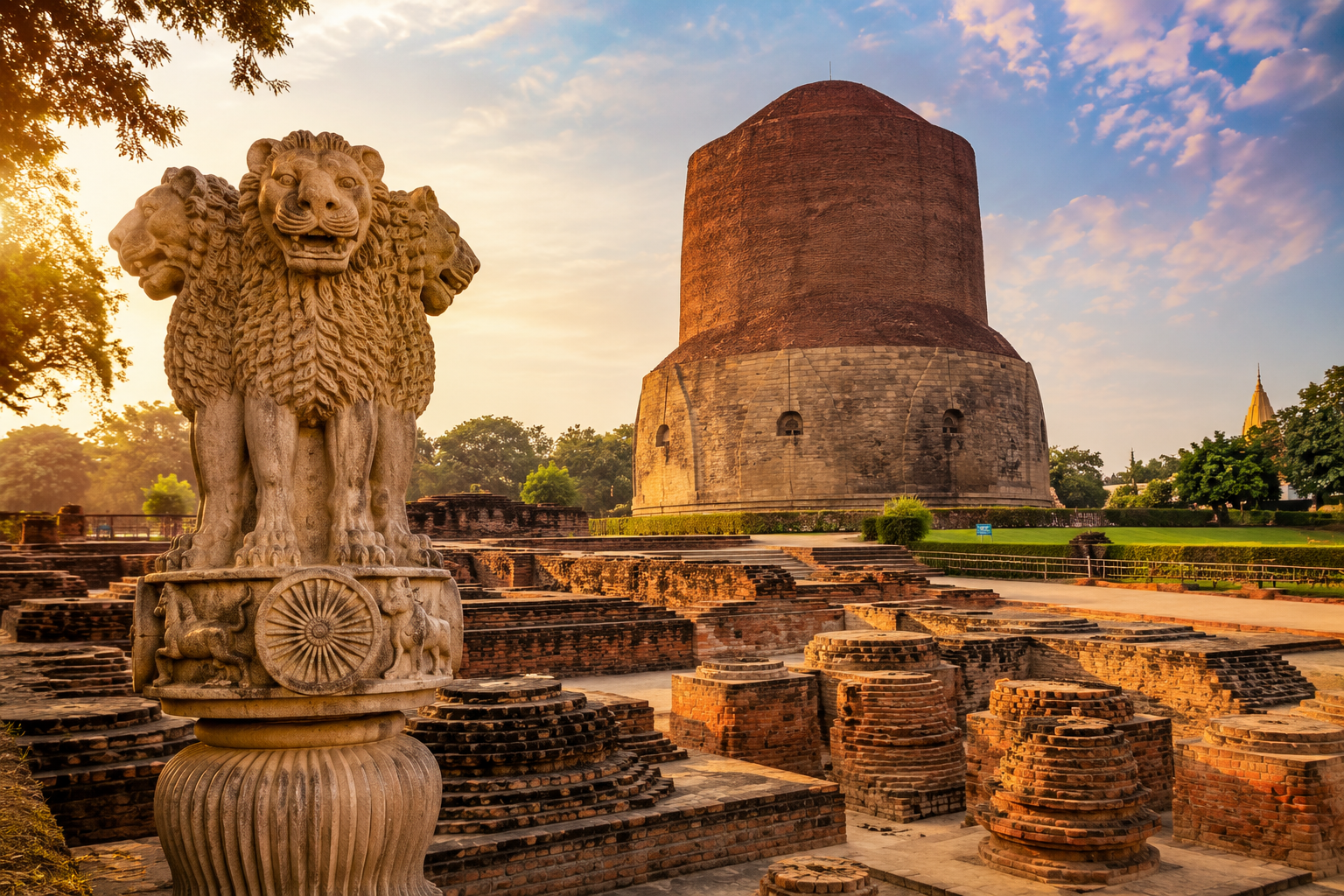
On 25 July 2026, India achieved another milestone in cultural heritage as the Ancient Buddhist Site of Sarnath was officially inscribed on the UNESCO World Heritage List during the 48th Session of the World Heritage Committee held in Busan, South Korea. With this recognition, Sarnath becomes India’s 45th UNESCO World Heritage Site, reinforcing the country’s position as one of the world’s richest custodians of historical and spiritual heritage.
Why Sarnath Matters
Sarnath, located about 10 km from Varanasi in Uttar Pradesh, is among the four holiest pilgrimage sites in Buddhism.
According to Buddhist tradition, this is where Gautama Buddha delivered his first sermon after attaining enlightenment at Bodh Gaya around the 6th century BCE. The sermon, known as Dharmachakra Pravartana (Turning of the Wheel of Dharma), laid the foundation of Buddhism by introducing the Four Noble Truths, the Noble Eightfold Path, and marking the birth of the Buddhist Sangha (monastic community).
Because of this historic event, Sarnath has attracted monks, scholars, rulers, and pilgrims from across Asia for nearly 2,500 years.
What UNESCO Recognized
The inscription includes two major components:
- Chaukhandi Stupa, marking the place where Buddha met his first five disciples.
- Archaeological Remains of Sarnath, including:
- Dhamekh Stupa
- Dharmarajika Stupa
- Mulagandhakuti Vihara
- Ashokan Pillar
- Ancient monasteries, temples and votive stupas
Together, these monuments preserve nearly 1,600 years of continuous Buddhist architectural and religious history, stretching from the pre-Mauryan period (5th–4th century BCE) until the site’s decline during the 12th century CE.
UNESCO accepted the nomination under Criteria (iii) and Criteria (vi), recognizing Sarnath’s exceptional testimony to Buddhist civilization and its direct association with one of the most significant events in world religious history.
A Journey Decades in the Making
Although Sarnath’s importance has long been acknowledged, the road to UNESCO recognition was extensive.
- Added to India’s Tentative List in 1998
- Official nomination submitted in January 2025
- Evaluated through an 18-month technical review
- Site inspected by ICOMOS (International Council on Monuments and Sites)
- Final approval granted in July 2026
The recognition reflects years of archaeological documentation, conservation planning, and international evaluation.
Home of India’s National Emblem
One of Sarnath’s greatest archaeological discoveries is the Ashokan Lion Capital, excavated by the Archaeological Survey of India (ASI) in the early 20th century.
This magnificent sandstone sculpture was later adopted as the National Emblem of India, while the Dharma Chakra (Ashoka Chakra) from Sarnath today occupies the center of the Indian national flag.
Sarnath is also home to India’s oldest site museum, established in 1904, which preserves priceless Buddhist sculptures, inscriptions, and relics discovered during excavations.
Why This Recognition Is Significant
UNESCO status extends beyond prestige. It helps:
- Strengthen global conservation efforts.
- Boost responsible cultural tourism.
- Increase international research collaborations.
- Promote sustainable heritage management.
- Enhance India’s cultural diplomacy with Buddhist-majority nations such as Japan, Sri Lanka, Thailand, Myanmar, Vietnam, Cambodia, Mongolia, and South Korea.
The recognition also reinforces India’s identity as the birthplace of Buddhism.
India’s Growing UNESCO Presence
With Sarnath’s inscription:
- India now has 45 UNESCO World Heritage Sites.
- India ranks 6th globally and 2nd in the Asia-Pacific region by the number of World Heritage Sites.
- The country also has 69 sites on UNESCO’s Tentative List, making them eligible for future nominations.
The achievement follows the inscription of the Maratha Military Landscapes of India in 2025, highlighting India’s sustained efforts to preserve and promote its cultural heritage.
Conclusion
Sarnath is not merely an archaeological site—it is where one of humanity’s most influential philosophies first took shape. Its inclusion on UNESCO’s World Heritage List recognizes both its historical importance and its continuing spiritual relevance. As the birthplace of the Buddha’s first teaching, Sarnath now stands among the world’s most treasured cultural landmarks, ensuring its legacy will be protected and celebrated for generations to come.