A daily puzzle for curious minds. One scientific breakthrough. Six clues. One answer.
For more than 100 years, physics textbooks taught the same thing:
There are two kinds of magnets.
That’s it.
Every hard drive, every MRI machine, every magnetic sensor, every electronics engineer on Earth worked within that framework.
Then researchers discovered something strange.
A class of materials that seemed to break the rules.
Not quite one type.
Not quite the other.
Something entirely different.
The discovery was so significant that Science magazine named it one of the Top 10 Scientific Breakthroughs of 2024.
Now it could help power the next generation of AI hardware, ultra-fast memory, and quantum technologies.
Can you identify it before the final clue?
Clue #1 — For a century, physics said there were exactly two types of magnets
Every school textbook agreed. Two categories. That was the rule.
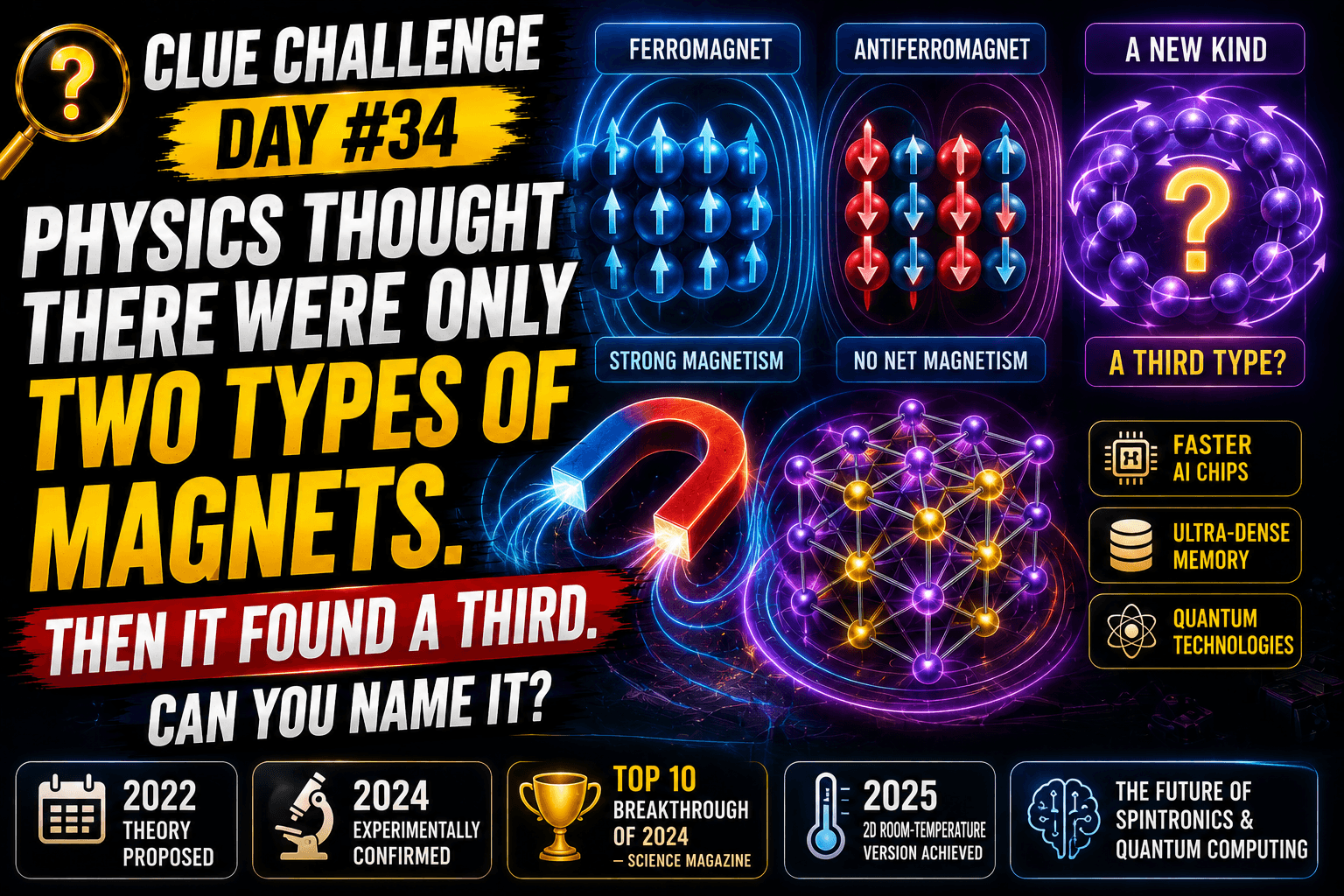
The first — ferromagnets — have spins all pointing the same direction, creating a strong external magnetic field. Your fridge magnet is one. So is every hard drive ever made.
The second — antiferromagnets — have spins pointing in opposite directions, perfectly cancelling each other out. No external magnetic field. Useful in theory. Maddeningly difficult to exploit in practice.
These two types — ferromagnets and antiferromagnets — received the most attention for both fundamental research and practical applications for the entirety of the 20th century.
Then, in 2022, a team of physicists quietly proposed something else entirely.
Clue #2 — It was hiding in materials scientists had studied for decades — and nobody noticed
The new magnets weren’t actually new at all. Many of the materials displaying this behaviour — like ruthenium dioxide — were well known, and no one had suspected they had any special powers.
The 2022 paper by Šmejkal, Sinova and Jungwirth that first named this phenomenon has since been cited more than 1,500 times.
A century of physics. Hiding in plain sight. Named — at last — in 2022.
Clue #3 — It combines the best properties of both known magnet types — and was named Science’s top breakthrough of 2024
Like ferromagnets, these materials exhibit spin-dependent splitting of electronic bands — meaning spin-up and spin-down electrons occupy slightly different energy levels. But they maintain zero net magnetisation, a hallmark of antiferromagnetism.
The best of both worlds. Fast like ferromagnets. Interference-resistant like antiferromagnets. And in December 2024:
Researchers from the University of Nottingham provided the first experimental imaging of this new magnetic order — confirming its unique spin-symmetry properties using nitrogen-vacancy centre microscopy and X-ray magnetic linear dichroism.
The discovery was named one of Science magazine’s top 10 breakthroughs of 2024.
Clue #4 — In 2025, it bent light in ways that defied explanation
Researchers cracked a century-old physics mystery by detecting magnetic signals in these materials using only light and a revamped laser technique — previously undetectable, these faint signals had been invisible to all conventional probes.
A magnet that bends light. That generates spin-polarised currents without a net magnetic field. That can be switched electrically — something previously thought impossible.
Clue #5 — It could make AI chips faster, cooler, and smaller than anything built today
Standard ferromagnetic materials used in memory devices allow data to be written easily — but they are vulnerable to interference from stray magnetic fields, which causes errors and limits storage density. Antiferromagnetic materials offer much better resistance to external disturbances, but their internal spins cancel each other out, making it difficult to read stored data electrically.
This third category overcomes both limitations — drawing growing interest because it could overcome key limitations of today’s magnetic memory technologies and enable faster, more compact data storage.
The race is on. IBM, Samsung, and quantum computing labs worldwide are paying very close attention.
Clue #6 — The first 2D room-temperature version was confirmed in 2025 — and it changes everything
A team at the Hong Kong University of Science and Technology published the first experimental observation of a two-dimensional layered room-temperature version of this material in Nature Physics — validating theoretical predictions and unveiling crystal-symmetry-paired spin-valley locking, critical for spintronics and valleytronics.
Room temperature. Two-dimensional. Practical. Manufacturable.
The theory became a laboratory result. The laboratory result is now becoming an engineering target.
So — what is this newly confirmed third class of magnetic material?
It has zero net magnetisation — yet generates spin-polarised currents. It was theorised in 2022, experimentally confirmed in 2024, named a top-10 science breakthrough, and is now being developed for the next generation of AI chips, quantum computers, and spintronic devices.
Bonus — can you also name:
- The 2022 paper’s three authors who first coined the term
- The common material — long considered unremarkable — confirmed as a leading example of this phenomenon
- The university that provided the first experimental image of it in December 2024
- The two emerging fields of technology it is expected to power beyond conventional computing
Drop your answer below. Unlike Wordle, this one could be inside your devices within a decade. Day #35 arrives tomorrow.
Missed yesterday’s challenge?
Check it here → Clue Challenge Day #33: Rich Nations Are Profiting From the World’s Genetic Blueprints
Answer to Yesterday’s Challenge: DAY #33
(Click above to reveal)