One civilization. Six clues. Hidden for 2,500 years. Revealed by lasers. Still rewriting Amazon history in 2026. All real.
For decades, many researchers believed the Amazon rainforest could never support large urban societies. Then scientists scanned beneath the jungle canopy and discovered something extraordinary: roads, plazas, agricultural landscapes, and entire cities connected across a vast network. And the discoveries haven’t stopped — similar lost cities are still emerging across the Amazon in 2025 and 2026. Can you identify the civilization before the final clue?
Clue #1 — Scientists used laser technology to see through the rainforest
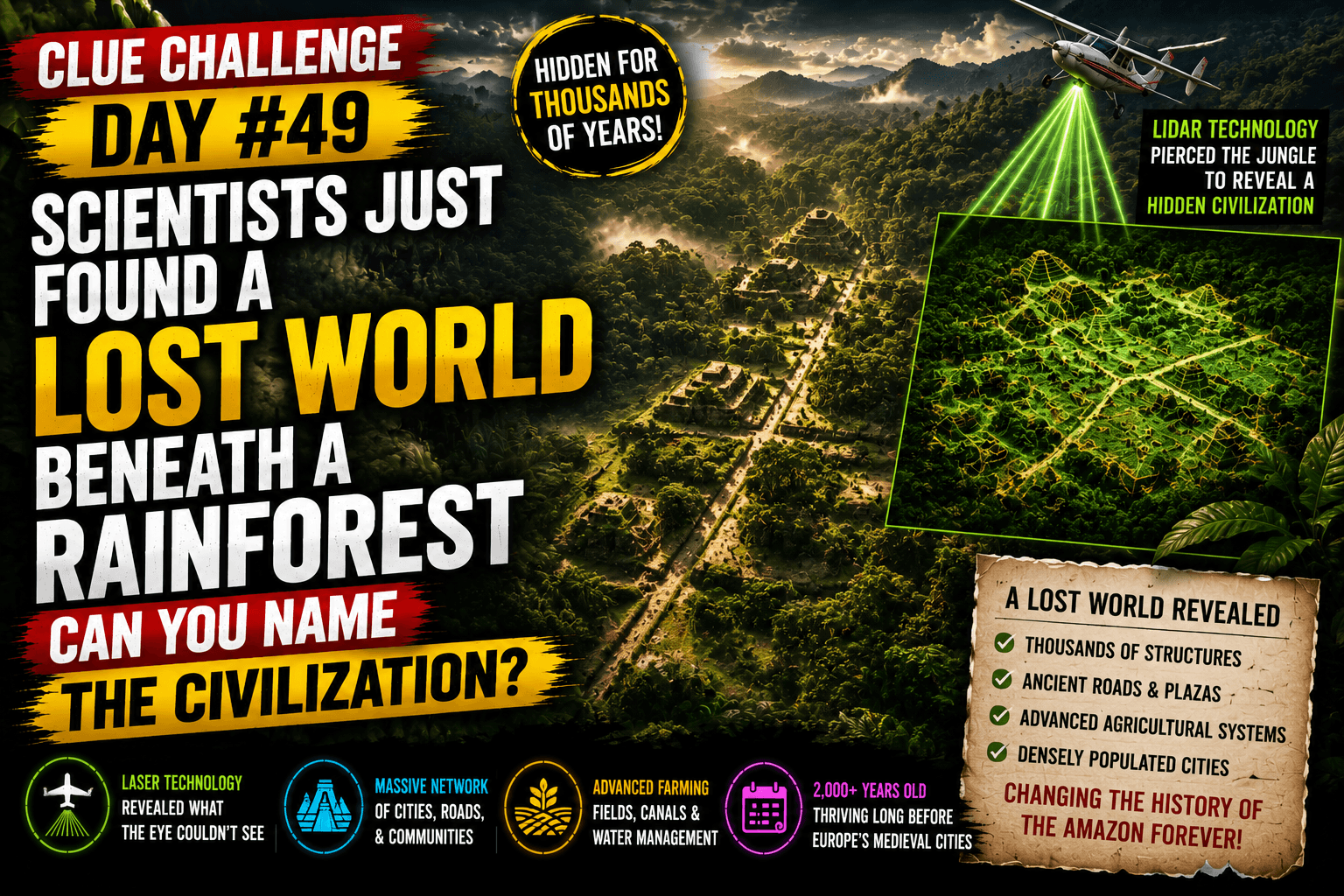
The breakthrough came through LiDAR (Light Detection and Ranging) — a technology that fires millions of laser pulses from aircraft and digitally strips away trees to reveal the ground beneath.
Using laser scanning technology, researchers found traces of 2,500-year-old cities in the Amazon rainforest — complete with a complex network of farmland and roads, the oldest and largest discovery of its kind in the region.
For decades, archaeologists had studied human-made mounds at the site, but it had not been systematically imaged like comparable settlements further north — until the Ecuadorian government scanned a vast swathe of the region in 2015.
What appeared underneath stunned archaeologists. This wasn’t a small village. It was an entire urbanised landscape, hiding in plain sight for over two millennia.
Clue #2 — It sits where the Andes meet the Amazon — and it’s 2,500 years old, not 2,000
The civilization flourished in a fertile basin at the foot of a volcano, on the eastern slopes of the Andes, where the mountains drop down into the Amazon Basin.
Radiocarbon dates showed the sites were occupied from around 500 BCE to between 300 CE and 600 CE — meaning the civilization thrived for roughly a thousand years, beginning 2,500 years ago.
That means these cities were thriving centuries before the Roman Empire reached its peak — and well over a millennium before most of Europe’s famous medieval cities existed.
Clue #3 — Over 6,000 structures, 15 cities, and roads stretching 25 kilometres
The images revealed more than 6,000 earthen platforms distributed in a geometric pattern, connected by roads and intertwined with the agricultural landscapes and river drainages of an urban agrarian civilization.
Researchers identified remnants of an urbanised landscape containing over 6,000 earthen platforms arranged in a geometric pattern, interconnected by public plazas and a vast network of roads linking 15 distinct urban centres.
A sophisticated web of straight, wide roads — some stretching over 15 miles — linked the settlements together, suggesting a level of regional interaction and engineering skill previously thought impossible in this environment.
Straight roads. Geometric planning. Fifteen connected cities. In the middle of the Amazon.
Clue #4 — Tens of thousands of people lived here — a population comparable to Roman-era London
Lead researcher Stéphen Rostain describes the population as having reached 10,000 to 30,000 people — comparable to Roman-era London. This bustling civilization flourished for over a thousand years before vanishing.
Previously, scientists assumed ancient South Americans lived nomadically or in tiny settlements in the Amazon — but researchers now estimate these newly discovered cities housed populations “in the 10,000s if not 100,000s.” Scientists are demonstrating conclusively that there were far more people in these areas, and that they significantly modified the landscape — a paradigm shift in how we think about ancient Amazonian occupation.
Clue #5 — The discoveries haven’t stopped — 2025 and 2026 are rewriting Amazon history even further
This isn’t a closed case from 2024. The story is still unfolding.
Rostain is now combining radiocarbon dating with his lidar findings to pinpoint exact occupation timelines — dating organic samples to discern when people inhabited, or re-inhabited, this ancient landscape.
Further discoveries have emerged from Bolivia’s Llanos de Mojos, where archaeologist Carla Jaimes Betancourt and her team used lidar to uncover monumental settlements over 1,400 years old — featuring geometric layouts, radiating roads, concentric moats, and pyramid-like structures reaching nearly 70 feet in height.
And just this year, in early 2026, LIDAR technology revealed traces of human modification beneath dense tropical forest canopy in the Chocó region of eastern Panama — extending this same laser-archaeology revolution into Central America.
One discovery in Ecuador. A continent-wide pattern emerging.
Clue #6 — The civilization’s name comes directly from the valley — and the river — where it flourished
The valley is home to the oldest currently-known urban settlements in the Amazon — archaeological digs and LIDAR surveys published in 2024 revealed a complex network of roads connecting densely populated areas dating back to at least 500 BCE and occupied as late as 600 CE.
These sites were discovered as the oldest known complex Amazonian society — predating other such societies by over a millennium.
The river runs from the Andean sierra down into the Amazon. The valley took its name from the river. And the civilization took its name from the valley.
So — Which Civilization Is It?
A lost civilization hidden beneath the Amazon rainforest for 2,500 years. Discovered using LiDAR in 2015, published in Science in January 2024 by archaeologist Stéphen Rostain of France’s CNRS. Over 6,000 earthen platforms across 15 connected cities. Roads stretching up to 25 kilometres. A population of 10,000–30,000 — comparable to Roman-era London. Located where the Andes meet the Amazon, in Ecuador. Part of a wider 2025–2026 wave of laser-revealed lost cities across Bolivia and now Panama.
Bonus — Can You Also Name?
- The technology that revealed the cities beneath the rainforest
- The modern country where the discovery was made
- The French research agency the lead archaeologist belongs to
- The Bolivian site where 21-metre pyramid structures were found using the same technology
Drop your answer below. Unlike Wordle, this puzzle was hidden beneath a rainforest for 2,500 years — and the laser revolution is still finding more. Day #50 arrives tomorrow.
Missed yesterday’s challenge?
Answer to Yesterday’s Challenge: DAY #48
(Click above to reveal)