One CPU architecture. Five clues. Announced this week at one of the world’s biggest tech summits. All real. All June 2026.
For 60 years, every CPU on Earth was built for one user: you. Human commands. Human timescales. Human workflows. This week, a company that already dominates AI chips announced it had built the world’s first CPU designed not for humans — but for AI agents. Can you name it before the final clue?
Clue #1 — Every CPU ever built was designed for a human sitting at a keyboard. This one isn’t.
For decades, CPUs have been designed primarily to support human-driven applications — web browsing, office software, gaming, enterprise computing. This new architecture changes that paradigm entirely.
“The CPU is no longer simply supporting the model — it’s driving it,” said its maker’s CEO at a packed keynote this week. As AI moves from training to production, the bottleneck is shifting away from GPUs toward orchestration, inference coordination, and real-time execution.
Agentic AI systems — built to execute tasks, call tools, and manage multi-step workflows — require processors that respond not in milliseconds, but nanoseconds. A new architecture was needed. It launched this week.
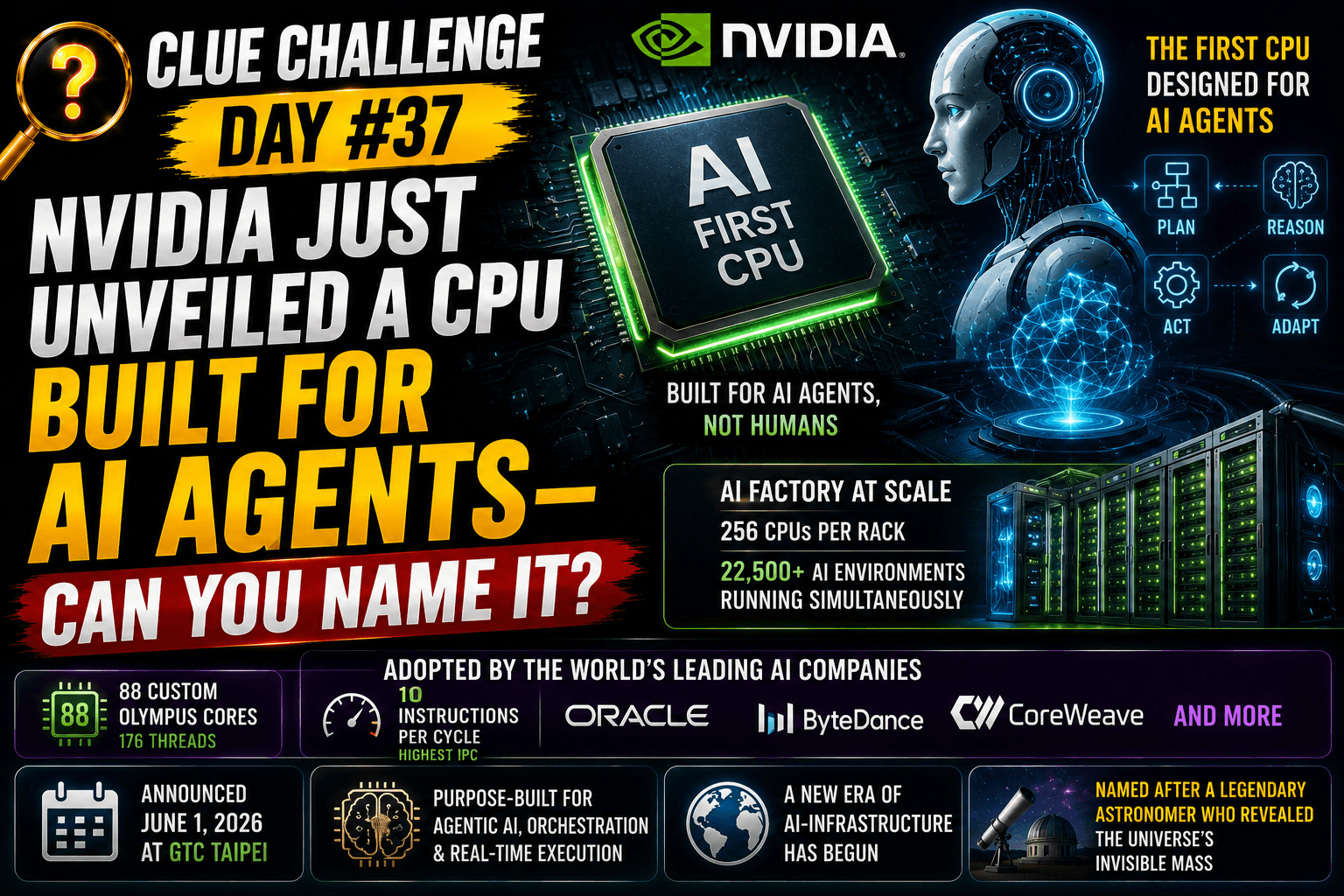
Clue #2 — It has 88 custom cores, executes 10 instructions per clock cycle, and is 1.8x faster than Intel and AMD
The processor integrates 88 custom “Olympus” cores based on a proprietary architecture. Each core supports two simultaneous threads — enabling 176 threads total. It includes 2MB of L2 cache per core and 164MB of shared L3 cache. Its CEO said at the keynote: “This has the highest IPC in the world” — able to fetch and execute 10 instructions per clock cycle.
It enables 1.8x faster task completion compared with x86 CPUs — the category dominated for decades by Intel and AMD — across agentic AI, reinforcement learning, and data processing workloads.
Clue #3 — OpenAI, Anthropic, Oracle, and ByteDance are all adopting it — right now
Customers exploring this new CPU include finance leader NYSE, global AI labs Anthropic, OpenAI, and SpaceXAI, and hyperscalers ByteDance, CoreWeave, Lambda, Nebius, Nscale, and Oracle.
Oracle Cloud Infrastructure plans to deploy hundreds of thousands of these CPUs beginning in 2026 — the first cloud provider to do so at hyperscale — because agentic AI demands sustained performance at massive scale.
Every major AI company in the world. Ordering the same new chip. Announced this week.
Clue #4 — A single rack holds 256 of them — running 22,500 simultaneous AI environments
A new CPU rack integrates 256 liquid-cooled units of this processor to sustain more than 22,500 concurrent CPU environments, each running independently at full performance — allowing AI factories to deploy and scale to tens of thousands of simultaneous agents.
One industry analyst called it “a bit revolutionary from an architectural perspective” — noting that while CPUs are typically drowned out by GPU news, the role of the CPU as the control and orchestration plane for GPU clusters becomes more demanding as agentic AI scales — not less.
Clue #5 — Its name is also shared with the astronomer who proved dark matter exists
This is your final clue — and your most direct one.
The CPU announced this week at GTC Taipei shares its name with a pioneering female astronomer whose work revealed that most of the universe is invisible. She was also honoured this year with an observatory built in her name in Chile — which recently captured an interstellar comet before the world knew to look for it.
Nvidia CEO Jensen Huang announced at GTC Taipei on June 1 that the company is launching this processor — reframing the entire CPU market around a simple but consequential argument: every AI agent needs one.
Same name. Two revolutions — one in physics, one in computing. Both changing how we see what was previously invisible.
So — what is this CPU architecture?
It was announced June 1, 2026, at GTC Taipei. It is the world’s first CPU purpose-built for AI agents, not humans. It has 88 custom Olympus cores. It is 1.8x faster than x86. OpenAI, Anthropic, Oracle, and ByteDance are already deploying it. And it shares its name with the woman who proved dark matter exists.
Bonus — can you name:
- The company that built it
- The custom core architecture inside it
- The observatory that shares its name — and the mountain in Chile where it sits
- The CEO who unveiled it at GTC Taipei on June 1, 2026
Drop your answer below. Unlike Wordle, this one is already running inside the world’s most powerful AI systems. Day #38 arrives tomorrow.
Missed yesterday’s challenge?
Clue Challenge Day #36: China Banned This Metal. The F-35 Needs It. Can You Name It?

Answer to Yesterday’s Challenge: DAY #36
(Click above to reveal)