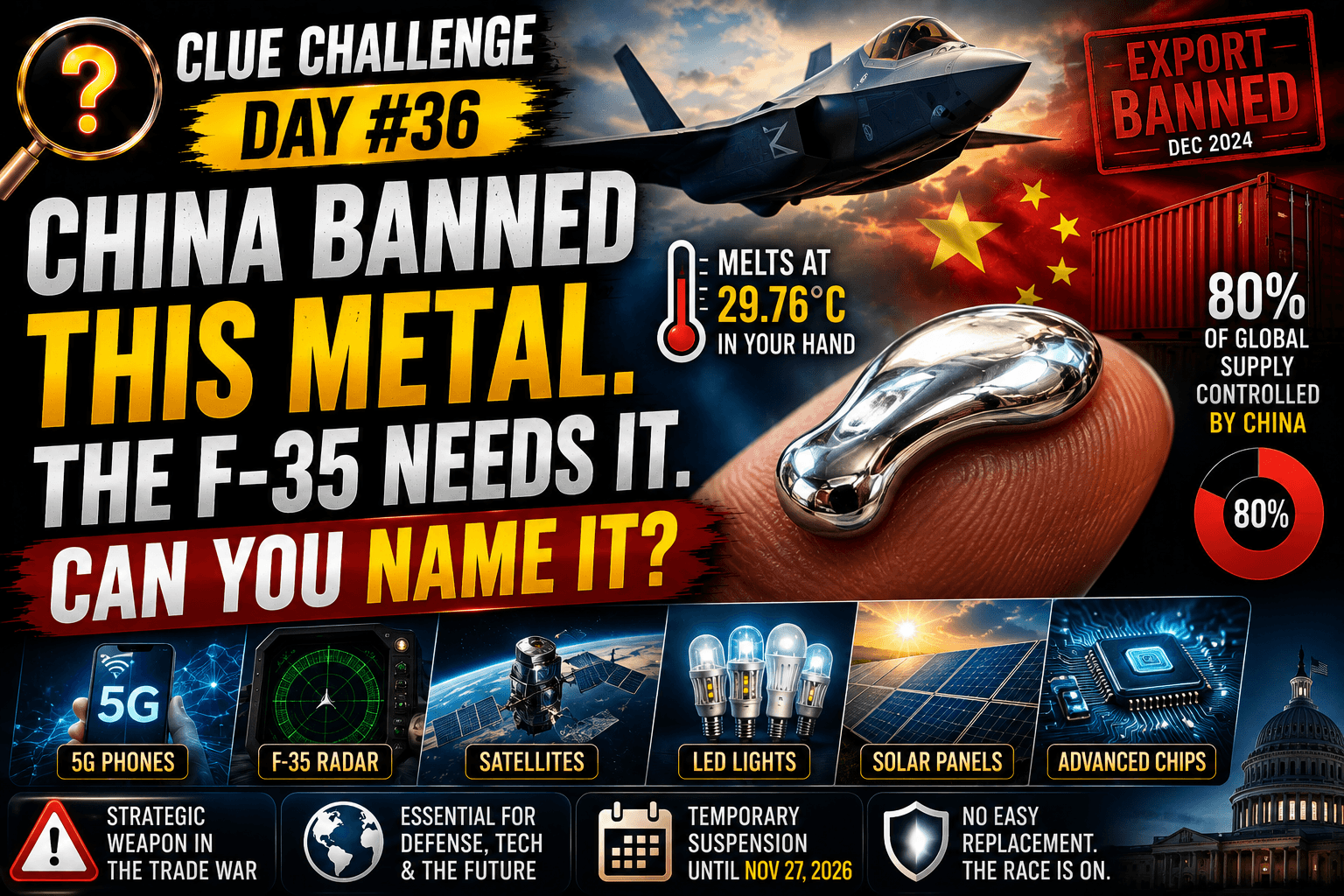
One element. Six clues. Hidden inside your smartphone, your fighter jets, your solar panels — and now at the centre of the US-China trade war. All real.
It melts in your palm. China controls 80% of global supply. In December 2024, Beijing pulled the trigger and banned its export to the United States. Defense contractors began rationing stockpiles overnight. Can you name the element before the final clue?
Clue #1 — It melts at 29.76°C — warm enough to turn liquid in your hand
Most people have never heard its name. Yet it is inside every device they own.
It sits inside the high-frequency chips that make 5G possible, the LEDs that light homes, and the solar cells that power satellites. In liquid form it even cools advanced electronics and enables flexible machines.
It is never found in pure form in nature. It is extracted as a byproduct when processing aluminium and zinc ores. Soft. Silver. Unremarkable to look at. Irreplaceable in practice.
Clue #2 — Every 5G phone on Earth contains it. So does every F-35 stealth fighter.
The radar system in each F-35 contains thousands of tiny chips made from compounds of this metal — chips that can detect enemy aircraft from extreme distances, even those designed to be invisible to conventional radar. This metal also helps chips survive heat and radiation critical in extreme military conditions.
In 2022, the US Department of Defense awarded Raytheon a $3.2 billion contract to equip up to 31 naval vessels — including new Arleigh Burke-class destroyers and aircraft carriers — with radar systems powered entirely by chips built from this metal’s compounds.
Commercial and military. Offensive and defensive. Space and sea. One metal, everywhere.
Clue #3 — China controls 80% of global supply — and in December 2024, it pulled the trigger
In December 2024, China’s Ministry of Commerce announced that exports of this metal and its compounds to the United States would not be permitted — a direct retaliation to US semiconductor export restrictions, and a deliberate signal of Beijing’s willingness to weaponise critical mineral dominance.
The ban led to immediate shortages for US users. Some importers began routing shipments through third countries to access supplies. Defense contractors started rationing stockpiles. The vulnerability of the entire Western semiconductor supply chain was exposed overnight.
Clue #4 — China then used it as a bargaining chip — literally — after Trump met Xi
Following the meeting between Trump and Xi Jinping in South Korea in October 2025, China suspended the export ban — temporarily. The suspension lasts until November 27, 2026.
Exports are now managed under licensing. The clause banning exports to military end-users remains fully in effect. Beijing retains the ability to reactivate stricter controls at any moment.
A one-year reprieve. A ticking clock. November 27, 2026.
Clue #5 — It could make silicon obsolete — and China knows it
Its two primary compounds (with Arsenide & Nitride) — one dominant in high-frequency and infrared systems, the other growing rapidly across 5G, electric vehicle power electronics, and defence — together account for the majority of its global end-use today.
As continued advances in chipmaking push the limits of conventional transistor scaling, industry experts see chips based on this metal’s compounds as the primary pathway beyond silicon — powering third-generation semiconductors and space photovoltaics.
The element whose dominance China is fighting hardest to preserve. The same one Huawei’s new chip law — unveiled in Shanghai this month — is partly designed to exploit.
Clue #6 — The clock runs out on November 27, 2026 — and nobody has a replacement ready
Despite the temporary restoration of supply, prices remain far above pre-ban levels. The cost of building new production capacity outside China far exceeds existing Chinese supply costs. Countries are stockpiling, driving sustained expansion in baseline demand.
The electric vehicle industry alone has seen adoption of chips built from this metal’s compounds rise from 5% of new EV models in 2020 to approximately 30–40% of new platforms by 2025–2026. Tesla, Volkswagen, BMW, and General Motors have all incorporated it.
One soft, silver, palm-melting metal. Inside the F-35. Inside your phone. Inside every EV rolling off a production line in 2026. Controlled — almost entirely — by one country. On a deadline.
So — what is this element?
Atomic number 31. Melts at body temperature. Never found alone in nature. China controls 80% of global supply and banned its export to the United States in December 2024. The ban was suspended in November 2025 — until November 27, 2026. Its two primary compounds power the world’s most advanced radar systems, every 5G network, and the next generation of post-silicon chips.
Also part of India’s 24 Critical and Strategic Minerals under the MMDR Act (Part D-First Schedule).
Bonus — can you name:
- Its two primary semiconductor compounds
- The fighter jet whose radar depends entirely on it
- The date China’s export ban suspension expires
- The Chinese tech giant whose new chip law unveiled this month relies on its compounds
Drop your answer below. Unlike Wordle, this one is already inside your pocket. Day #37 arrives tomorrow.
Missed yesterday’s challenge?
Answer to Yesterday’s Challenge: DAY #35
(Click above to reveal)