Core Strategic Reality
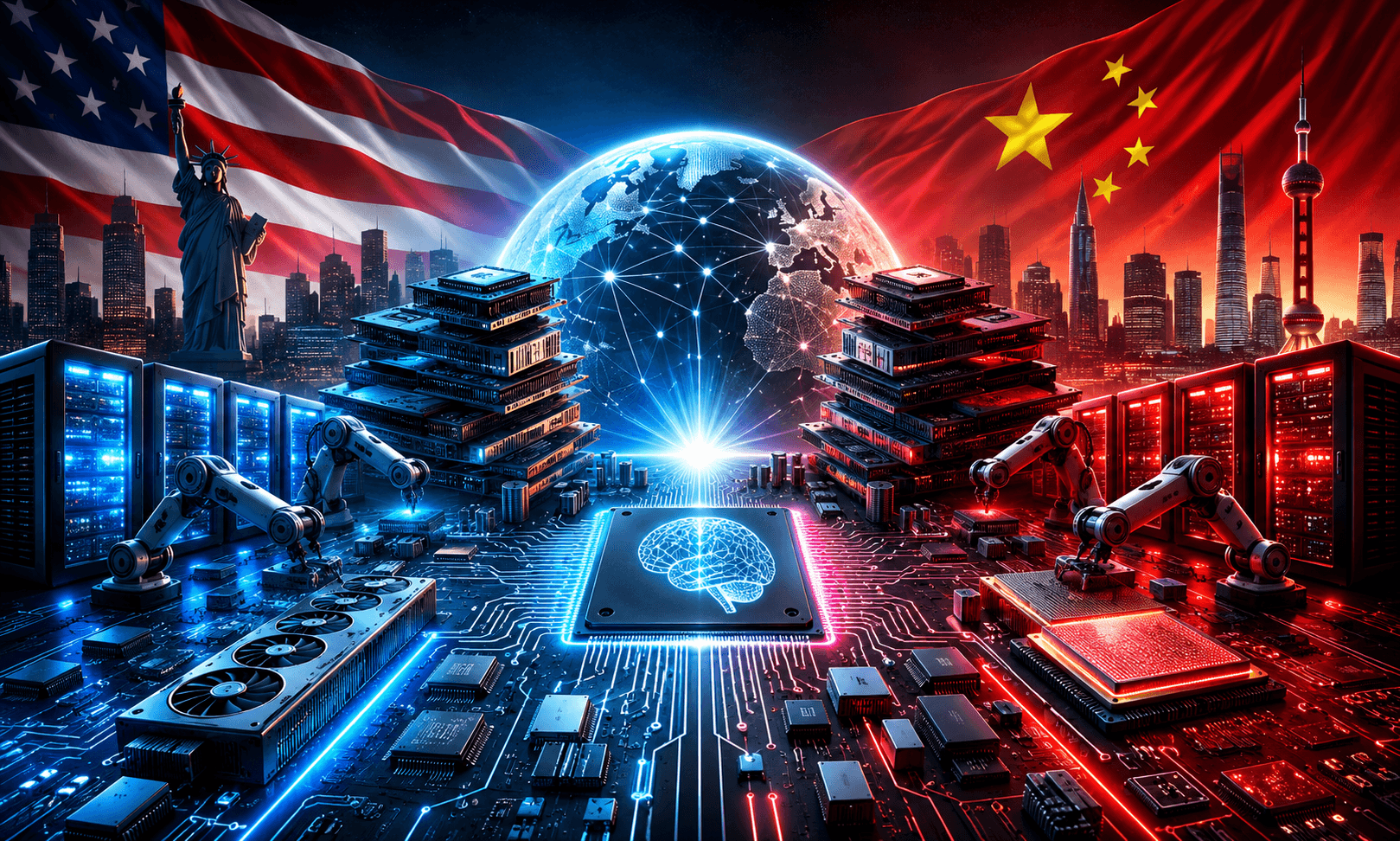
AI = National Power
AI now affects:
- Economic productivity
- Cyber warfare
- Autonomous weapons
- Intelligence operations
- Financial systems
- Scientific research
- Propaganda systems
- Space & military technologies
This is why Washington and Beijing increasingly treat AI as:
A national security asset.
The AI race is not simply:
- OpenAI vs DeepSeek
- Silicon Valley vs Shenzhen
It is fundamentally about:
Which country controls the critical layers of future civilization infrastructure.
The AI stack includes:
- Chips
- Compute
- Data
- Talent
- Energy
- Cloud infrastructure
- Software ecosystems
- Global standards
- Military integration
- Financial dominance
The United States and China each possess different structural advantages.
PART I — UNITED STATES STRATEGIC ADVANTAGES
1. Semiconductor Dominance = America’s Biggest Weapon
Why This Matters
AI without advanced chips is nearly impossible at frontier scale.
The US controls critical layers of:
- GPU architecture
- AI accelerators
- Chip software
- Semiconductor ecosystems
Key US-linked dominance:
- NVIDIA
- AMD
- CUDA software stack
- AI cloud ecosystems
America’s Biggest Leverage
“Compute Chokepoint”
Washington realized:
Controlling advanced chips means controlling AI speed globally.
Thus export controls targeted:
- H100 GPUs
- Blackwell systems
- Advanced lithography tools
- AI compute clusters
This created one of the strongest technological sanctions systems in modern history.
2. Alliance Network Advantage
US Global Coalition System
America has strategic alignment with:
- Japan
- Netherlands
- Taiwan
- South Korea
- EU partners
This matters because advanced semiconductor supply chains are globally distributed.
Example:
- ASML (Netherlands) → EUV lithography
- TSMC (Taiwan) → advanced fabrication
- US → chip design + software
- Japan → semiconductor materials
China struggles to replicate this alliance ecosystem.
3. Frontier Research Leadership
America Still Leads in Frontier Labs
Major frontier AI companies:
- OpenAI
- Anthropic
- Meta
US advantages:
- Top researchers
- Nobel-level science ecosystem
- Elite universities
- Venture capital culture
Why Talent Matters
The US attracts:
- Indian engineers
- Chinese researchers
- European scientists
- Global AI talent
America’s immigration ecosystem acts like:
A global talent vacuum cleaner.
4. Financial Power Advantage
Deep Capital Markets
US dominance includes:
- Venture capital
- Public markets
- Cloud financing
- Startup scaling
This allows:
- Massive AI investments
- Fast commercialization
- Rapid experimentation
AI infrastructure now requires:
Hundreds of billions of dollars.
The US financial system supports this scale better than any country.
5. Cloud Infrastructure Dominance
Major cloud giants:
- Microsoft
- Amazon
This gives the US:
- Massive compute concentration
- AI deployment power
- Enterprise AI integration advantage
6. Dollar Dominance = Hidden AI Weapon
Why the Dollar Matters
AI expansion requires:
- Energy
- Chips
- Data centers
- Global financing
The US dollar system enables:
- Cheap capital access
- Global investment flows
- Sanction leverage
This gives Washington indirect power over:
- AI infrastructure financing
- Semiconductor trade
- Technology investments
7. Military Integration Advantage
The US has stronger integration between:
- AI companies
- Defense sector
- Intelligence agencies
The Pentagon increasingly works with:
- Palantir
- OpenAI partnerships
- Defense AI startups
This accelerates:
- Battlefield AI
- Autonomous systems
- Intelligence analysis
- Drone warfare
PART II — CHINA STRATEGIC ADVANTAGES
1. Scale Advantage
China’s biggest advantage:
Scale.
China can deploy AI across:
- Smart cities
- Manufacturing
- Surveillance
- Logistics
- Public infrastructure
faster than most democracies.
2. Manufacturing Power
China = World Factory
AI hardware requires:
- Rare earths
- Batteries
- Electronics supply chains
- Industrial manufacturing
China dominates:
- Electronics assembly
- Industrial ecosystems
- Supply-chain integration
This creates:
AI industrialization leverage.
3. Data Advantage
Massive Population + Fewer Restrictions
China’s advantages:
- Huge user base
- Large digital ecosystems
- State-coordinated data aggregation
Data from:
- Payments
- Social apps
- E-commerce
- Surveillance networks
can accelerate AI deployment.
4. State Coordination Advantage
China Can Mobilize National Resources Faster
Beijing can:
- Direct capital rapidly
- Align companies strategically
- Subsidize infrastructure
- Coordinate industrial policy
This enables:
- Faster AI industrial rollout
- Large national projects
- Strategic long-term planning
5. “Good Enough AI” Strategy
China’s Critical Insight
China may not need to beat the US everywhere.
Instead:
It can dominate scalable, affordable AI.
This includes:
- Cheap AI models
- Industrial automation
- Developing world deployment
- State-backed ecosystems
6. Open-Source Leverage
Chinese firms increasingly emphasize:
- Open-source models
- Cost-efficient deployment
- Lower infrastructure barriers
This strategy may attract:
- Africa
- Southeast Asia
- Latin America
- Middle East markets
especially where Western AI services are expensive.
7. Rare Earth Dominance
Hidden Strategic Weapon
China dominates many critical mineral supply chains:
- Rare earth processing
- Battery materials
- Industrial metals
These are essential for:
- Electronics
- Data centers
- Military systems
- Semiconductor ecosystems
8. Domestic Market Protection
China’s protected domestic ecosystem helps:
- Local AI firms scale quickly
- National champions survive
- Foreign competition remain limited
This creates:
- Strong internal AI ecosystems
- Massive testing environments
PART III — STRATEGIC WEAKNESSES
US Weaknesses
1. Manufacturing Dependence
America still relies heavily on Asian manufacturing.
2. Energy Constraints
AI data centers consume enormous electricity.
Power shortages may become a future bottleneck.
3. Regulation & Legal Pressure
Democratic systems slow deployment through:
- Lawsuits
- Privacy debates
- Safety regulation
China Weaknesses
1. Advanced Chip Dependence
China still struggles at the highest-end semiconductor layer.
2. Talent Outflow
Many elite researchers prefer:
- US universities
- Western labs
3. Trust Deficit
Some countries fear:
- Surveillance exports
- State-linked AI systems
- Data security concerns
PART IV — THE MOST IMPORTANT LEVERAGE POINTS
America’s Strongest Leverage
| Strategic Lever | Why It Matters |
|---|---|
| NVIDIA dominance | AI compute control |
| Dollar system | Financial leverage |
| Alliance system | Supply-chain coordination |
| Frontier research | AGI leadership potential |
| Cloud ecosystems | Global AI deployment |
China’s Strongest Leverage
| Strategic Lever | Why It Matters |
|---|---|
| Manufacturing scale | Industrial AI dominance |
| Population/data scale | AI training & deployment |
| State coordination | Rapid infrastructure buildout |
| Cost-efficient AI | Global South expansion |
| Rare earth ecosystem | Hardware supply leverage |
THE BIGGEST STRATEGIC FEAR (BOTH SIDES)
US Fear
China achieves:
- Semiconductor self-reliance
- Competitive AI ecosystems
- Parallel global standards
breaking US technological dominance.
China Fear
The US permanently blocks:
- Advanced compute access
- Frontier chips
- Semiconductor scaling
keeping China technologically dependent.
Latest Updated From Trump’s Visit to China
A. US–China AI Guardrail Talks
On 14 May 2026, US and Chinese officials discussed AI guardrails and safety mechanisms amid fears about misuse of advanced AI systems.
This is important because:
- Competition continues
- But both sides fear uncontrolled escalation
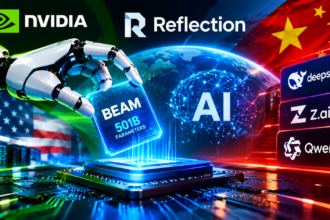
B. NVIDIA H200 Export Debate
The US reportedly approved conditional H200 sales to select Chinese firms, though implementation remains controversial and stalled.
This shows:
Washington wants containment — but also fears losing the Chinese market completely.
C. Jensen Huang Became Geopolitically Important
Jensen Huang is now one of the world’s most strategically influential tech CEOs.
His comments increasingly shape:
- AI policy debates
- Export control discussions
- US–China semiconductor politics
Recent remarks emphasized that the US should retain leadership in frontier AI hardware.
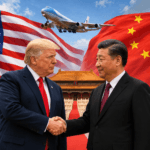
D. Trump–Xi AI Discussions
AI governance became a major topic during 2026 US–China diplomatic engagement.
Key themes:
- AI safety
- Chip exports
- Strategic stability
- Technology competition
E. China’s “Good Enough” Strategy
China increasingly focuses on:
Efficient AI rather than absolute frontier dominance.
Goal:
- Build scalable domestic systems
- Reduce dependence on US infrastructure
- Win deployment wars globally
FINAL STRATEGIC INSIGHT
The AI race is becoming:
A battle between two different civilization models.
US Model
- Open innovation
- Private-sector leadership
- Alliance-based ecosystems
- Frontier research dominance
China Model
- State-directed scaling
- Industrial integration
- Rapid deployment
- Infrastructure-led influence
The most likely future is not:
One global AI system.
Instead:
- American AI sphere
- Chinese AI sphere
may emerge simultaneously — with competing standards, platforms, chips, governance systems, and geopolitical influence across the world.