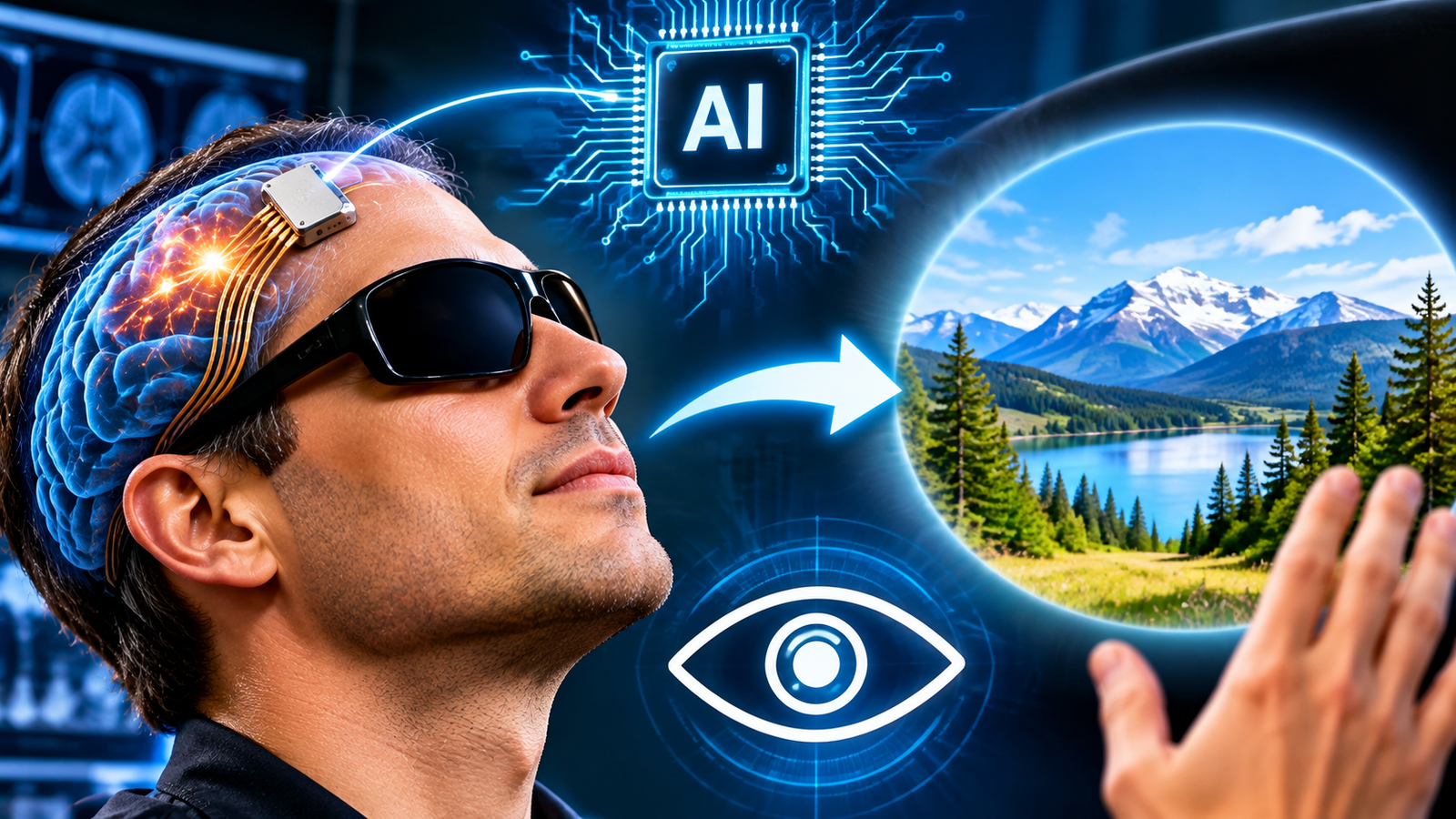
Artificial intelligence could help bring bionic vision closer to reality by making experimental brain implants more accurate and responsive to individual users. Researchers from the University of California, Santa Barbara (UCSB), ETH Zurich and Miguel Hernández University have demonstrated how deep learning can improve the way electrical signals stimulate the brain’s visual system.
The research, published in the journal Neuron, explores a major challenge in artificial vision: producing predictable visual experiences by directly stimulating the brain. It does not yet restore normal sight, but offers a potential pathway towards more effective visual prostheses.
How Does the AI-Powered Bionic Eye Work?
Unlike conventional visual prostheses that attempt to stimulate the retina, a visual cortical prosthesis bypasses the eyes and optic nerves. It sends electrical signals directly to the visual cortex, the brain region responsible for processing visual information.
The researchers tested their approach with a 27-year-old blind man who had lost his vision following a traumatic brain injury. In 2024, he received an experimental implant containing 96 electrodes positioned in his visual cortex at Hospital IMED Elche in Spain.
Electrical stimulation produced visual sensations known as phosphenes — flashes, spots and shapes of light that can resemble stars or fireworks.
However, producing consistent patterns is difficult because the brain does not respond identically to every electrical signal.
How AI Improved Brain Implant Precision
To address this problem, scientists trained a deep neural network to predict how the participant’s visual cortex would respond to different electrical stimulation patterns.
The AI system also considered the brain’s resting activity immediately before stimulation. This helped account for changes in neural activity that could influence the resulting visual experience.
Researchers then used the model to identify electrical stimulation patterns more likely to produce specific neural responses.
Testing showed that AI-designed patterns reproduced targeted brain activity more accurately than comparison approaches while requiring less electrical current. Researchers also found that actual neural activity recorded from the brain predicted the participant’s reported visual experiences better than stimulation settings alone.
Can AI Bionic Eyes Restore Sight to Blind People?
The findings could eventually benefit people whose eyes or optic nerves are damaged but whose visual cortex remains capable of responding to stimulation. Potential groups include individuals who have lost vision following traumatic brain injuries, strokes or certain neurodegenerative conditions.
However, the experiment involved one participant, and the visual experiences were still limited to flashes and shapes of light. Recognising objects, reading text and navigating independently remain much bigger challenges.
The next step is developing systems that continuously learn how an individual’s brain responds and adjust stimulation accordingly.
The research highlights a promising direction for neurotechnology: instead of treating the brain like a screen made of pixels, future bionic vision devices could use AI to adapt to the brain itself.
Reference : SD