
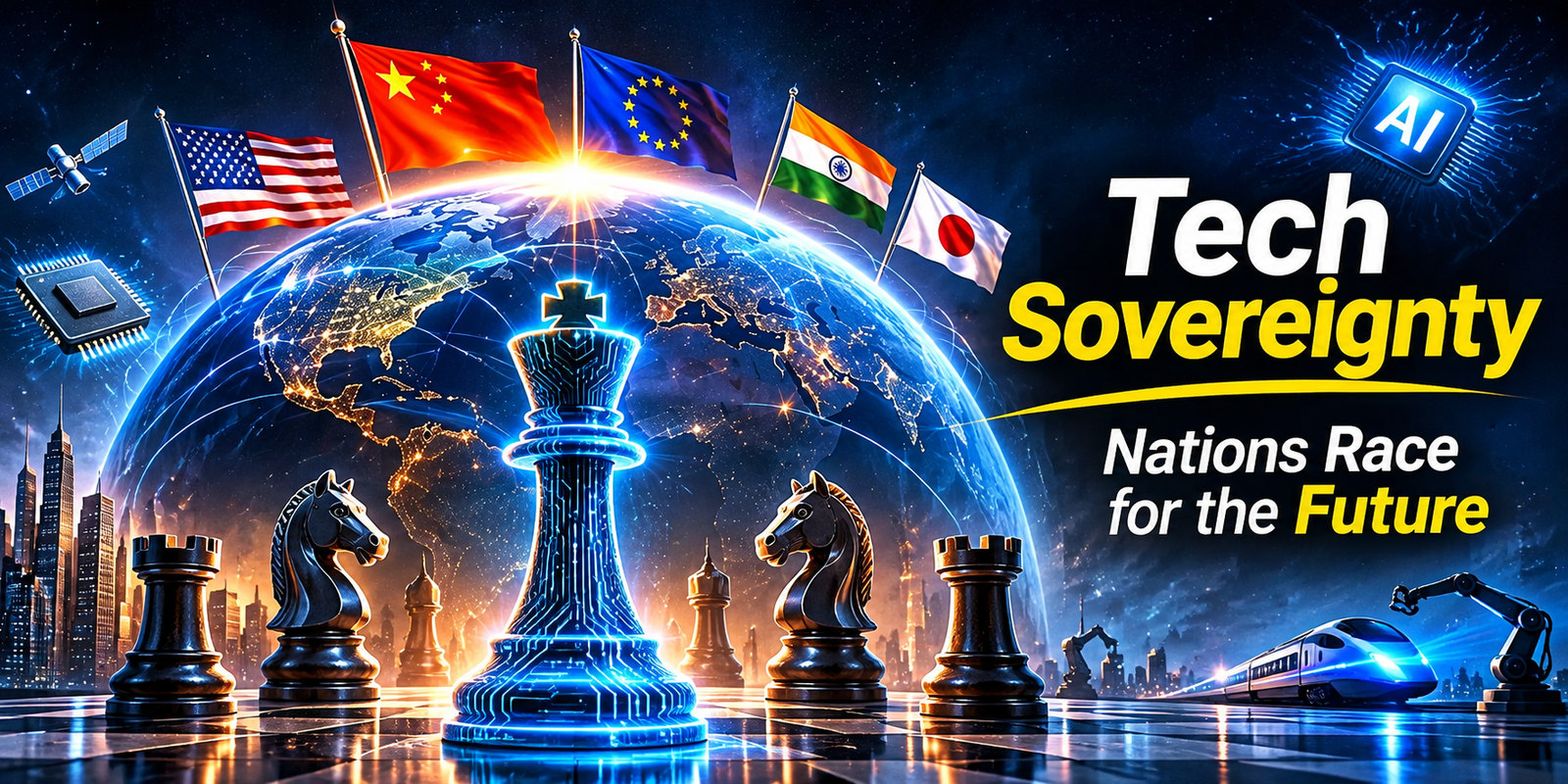
In an era defined by geopolitical tensions, supply chain vulnerabilities, and the transformative power of artificial intelligence, tech sovereignty has emerged as a strategic priority for governments worldwide. Tech sovereignty refers to a nation’s or region’s capacity to independently develop, control, regulate, and secure critical digital technologies including semiconductors, AI systems, cloud infrastructure, and data reducing reliance on foreign providers and mitigating risks from extraterritorial laws or disruptions. What began as concerns over cybersecurity and data privacy has evolved into comprehensive industrial policies, export controls, and investment drives aimed at building resilient domestic capabilities.
The European Union has taken one of the most ambitious recent steps. In June 2026, the European Commission launched the European Technological Sovereignty Package, explicitly aiming to ensure “nobody has a kill switch” over Europe’s technology. Key elements include the proposed Chips Act 2.0, targeting around €120 billion in investment by 2035 to strengthen semiconductor design, manufacturing, and AI-specific chips, while accelerating permitting processes. The Cloud and AI Development Act (CADA) introduces a four-tier sovereignty assurance framework for cloud services, requiring risk assessments and seeking to triple EU data centre capacity within five to seven years. Complementary measures include a €2 billion Open Source Strategy promoting “Free Software first” principles in public procurement and a push for AI factories and gigafactories to develop sovereign frontier models. These initiatives address Europe’s heavy dependence over 80% of key digital products and infrastructure are imported—while balancing innovation with regulatory control.
The United States has pursued tech sovereignty through a mix of industrial policy and strategic leverage. The 2022 CHIPS and Science Act allocated tens of billions of dollars in subsidies and tax incentives to onshore semiconductor manufacturing, with the goal of raising the U.S. share of leading-edge logic chip production significantly by 2030. Complementary efforts include export controls restricting advanced AI chips and technology transfers to adversaries, fast-tracked permitting for data centres, and the 2025 AI Action Plan promoting an American AI stack as a global standard while supporting exports to allies. Initiatives such as the Pax Silica Summit further expand partnerships on AI and semiconductor supply chains, framing U.S. technology as both a competitive advantage and a tool of influence.
China has long prioritised technological self-reliance as a core national strategy. Through successive phases of the state-backed “Big Fund” and related investments, Beijing has channelled massive resources into domestic semiconductor production, AI chips, and related ecosystems. Targets include high levels of self-sufficiency (such as 80% in certain semiconductor segments by 2030), development of indigenous alternatives to foreign equipment and high-end chips, and deep integration of AI across industry via “AI+” plans. Despite ongoing reliance on some foreign components and remote compute access exacerbated by U.S. export controls China continues to advance domestic capabilities in logic chips, packaging, and AI accelerators through companies like Huawei and others.
Other nations are also active. Japan is investing heavily in advanced semiconductor initiatives such as Rapidus and AI infrastructure. India, the UAE, Canada, France, and others are subsidising sovereign AI models trained on local data and languages, domestic compute capacity, and trusted cloud options. Gartner has projected that by 2028 a majority of governments will introduce some form of technological sovereignty requirements.
These efforts share common tools: subsidies and industrial policy to build capacity (“cost”), diversification and open-source strategies to enable exit from dependencies, and export controls or procurement rules to create leverage. Yet challenges remain. Full autonomy is costly and often impractical given global specialised supply chains; overemphasis on sovereignty can fragment markets, raise prices, and slow innovation. Europe faces the tension between strict control and access to cutting-edge U.S. or other technologies, while the U.S.-China rivalry risks a broader “splinternet” of competing standards and blocs.
Ultimately, tech sovereignty reflects a broader shift from pure globalisation toward managed interdependence. Governments are no longer content to rely solely on market forces for technologies that underpin economic competitiveness, national security, and societal resilience. Success will depend on pragmatic prioritisation securing critical layers of the tech stack while maintaining beneficial partnerships rather than absolute isolation. As AI and digital infrastructure continue to reshape power dynamics, these national and regional strategies will define the contours of the 21st-century technological order.