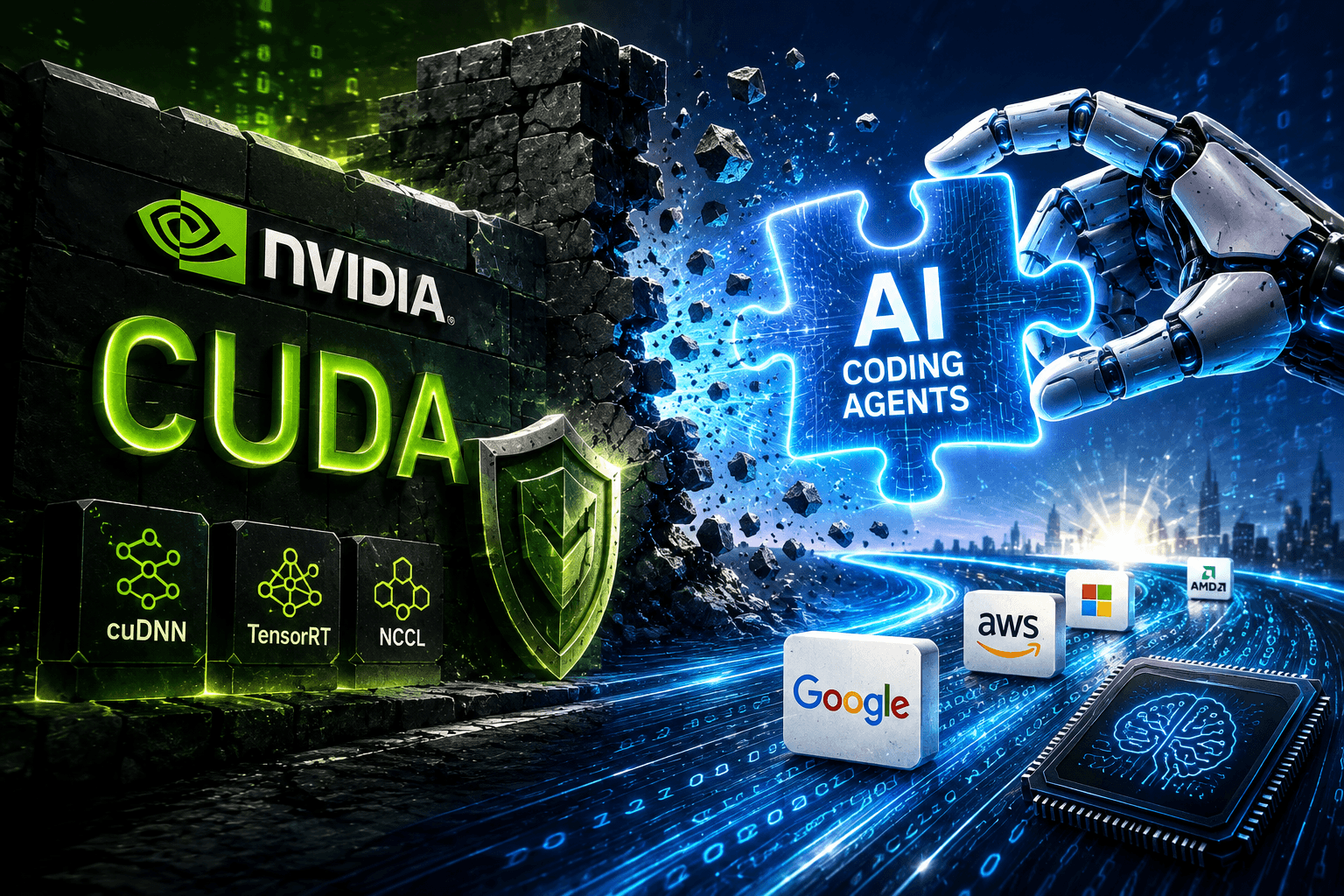
For nearly two decades, CUDA—Nvidia’s proprietary software platform—has been the company’s greatest competitive weapon. While Nvidia’s GPUs dominate headlines, it is CUDA that has locked millions of developers into the Nvidia ecosystem, making it difficult for rivals to compete even when they build capable AI chips.
Now, a new force is beginning to challenge that software advantage: AI coding agents.
As generative AI becomes capable of writing complex system software, industry experts believe Nvidia’s famous “CUDA moat” may no longer be as impossible to cross as it once seemed.
What Is the CUDA Moat?
CUDA (Compute Unified Device Architecture), introduced in 2006, allows developers to program Nvidia GPUs efficiently using a rich ecosystem of libraries, debugging tools, compilers, and optimization software.
Over the years it evolved into much more than a programming framework.
Today CUDA powers:
- Large Language Models (LLMs)
- AI training clusters
- Scientific computing
- Robotics
- Autonomous driving
- Supercomputers
- Digital twins
Because thousands of AI frameworks—including PyTorch, TensorFlow, RAPIDS, TensorRT, cuDNN, NCCL, and CUDA-X—depend on it, enterprises have invested millions of engineering hours building software specifically around Nvidia hardware.
This software lock-in has become Nvidia’s biggest competitive advantage.
AI Coding Agents Are Rewriting the Rules
The latest disruption comes from AI-powered coding agents.Instead of requiring years of expert engineering, these AI systems can automatically generate low-level software for AI accelerators.
According to AI startup Infinity, its coding agents (including the Ignition system) recreated CUDA-like software and full inference stacks for AI chipmaker D-Matrix (Corsair silicon). Tensor-parallel matrix multiplications ran across the hardware within about 10 hours of access; within days, models such as Qwen3, Qwen3.5, and Gemma4 were running end-to-end. Infinity has raised further funding and positioned itself as enabling high-performance inference on any chip.
DeepSeek founder Liang Wenfeng has argued (in leaked remarks from investor discussions) that AI coding agents, together with the company’s TileLang programming language, have dramatically reduced the complexity of developing AI system software. TileLang—a Pythonic domain-specific language built on TVM—enables high-performance kernels with multi-backend support (CUDA, Metal, ROCm paths, and more). DeepSeek has released TileKernels and continues active development (v0.1.13 in early August 2026), allowing reduced dependence on Nvidia’s full stack and easier porting to alternatives such as Huawei Ascend.
Meanwhile, Google, Microsoft, Amazon, OpenAI, Anthropic, and several chip startups are investing heavily in AI-generated infrastructure software. Cursor’s multi-agent systems have autonomously optimized hundreds of CUDA kernels for Blackwell GPUs, delivering large speedups. Ironically, Nvidia itself now uses AI coding agents internally to accelerate CUDA development, validation, and tools such as Nsight AI Copilot and ComputeEval benchmarks for LLM-written CUDA code.
AMD is responding aggressively. At its Advancing AI 2026 conference (July 2026), it launched ROCm.ai—an agent-native developer experience integrating ROCm CLI, AMD Skills (for tools like Claude, Cursor, and Codex), and optimizers. This aims for “agentic parity,” closing the fluency gap so that AI agents can onboard and optimize for AMD hardware as readily as for CUDA. Anthropic has committed significant capacity (reported up to 2 GW of Helios racks) to AMD platforms.
This shift benefits specialized AI chips from companies such as Google (TPU), Amazon (Trainium & Inferentia), AMD (Instinct), Groq, Cerebras, Rebellions, and numerous Chinese AI accelerator firms.
The Rise of the “Inference Era”
Another challenge comes from the industry’s rapid shift toward AI inference.
During the first AI boom, companies focused on training giant models, where Nvidia’s software ecosystem delivered unmatched performance.
Today, businesses increasingly care about running AI efficiently and cheaply.
Inference workloads prioritize:
- Lower cost
- Faster responses
- Energy efficiency
- Cross-platform compatibility
This shift benefits specialized AI chips from companies such as Google (TPU), Amazon (Trainium & Inferentia), AMD (Instinct), Groq, Cerebras, Rebellions, and numerous Chinese AI accelerator firms.
If software becomes portable across multiple chips, CUDA’s traditional lock-in weakens considerably.
Yet Nvidia Isn’t Standing Still
Many experts argue that reports of CUDA’s decline are premature.
Writing software is only the first step.
The harder challenge is:
- performance optimization,
- debugging,
- compiler engineering,
- hardware tuning,
- distributed computing,
- verification,
- production deployment.
These are precisely the areas where Nvidia has spent nearly twenty years building an unmatched ecosystem.
Former Nvidia engineer Bing Xu believes AI agents may actually strengthen CUDA because AI-generated code still requires sophisticated verification tools—an area where Nvidia remains the industry leader.
Similarly, Chris Lattner, creator of LLVM and CEO of Modular, argues that AI dramatically speeds up coding but not the complex optimization work required to maximize chip performance.
Pressure Mounts on Nvidia
The timing is significant.
Recent developments show competition intensifying:
- Alibaba unveiled Qwen3.8-Max, showcasing China’s rapidly advancing AI ecosystem.
- DeepSeek V4-Flash has emerged as one of the world’s most cost-efficient frontier AI models.
- Major hyperscalers including Amazon, Microsoft, and Google continue expanding proprietary AI chips to reduce dependence on Nvidia.
- AI coding agents from firms like Anthropic, OpenAI, and DeepSeek are becoming increasingly capable of generating infrastructure-level software.
Together, these trends suggest that software—not hardware alone—is becoming the next major battleground.
The Bottom Line
The CUDA Moat is not disappearing—but it is evolving.
AI coding agents are lowering barriers that once protected Nvidia’s ecosystem, while the industry’s move toward inference and specialized AI chips is encouraging greater software portability.
However, Nvidia still commands the world’s deepest AI software stack, strongest developer community, and decades of optimization expertise.
The next phase of the AI race may no longer be about building the fastest chip—it may be about building the most adaptable software ecosystem, where AI itself helps write the code that powers the future.