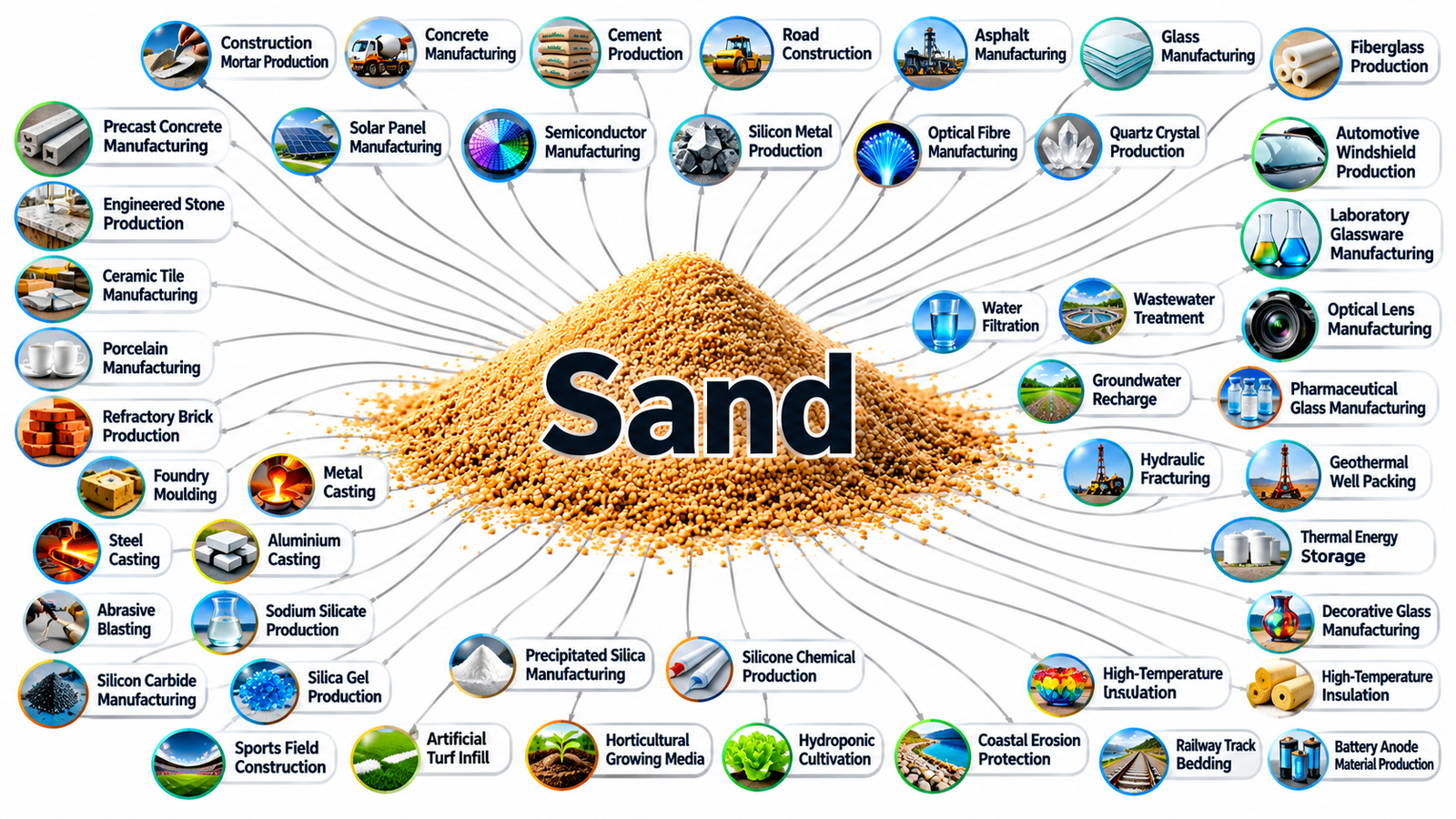
Sand is everywhere from the concrete beneath our feet to the glass in our smartphones, solar panels, highways, factories and modern cities. Yet one of the world’s most consumed natural resources is becoming an increasingly serious environmental concern.
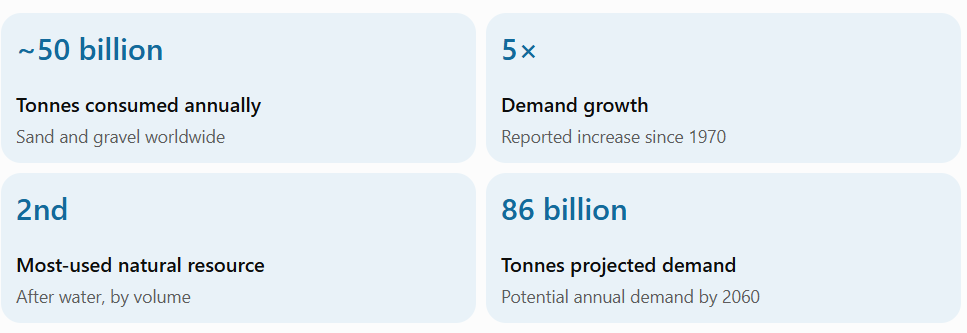
The world uses approximately 50 billion tonnes of sand and gravel every year. Extraction is putting growing pressure on rivers, coastlines, ecosystems and communities, while natural replenishment cannot keep pace with demand in many locations.
Often treated as an inexpensive and virtually limitless material, sand is now emerging as a strategic resource with implications for infrastructure, economic security, environmental protection and future industrial development.
Sand by the numbers
Why sand is indispensable to the global economy
Sand is not a single uniform commodity. Its grain size, shape, mineral composition, purity and chemical properties determine where it can be used. Some sand is suitable for construction, while specialized silica-rich material is required for advanced industrial applications.
1. Construction: the biggest driver of demand
Buildings, bridges, tunnels, airports, roads, ports and urban infrastructure require enormous quantities of aggregates. Sand and gravel are essential ingredients in concrete, cement-related products, mortar and asphalt.
The construction sector is the largest consumer of sand and silicate materials. An OECD analysis estimates that construction consumes around 30 billion tonnes of sand, gravel and rocks annually for buildings and infrastructure.
As urban populations grow and countries invest in housing, transport and infrastructure, demand for construction materials continues to put pressure on sand supply.
2. Glass and manufacturing
Silica sand is a major raw material in glass manufacturing. It is used to produce:
- Windows and architectural glass
- Glass bottles and containers
- Fiberglass and insulation
- Automotive windshields
- Laboratory and pharmaceutical glassware
- Optical glass and lenses
Glass is also important for buildings, vehicles, consumer products and industrial equipment, making sand an essential part of manufacturing supply chains.
3. Semiconductors, solar panels and advanced technology
High-purity silica and silicon-derived materials are critical to modern technology. Sand is an upstream source of silicon, which is further processed and purified into materials used in semiconductor manufacturing and solar photovoltaic cells.
Its importance extends to optical fibres, quartz components, electronics, silicon-based materials and other advanced applications.
This creates a surprising connection: the same broad natural resource that supports concrete buildings is also part of the supply chain behind digital infrastructure and clean-energy technologies. However, ordinary construction sand cannot simply be substituted for the specialized high-purity materials required in these industries.
The hidden environmental crisis of sand mining
Sand is naturally formed through weathering, erosion and the movement of sediment over long geological periods. Rivers transport sediment from mountains and inland landscapes toward deltas, floodplains and coastal ecosystems.
But extraction can remove sediment faster than natural processes replenish it, creating a growing imbalance.
Rivers are losing their sediment balance
Excessive riverbed mining can deepen channels, destabilize riverbanks, change water flow and increase erosion. It can also affect groundwater levels, damage nearby infrastructure and contribute to habitat degradation.
UNEP has warned that unsustainable extraction is linked to river pollution, flooding, shrinking aquifers and worsening drought risks in some regions. Dams can compound the problem by trapping sediment that would naturally replenish downstream environments.
Coastal ecosystems face growing pressure
Sand is also part of the natural defence system of beaches and coastlines. Coastal sediment helps maintain beaches, dunes and habitats that can buffer communities against waves, storms and erosion.
Removing too much sand from coastal and marine environments can accelerate erosion, damage habitats and weaken natural coastal protection. This is particularly concerning for island nations and densely populated coastal regions facing rising sea levels and increasingly severe storms.
Biodiversity and livelihoods are at risk
Sand habitats support organisms and ecosystems that are easy to overlook. River, coastal and marine sediment environments provide habitat for fish, turtles, birds, crabs and other organisms.
When extraction damages these environments, the consequences can extend beyond wildlife, affecting fishing communities, tourism, food security and local livelihoods. Sand is not just a material waiting to be mined; it also performs important ecological functions when it remains within natural systems.
Sand demand could rise further by 2060
The pressure is unlikely to disappear soon. Urbanization, population growth, infrastructure expansion, industrialization and renewable-energy development are creating new demand for sand and silicate materials.
An OECD projection cited in its resource analysis estimates that global demand could reach 86 billion tonnes annually by 2060, if growth continues along the projected trajectory. UNEP’s 2026 report also warns that demand for sand used in buildings could rise by up to 45% by 2060.
The concern is not simply that the planet contains less sand. Sand exists in many environments, but not all deposits are accessible, environmentally safe to extract or suitable for the same industrial purpose. A growing shortage of usable sand in the right location and quality can create economic pressure, increase costs and disrupt supply chains.
Why sand is becoming a strategic resource
Sand and silicates are increasingly connected to economic resilience and supply-chain security. High-purity quartz and silicon materials are particularly important for semiconductor and solar supply chains, where processing requirements are demanding and supply can be concentrated.
The OECD has highlighted trade dependencies involving silicon-based materials and high-purity quartz, illustrating that a seemingly ordinary raw material can become strategically important when it feeds critical technologies.
This could make sand an important resource consideration for governments planning infrastructure, industrial capacity, energy transitions and environmental security.
Can the world reduce its dependence on natural sand?
Completely eliminating sand consumption is unrealistic. The challenge is to use it more efficiently and reduce environmentally damaging extraction.
Several alternatives and solutions are gaining attention:
- Manufactured sand (M-sand): Produced by crushing suitable rock to create aggregates for construction, reducing reliance on certain natural sand deposits.
- Recycled construction materials: Recovering sand and aggregates from demolished concrete and construction waste.
- Ore-sand: Repurposing suitable sand-like materials generated during mineral processing to reduce waste and potentially supply construction materials.
- Better extraction regulations: Setting science-based limits, monitoring extraction sites and protecting sensitive rivers, coastlines and habitats.
- Circular construction: Designing buildings and infrastructure to use fewer virgin materials and improve recycling and reuse.
- Resource mapping: Identifying suitable deposits, tracking extraction and improving transparency in supply chains.
UNEP has advocated stronger resource governance, improved monitoring, recycling and alternative materials to address the sand sustainability challenge.
The bottom line
Sand may not have the glamour of gold, lithium or rare earth minerals, but it is one of the materials that quietly holds the global economy together.
It builds our cities, supports transportation, enables manufacturing, feeds technology supply chains and contributes to renewable-energy infrastructure. At the same time, natural sand ecosystems protect coastlines, sustain biodiversity, support water security and provide livelihoods.
The growing concern is that the world is treating sand as an unlimited resource when its availability, quality and natural replenishment are constrained.
The next resource crisis may not be about a rare mineral buried deep underground. It could be about a material lying beneath our feet, flowing through our rivers and disappearing from our ecosystems faster than nature can replace it.