
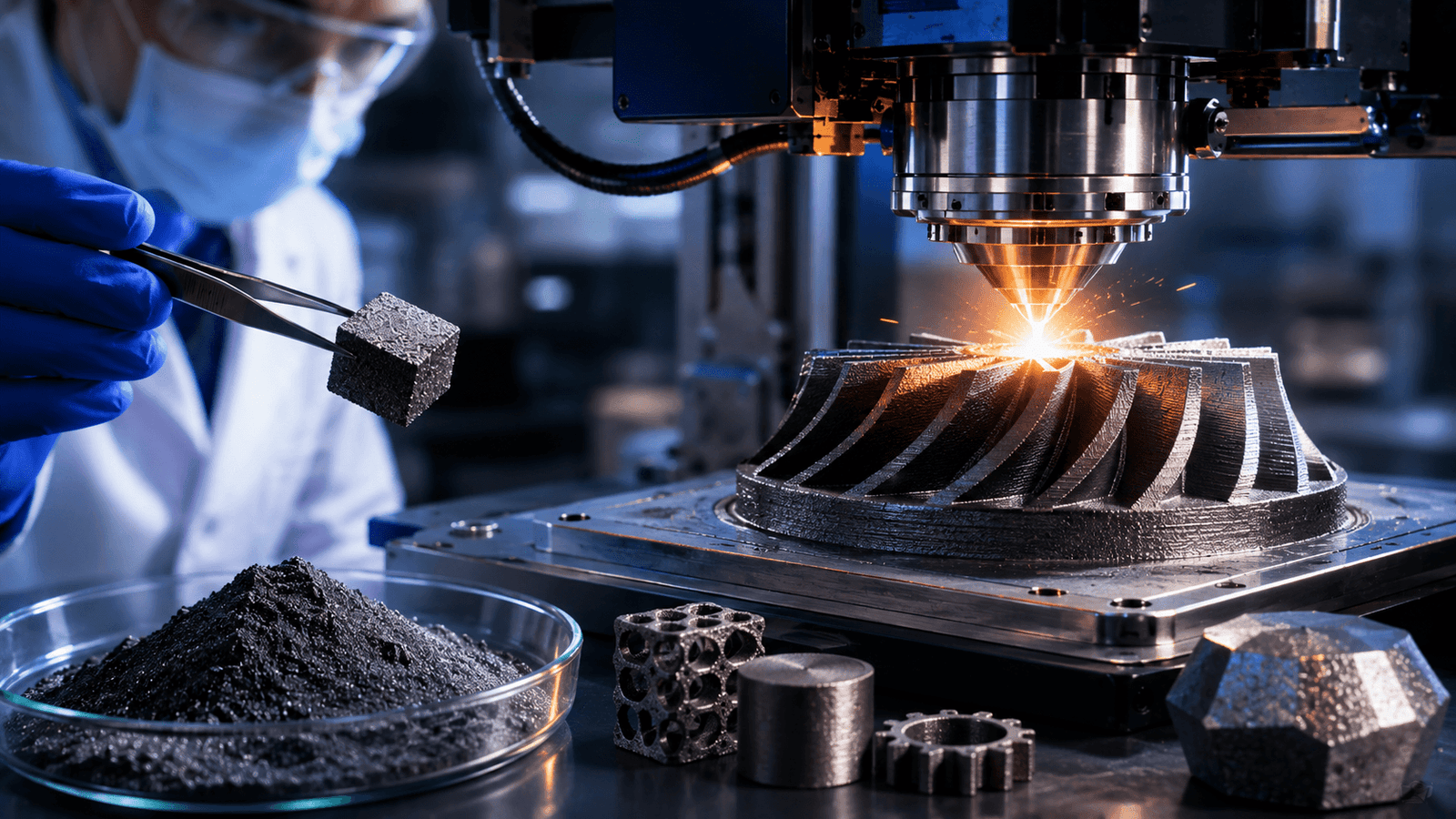
A team of researchers has developed an innovative 3D printing technique capable of manufacturing tungsten carbide-cobalt (WC-Co)—one of the toughest engineering materials used in modern industry—while using significantly less expensive raw material.
Instead of completely melting the metal during printing, the researchers used a controlled heating process that softens the material just enough for deposition, preserving its exceptional hardness and reducing manufacturing defects.
The breakthrough, led by Hiroshima University in collaboration with Mitsubishi Materials Hardmetal Corporation, could pave the way for cheaper, more sustainable production of cutting tools, industrial molds, mining equipment, and wear-resistant components.
The findings were published in the International Journal of Refractory Metals and Hard Materials.
What Is Tungsten Carbide?
Tungsten carbide (chemical formula WC) is an ultra-hard ceramic compound made by combining tungsten and carbon atoms.
For industrial applications, manufacturers usually mix tungsten carbide with cobalt, creating a composite known as tungsten carbide-cobalt (WC-Co) or cemented carbide.
In this combination:
- Tungsten carbide provides exceptional hardness and wear resistance.
- Cobalt acts as a metallic binder that holds the carbide particles together, improving toughness and durability.
The result is a material capable of surviving extreme pressure, friction, heat, and repeated mechanical stress.
Why Is Tungsten Carbide So Important?
Because of its remarkable mechanical properties, tungsten carbide is found in industries worldwide.
Common applications include:
- Industrial cutting tools
- CNC machining inserts
- Drill bits
- Mining equipment
- Tunnel boring machines
- Construction tools
- Metal molds
- Aerospace components
- Automotive manufacturing
- Precision engineering
Its ability to maintain sharp cutting edges under harsh conditions has made it indispensable for modern manufacturing.
The Biggest Problem: It Is Extremely Expensive
Despite its advantages, tungsten carbide presents a major manufacturing challenge.
Both tungsten and cobalt are expensive raw materials, and conventional production methods often generate significant waste.
Traditional manufacturing relies on powder metallurgy, where fine tungsten carbide and cobalt powders are:
- Mixed together.
- Compressed under high pressure.
- Heated in a sintering furnace to bond the particles.
Although this process produces exceptionally durable components, manufacturers frequently use more material than ends up in the finished product, increasing costs.
Reducing waste has therefore become a major goal for industry.
The New 3D Printing Breakthrough
Researchers explored whether additive manufacturing (3D printing) could offer a better solution.
Unlike conventional machining, which removes material by cutting, additive manufacturing builds an object layer by layer, placing material only where it is needed.
This minimizes waste while enabling more complex designs.
However, printing tungsten carbide has long been difficult because its extreme hardness and high melting temperature make it prone to cracking and structural damage during manufacturing.
A Different Way to Print Hard Metals
Instead of using conventional laser melting, the research team employed a technique called Hot-Wire Laser Irradiation, also known as laser hot-wire welding.
The process combines:
- a focused laser beam,
- a preheated filler rod,
- and carefully controlled temperatures.
Preheating the filler material reduces the laser energy required while increasing deposition efficiency.
More importantly, the researchers avoided fully melting the tungsten carbide.
Instead, they softened the material just enough to bond it to the growing structure.
This proved to be the key innovation.
Why Softening Works Better Than Melting
Completely melting tungsten carbide can alter its internal microstructure.
That often causes:
- grain growth,
- reduced hardness,
- internal defects,
- cracking,
- and decomposition of tungsten carbide particles.
By heating only enough to soften the cobalt binder while preserving the carbide particles, researchers maintained the material’s original mechanical properties.
According to lead researcher Dr. Keita Marumoto:
“By using additive manufacturing, cemented carbide can be deposited only where it is needed, thereby reducing material consumption.”
Hardness Comparable to Industrial-Grade Carbides
One of the study’s biggest achievements was preserving the material’s exceptional hardness.
The researchers successfully produced components with hardness exceeding 1400 HV (Vickers Hardness).
What Is Vickers Hardness?
Vickers Hardness (HV) measures how strongly a material resists indentation.
A hardness above 1400 HV places tungsten carbide among the toughest engineering materials used in industry.
For comparison:
| Material | Approximate Hardness (HV) |
|---|---|
| Mild steel | 150–250 |
| Stainless steel | 200–350 |
| Titanium alloy | 300–400 |
| Tool steel | 700–900 |
| Tungsten Carbide (WC-Co) | 1400+ |
| Sapphire | ~2200 |
| Diamond | 7000–10000 |
Although diamond remains significantly harder, tungsten carbide offers a unique combination of hardness, toughness, and manufacturability that makes it ideal for industrial applications.
Solving the Cracking Problem
During testing, researchers evaluated two different manufacturing approaches.
One method produced minor decomposition of tungsten carbide near the top of the printed structure.
The second method avoided most decomposition but initially failed to achieve the required hardness.
To overcome this challenge, the team introduced a nickel-alloy intermediate layer and precisely controlled the printing temperature.
This ensured:
- cobalt melted appropriately,
- carbide grains remained stable,
- grain growth was minimized,
- and the finished structure remained defect-free.
Why This Research Matters
The implications extend far beyond tungsten carbide.
The researchers believe the concept of forming metals by controlled softening rather than complete melting could transform additive manufacturing for many difficult-to-process materials.
Potential benefits include:
- Lower production costs
- Reduced raw material consumption
- Less industrial waste
- Improved manufacturing efficiency
- More complex tool geometries
- Faster production of customized industrial components
As industries increasingly seek sustainable manufacturing solutions, such approaches could significantly reduce both costs and environmental impact.
Future Applications
The research team plans to focus on:
- commercial cutting tools,
- industrial molds,
- wear-resistant machine parts,
- mining equipment,
- and additional ultra-hard materials.
Future work will also aim to:
- reduce cracking further,
- improve durability,
- print more complex geometries,
- and scale the technology for mass production.
If successful, manufacturers may eventually print carbide only where it is required, dramatically improving material efficiency.
Key Highlights
| Feature | New Development |
|---|---|
| Material | Tungsten Carbide-Cobalt (WC-Co) |
| Technology | Hot-Wire Laser Additive Manufacturing |
| Main Innovation | Softens instead of fully melting the material |
| Hardness Achieved | Above 1400 HV |
| Main Benefit | Lower waste and reduced raw material use |
| Industrial Uses | Cutting tools, drills, molds, mining and construction equipment |
| Research Institution | Hiroshima University |
| Industry Partner | Mitsubishi Materials Hardmetal Corporation |
| Journal | International Journal of Refractory Metals and Hard Materials |
Conclusion
The Hiroshima University team’s breakthrough demonstrates that even one of the world’s hardest engineering materials can be manufactured more efficiently through innovative 3D printing techniques. By replacing complete melting with carefully controlled softening, the researchers produced industrial-grade tungsten carbide components with hardness exceeding 1400 HV while reducing waste and preserving structural integrity.
Beyond improving tungsten carbide manufacturing, the study introduces a broader concept that could reshape additive manufacturing of other advanced materials. If the process proves scalable, industries ranging from aerospace and mining to automotive and precision engineering could benefit from stronger, more sustainable, and more cost-effective production of high-performance components.