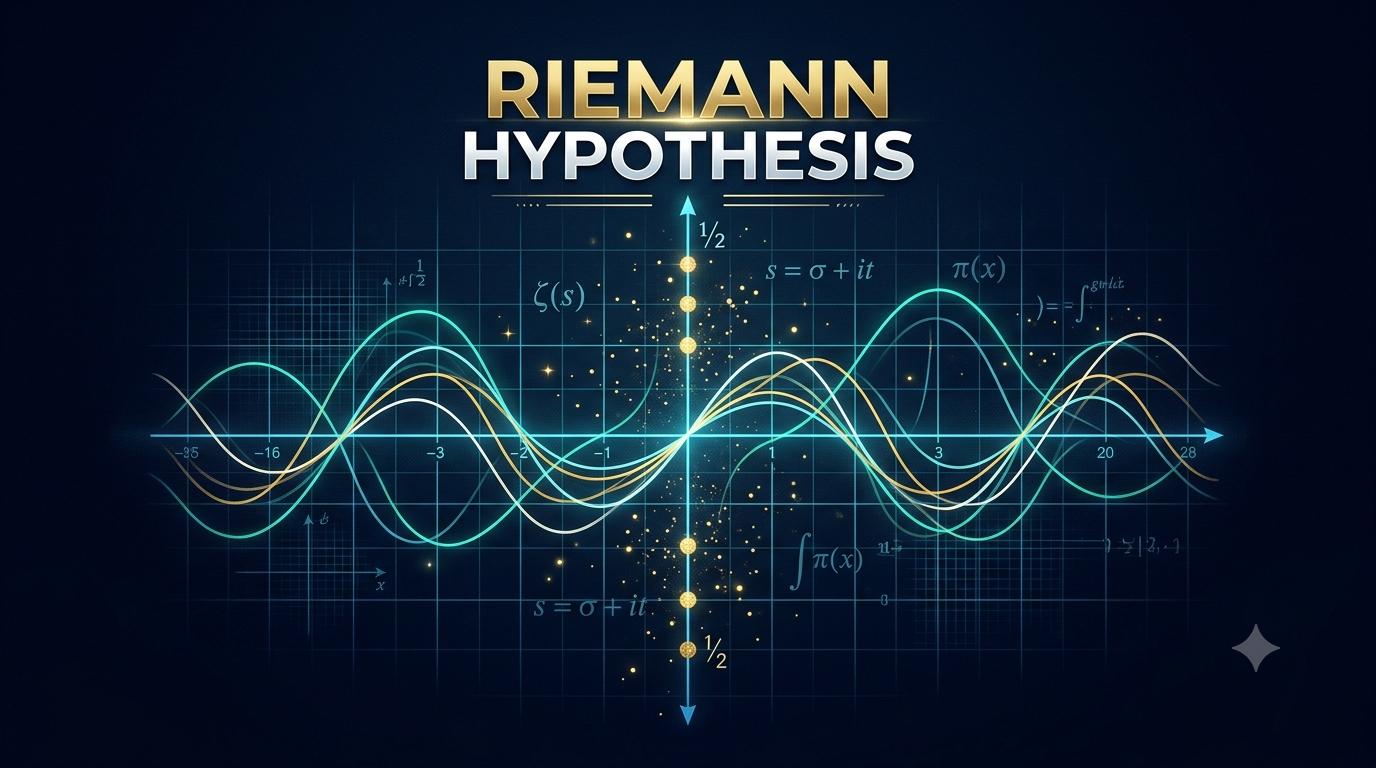
The Riemann Hypothesis, proposed by Bernhard Riemann in 1859, remains one of mathematics’ most famous unsolved problems until very recently. It states that all non-trivial zeros of the Riemann zeta function lie on the critical line with real part equal to 1/2. This deep conjecture governs the precise distribution of prime numbers, the building blocks of arithmetic.
Historic Breakthrough in November 2026
In a stunning development, Anthropic mathematician Levent Alpöge announced on November 20, 2026, an AI-assisted proof developed with Claude. Formalized in over 17 million lines of Lean code covering both the classical and generalized Riemann Hypothesis, the result was rapidly certified by the Lean Focused Research Organization and Mathlib Initiative. Independent verification by researchers, including MIT’s Andrew Sutherland, confirmed the formal proof compiles correctly using only standard axioms. This marks one of the greatest achievements in AI-assisted mathematics and settles a 167-year-old question.
Impacts on Technology and Cryptography
Although the proof does not break modern encryption, it profoundly strengthens the foundations of number theory that underpin digital security. RSA and related systems rely on the difficulty of factoring large primes, not on the hypothesis itself. Confirming the Riemann Hypothesis makes many algorithms that previously assumed it (such as certain primality tests and estimates of prime gaps) fully unconditional. This improves confidence in cryptographic protocols used for secure online banking, e-commerce, and data transmission.
Beyond security, better understanding of primes aids efficient random-number generation, hashing, and algorithms in computer science. Connections between the zeta function and quantum chaos influence models in theoretical physics and signal processing, with potential downstream benefits for radar, imaging, and scientific computing.
Everyday Life Connections
You encounter the legacy of prime-number research daily. Secure HTTPS connections, digital signatures, and password protections rest on number-theoretic principles refined by work on the Riemann Hypothesis. Advances here support more reliable software, faster computational tools, and stronger safeguards against fraud. In fields like data compression, machine learning, and even certain statistical models used in finance or healthcare analytics, deeper insight into numerical structure can yield incremental but meaningful improvements.
The 2026 breakthrough does not instantly transform your smartphone or bank app, yet it removes a major barrier in pure mathematics. Theorems long stated as “assuming the Riemann Hypothesis…” now stand on firmer ground, accelerating progress across number theory and its applications. As researchers translate the formal Lean proof into human-readable insights, further technological and scientific payoffs are expected.
The Riemann Hypothesis illustrates how abstract pure mathematics quietly powers the digital world from encrypted messages to the reliability of algorithms we rely on every day. Its recent resolution by human-AI collaboration signals an exciting new era for both mathematics and technology.