
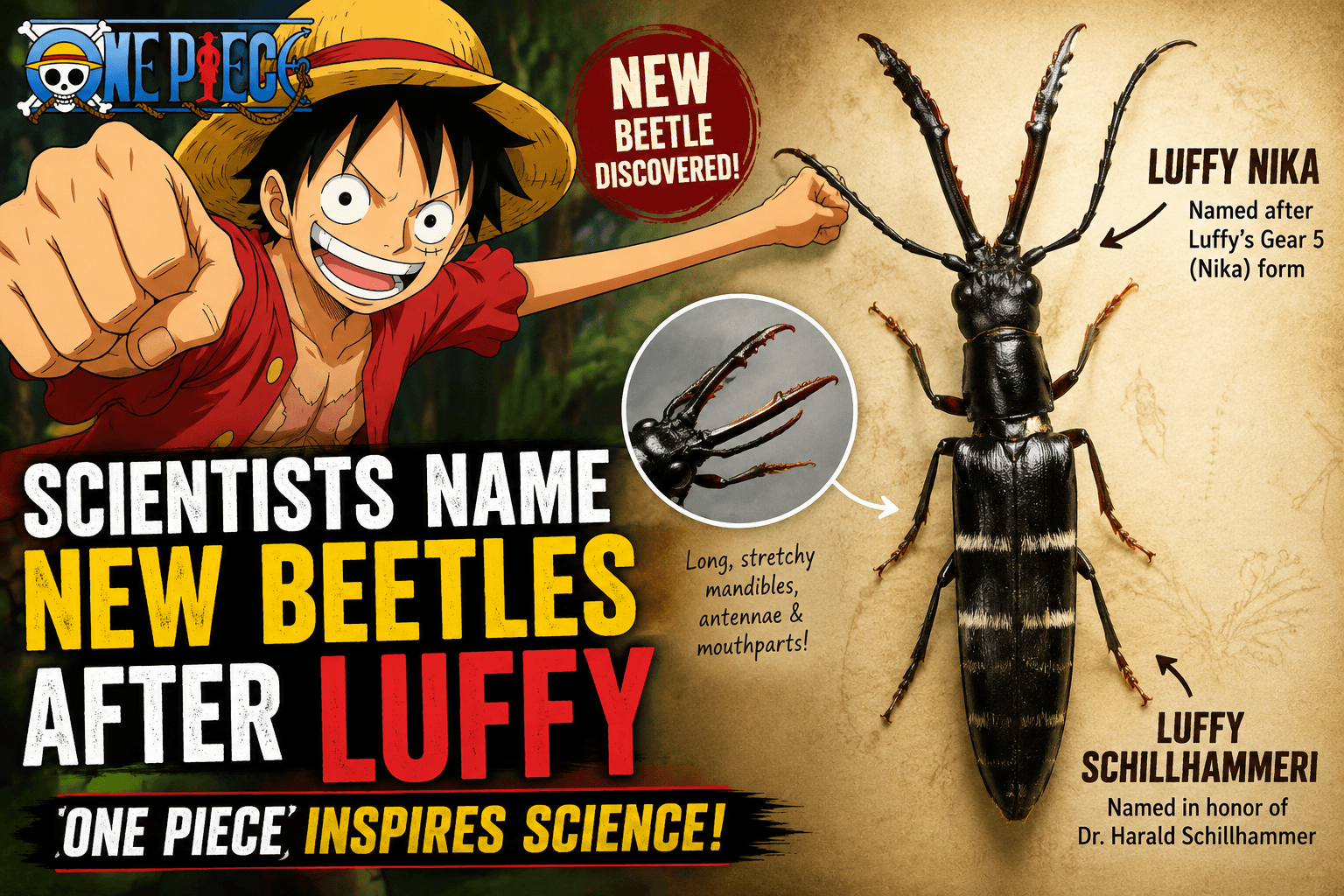
Anime has inspired millions of fans around the world, but now it has also inspired scientific taxonomy. Researchers have officially named a newly discovered beetle genus Luffy, after Monkey D. Luffy, the rubber-bodied protagonist of the globally popular anime and manga One Piece.
The discovery, published in the peer-reviewed journal ZooKeys, is more than a fun pop-culture reference. Scientists say the beetles’ unusually long and slender body parts reminded them of Luffy’s famous stretching abilities, making the name a fitting tribute.
Why Were the Beetles Named “Luffy”?
Unlike most beetles in their family, these insects possess exceptionally long mandibles, antennae, and mouthparts. Their elongated appearance closely resembles the way Luffy stretches his arms and body using the powers of the Gum-Gum (later revealed as the Human-Human Fruit, Model: Nika) in One Piece.
Rather than choosing the name simply because the researchers were anime fans, they selected Luffy because the beetles’ physical characteristics genuinely matched the character’s iconic abilities.
Two New Species Identified
Scientists have currently identified two species in the newly established genus:
- Luffy schillhammeri – discovered in the broadleaf forests of Yunnan Province, China. The species honors beetle researcher Dr. Harald Schillhammer for his contributions to entomology.
- Luffy nika – discovered in Louang Namtha, northern Laos. Its name references Gear 5 (Nika), Luffy’s latest and most powerful transformation introduced in the One Piece series.
Interestingly, Luffy nika has striking white bands of hair across its body, reminding researchers of Luffy’s white-haired, cloud-like appearance after awakening his Nika powers.
More Than an Anime Tribute
Beyond the catchy name, the discovery has important scientific value.
Researchers from the Natural History Museum of Denmark conducted a detailed study of rove beetles belonging to the Ocypus group. By comparing tiny anatomical features across numerous species, they concluded that the new Luffy genus occupies an unusual position in the beetle family tree.
Its characteristics bridge a gap between previously known evolutionary groups, making it a valuable clue for understanding how these insects evolved over millions of years.
In simple terms, the new genus acts like a missing puzzle piece that helps scientists better understand beetle evolution.
Pop Culture Meets Modern Science
Naming species after famous fictional characters has become increasingly common in recent years. Scientists have previously named organisms after Pokémon, Star Wars, Harry Potter, and Marvel characters to make biodiversity research more engaging for the public.
The Luffy beetles continue this trend by connecting scientific discovery with one of the world’s most recognizable anime franchises.
With One Piece enjoying renewed popularity through its ongoing manga, anime, Netflix adaptation, and the global success of the Egghead Arc, the new beetle names are likely to attract attention far beyond the scientific community.
Why It Matters
Scientists believe memorable names can spark curiosity among young people and encourage greater interest in biology, taxonomy, and wildlife conservation. While the discovery celebrates one of anime’s most beloved characters, it also highlights how much of Earth’s biodiversity remains unexplored.
Every newly discovered species improves our understanding of evolution and ecosystems—and sometimes, as in this case, reminds us that science and popular culture can come together in unexpectedly creative ways.
As Monkey D. Luffy continues his fictional quest to become the Pirate King, his name has now secured a permanent place in the scientific world, proving that inspiration can come from anywhere—even an anime adventure across the Grand Line.