
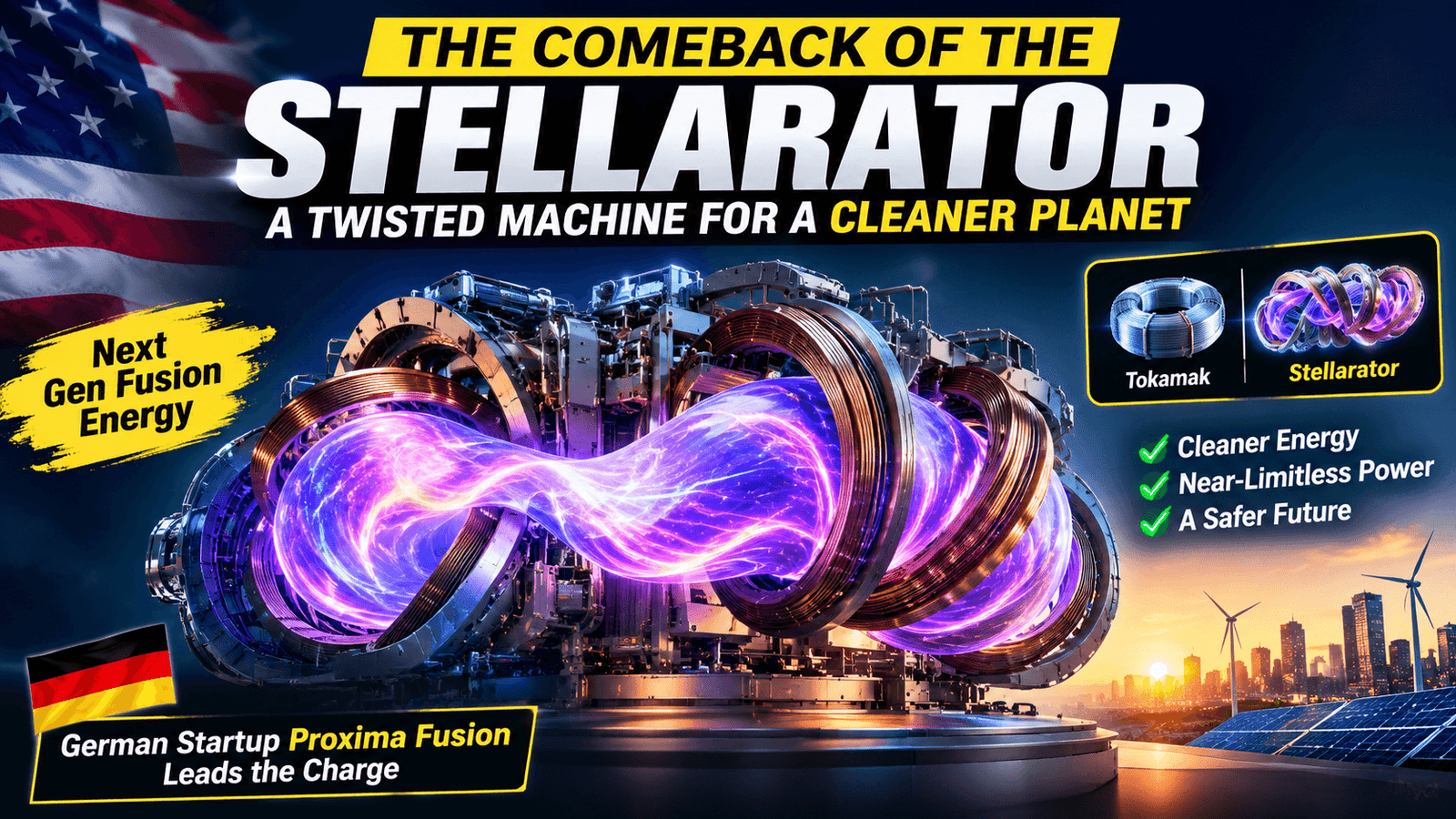
For decades, the tokamak dominated the global race to achieve nuclear fusion. Now, a far more complex machine—the stellarator—is attracting fresh investment and scientific attention.
At the centre of this revival is German startup Proxima Fusion, which is betting that its twisted magnetic fusion reactor could eventually deliver continuous, commercial clean energy. The timing is significant: in July 2026, Proxima raised €411 million, with investors including Google and German energy company RWE, to accelerate its fusion programme.
What is a stellarator?
A stellarator is a type of nuclear fusion reactor designed to recreate the process that powers the Sun.
The challenge is enormous. Hydrogen isotopes must be heated into a superheated plasma at temperatures of well over 100 million°C. At such temperatures, no physical container can hold the plasma. Instead, powerful magnetic fields keep it suspended inside a doughnut-shaped chamber.
This is where the stellarator differs from the better-known tokamak.
A tokamak uses external magnets plus an electric current flowing through the plasma. A stellarator, however, relies primarily on an extraordinarily complex arrangement of externally shaped magnetic coils that twist the magnetic field into the required configuration.
Stellarator vs Tokamak: What is the advantage?
The biggest attraction of the stellarator is its potential for steady-state operation.
Tokamaks traditionally depend on driving a large plasma current, creating operational and stability challenges. Stellarators are designed to generate their complex magnetic geometry externally, potentially allowing them to operate continuously for much longer periods.
The trade-off is engineering complexity. Earlier stellarators were difficult to design and manufacture with sufficient precision. That changed with advanced computational optimisation.
The breakthrough came through Germany’s Wendelstein 7-X (W7-X) experiment. Modern computer modelling helped scientists design magnetic fields capable of confining plasma far more effectively than earlier stellarator concepts. In a major 2026 development, researchers reported W7-X achieving plasma performance comparable with similarly sized tokamaks in a key fusion metric, strengthening the case for the optimised stellarator.
Why Proxima Fusion is betting on the stellarator
Proxima Fusion emerged from Germany’s Max Planck Institute for Plasma Physics ecosystem and wants to convert decades of W7-X research into a commercial power plant.
Its strategy combines optimised stellarator physics with high-temperature superconducting magnets, including REBCO-based technology. Stronger magnetic fields could allow a smaller reactor to confine hotter, denser plasma—critical ingredients for increasing fusion performance.
The company’s roadmap is ambitious. It aims to complete its Stellarator Model Coil in 2027, build the Alpha demonstration stellarator in the early 2030s, and eventually develop Stellaris, a commercial fusion power plant targeted for the late 2030s.
Why this matters now
In February 2026, Proxima, the Bavarian government, RWE and the Max Planck Institute for Plasma Physics signed an agreement outlining cooperation on Alpha and a possible Stellaris pilot plant in Bavaria.
Fusion remains one of science’s hardest engineering challenges, and no commercial stellarator has yet delivered electricity to the grid. But the stellarator is no longer a discarded alternative.
The big question now is whether better computing, superconducting magnets and record-setting plasma physics can finally turn this beautifully complicated machine into a practical power plant.