
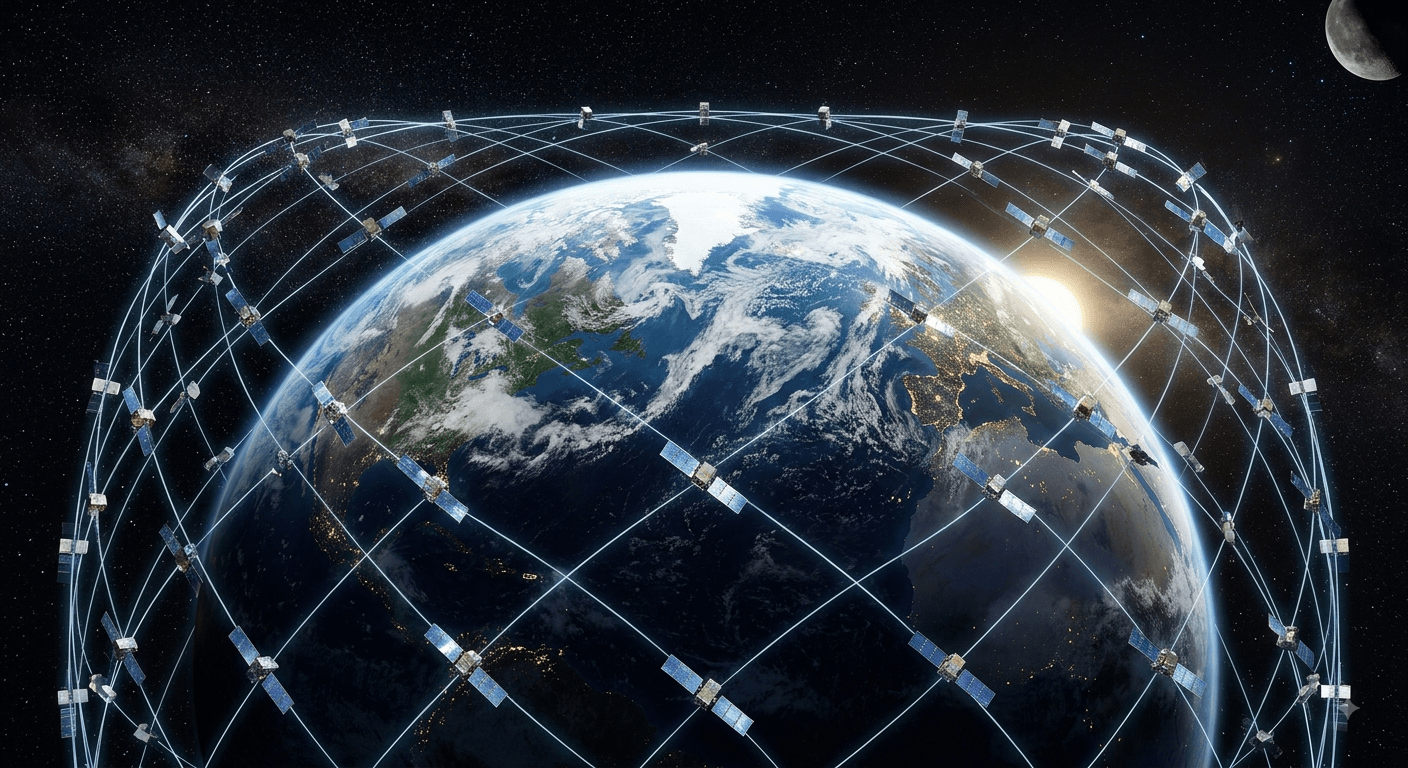
Russia is accelerating work on Rassvet, a low-Earth-orbit satellite network that could eventually give its military something it has lacked throughout much of the Ukraine war: resilient, high-speed communications beyond the reach of conventional battlefield jamming.
That makes Rassvet more than a civilian internet project. If deployed at scale, the network could become a critical layer connecting drones, reconnaissance systems, commanders and long-range strike platforms.
What is Rassvet?
Rassvet, meaning “Dawn,” is being developed by Russian aerospace company Bureau 1440 as a broadband satellite constellation. The company says its system is designed around satellites linked through laser communications, with a long-term goal of seamless global connectivity. Its published specifications envisage speeds of up to 1 Gbps and latency below 70 milliseconds.
The programme entered a new phase in March 2026, when Bureau 1440 announced the launch of its first 16 production satellites. Its official timeline also records a further successful satellite deployment in July.
Why could this matter for drone warfare?
Modern warfare increasingly depends on one invisible resource: connectivity.
A drone may have advanced sensors and artificial intelligence, but long-range operations still depend heavily on reliable links for transmitting video, receiving commands and sharing intelligence. Ground-based communications can be jammed, intercepted or destroyed.
A large satellite constellation changes that equation.
Ukraine has benefited enormously from satellite connectivity during the war, while concerns have grown over Russian forces gaining access to similar capabilities. Reuters reported on August 10 that Ukrainian military intelligence believes Russia is deploying Rassvet faster than expected, describing it as a domestic counterpart to Starlink.
Russia’s ambitious satellite targets
According to Major General Vadym Skibitskyi of Ukraine’s military intelligence, Moscow plans to expand the constellation to 292 satellites by 2027 and 924 by 2035. Those figures have not been independently verified, and Rassvet’s present coverage remains intermittent rather than comparable to a mature global constellation.
That distinction is crucial. Launching satellites is not the same as achieving persistent battlefield connectivity. A military-grade network requires sufficient satellite density, affordable terminals, secure ground infrastructure and dependable links between satellites.
From individual drones to networked warfare
The strategic significance could grow as Russia expands drone production and experiments with more coordinated unmanned operations.
Persistent satellite links could potentially allow forces to transmit targeting information across larger distances and maintain communications when terrestrial infrastructure is under attack or electronic warfare disrupts conventional signals.
In other words, the battlefield could become increasingly network-centric: sensors detect, satellites relay, algorithms process and drones respond.
This is also why Rassvet has attracted international attention. The European Union’s latest sanctions package targeted parts of Russia’s military technology ecosystem, including entities associated with the development of a Russian alternative to Starlink.
The bigger battle may be above the battlefield
Rassvet is still far from proving itself as a fully operational Starlink equivalent. Technical failures, manufacturing capacity and the enormous cost of deploying hundreds of satellites remain major challenges.
But the current affairs signal is clear: space infrastructure is becoming part of drone warfare itself.
The next phase of military competition may not simply be about building faster drones. It could be about controlling the communications network that tells those drones where to go, what to see and when to strike.
If Rassvet reaches anything close to its planned scale, Russia’s drone war could become far more connected—and the contest for military advantage may increasingly extend from the ground into orbit.