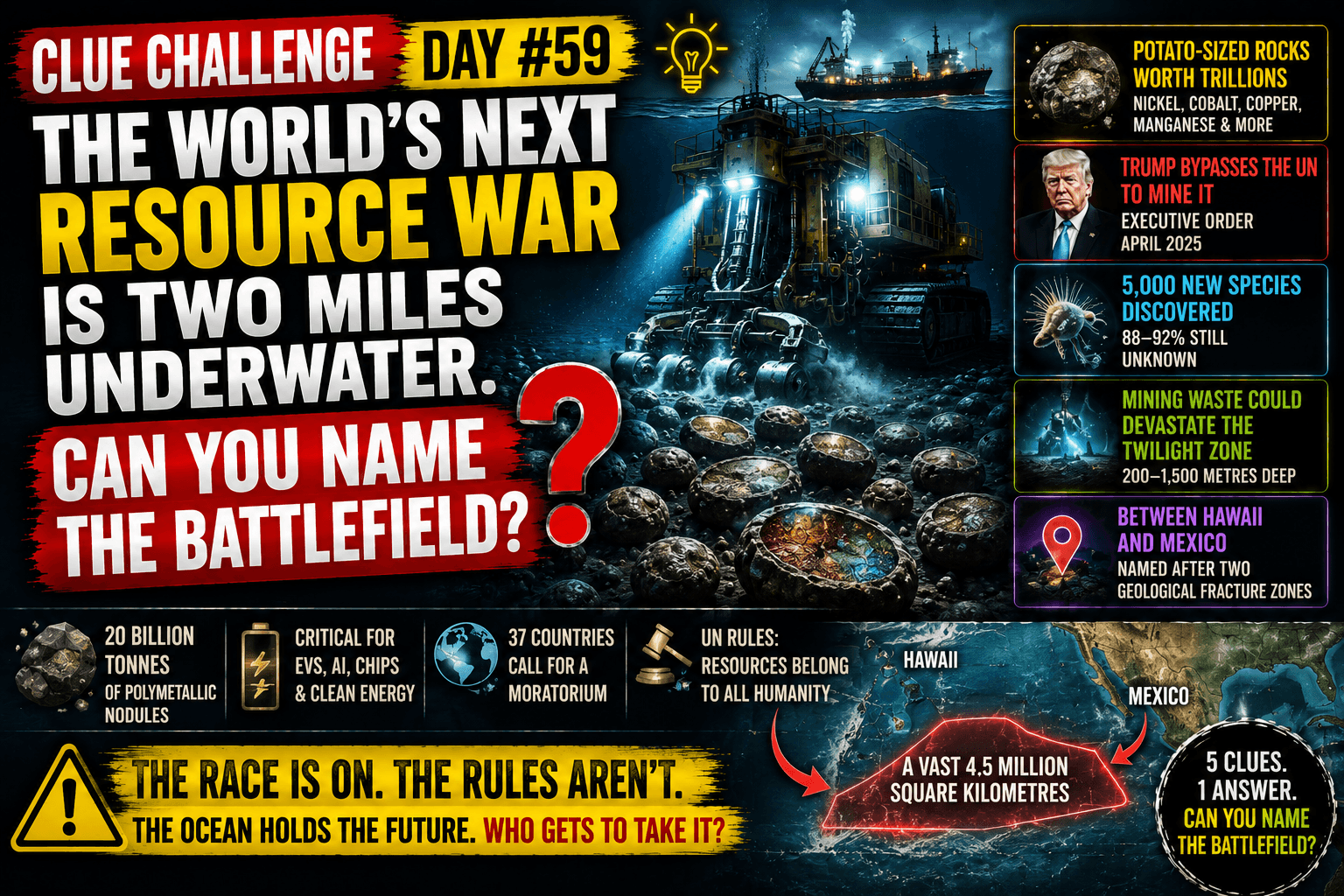
One zone. Five clues. 5,000 unknown species. Trump just bypassed the UN to mine it. All real.
Two miles beneath the Pacific Ocean, the seafloor is carpeted with potato-shaped rocks that took millions of years to form. Inside each one: nickel, cobalt, copper, and manganese — the exact minerals the world needs for electric vehicles, AI chips, and clean energy. It is one of the world’s largest offshore manganese nodule regions. And right now, the most explosive geopolitical resource battle of 2026 is being fought over who gets to take them. Can you name the zone before the final clue?
Clue #1 — The seafloor here is carpeted with potato-shaped rocks worth trillions — formed over millions of years
Two miles beneath the waves, the muddy seafloor is scattered with polymetallic nodules — black, potato-sized rocks that formed over millions of years as metals slowly accumulated around tiny fragments of shell or bone. Inside them are minerals prized for everything from electric vehicle batteries to high-tech weapons.
Polymetallic nodules containing nickel, copper, cobalt, and manganese cover up to 70% of the seafloor in certain parts of this zone. Researchers estimate there are more than 20 billion tonnes of nodules in the area — including around 270 million tonnes of nickel alone. For comparison, the entire world produced just 3.3 million tonnes of nickel in 2023.
Clue #2 — Trump signed an executive order in April 2025 bypassing the UN to mine it — and the world erupted
President Trump’s April 2025 executive order “unleashing America’s offshore critical minerals” ordered NOAA to expedite seabed mining permits in international waters — far outside US jurisdiction. A Canadian mining firm immediately submitted an application via its US subsidiary, calling it a “world first.”
The International Seabed Authority condemned the move, reminding countries that “unilateral exploitation of resources that belong to no single state but to all of humanity is prohibited.” If NOAA approves the applications, it would be the first commercial mining operation to bypass the ISA entirely.
As of 2025, 37 countries have joined a moratorium movement against seabed mining — with others requesting a precautionary pause instead.
Clue #3 — Scientists discovered 5,000 species here new to science — and 88–92% of all species remain unknown
In this zone alone, researchers have recently discovered over 5,000 species that were entirely new to science.
A 2023 study found that 88% to 92% of species in the region are new to science. Many organisms — including delicate glass sponges and giant single-celled creatures called xenophyophores — live directly on the nodules themselves. Remove the nodules, researchers say, and entire habitats disappear permanently.
A 1979 mining test left scars still visible on the seafloor when scientists returned decades later.
Clue #4 — Mining waste would devastate the twilight zone — 200 to 1,500 metres below the surface
A study published in Nature Communications in November 2025 found that waste discharged from deep-sea mining operations in this zone would disrupt marine life in the midwater “twilight zone.” Specifically, 53% of all zooplankton and 60% of micronekton would be impacted — ultimately affecting predators higher up the food web, including the fish and shrimp humans eat.
An October 2025 study found the habitats of 30 species of sharks, rays, and chimaeras overlap with proposed mining areas. Nearly two-thirds of these species are already threatened with extinction due to overfishing — seabed mining discharges would only further elevate their extinction risk.
Clue #5 — It sits between Hawaii and Mexico — and its name refers to two geological fracture lines
Mining companies have focused their tests on this massive stretch of seafloor between Hawaii and Mexico, where the seabed is practically paved with nodules.
Currently, about 1.5 million square kilometres of this zone are under licence for exploration — already hosting 17 deep-sea mining contractors whose combined exploration areas cover approximately 1 million square kilometres.
Its name combines two words — each referring to a distinct geological fracture zone that defines its boundaries. One fracture runs north of it. One runs south. Together they give this zone its full three-word name. That name is your answer.
So — what is this zone?
A 4.5 million square kilometre stretch of the Pacific Ocean, two miles deep, between Hawaii and Mexico. Carpeted with 20 billion tonnes of mineral-rich nodules. Home to 5,000 species new to science — and 88% more yet undiscovered. The target of Trump’s unilateral mining executive order in April 2025. Condemned by 37 nations and the ISA. Now the subject of NOAA permit applications that could permanently reshape international ocean law.
Bonus — can you name:
- The Canadian mining company applying to mine it via a US subsidiary
- The 1980 US law Trump used to bypass the ISA
- The UN body responsible for regulating international seabed mining
- The year the ISA failed to finalise mining regulations — missing its own deadline
Drop your answer below. Unlike Wordle, this one sits two miles beneath the ocean — and the race to reach it has already begun. Day #60 arrives tomorrow.
Missed yesterday’s challenge?
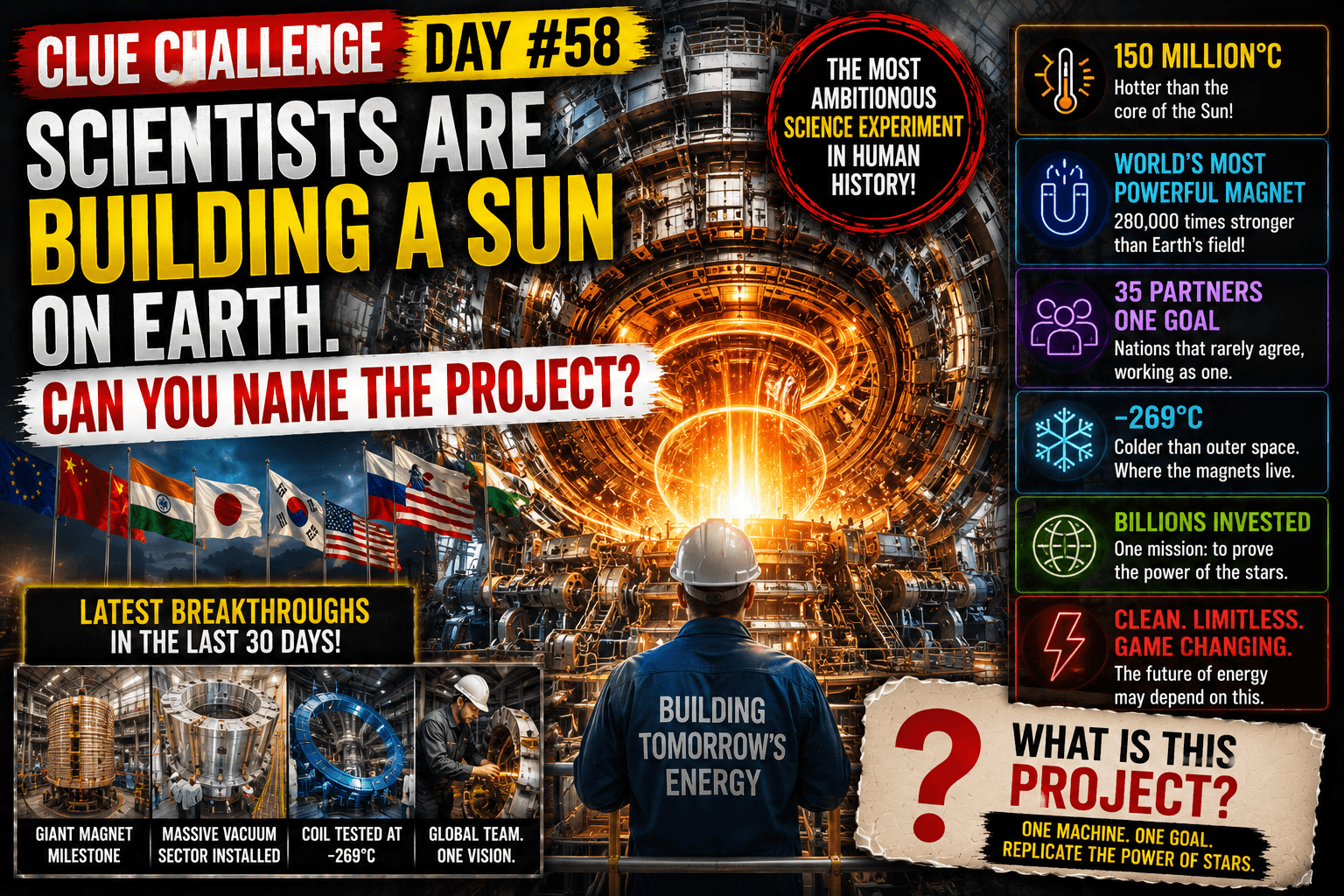
Answer to Yesterday’s Challenge: DAY #58
(Click above to reveal)