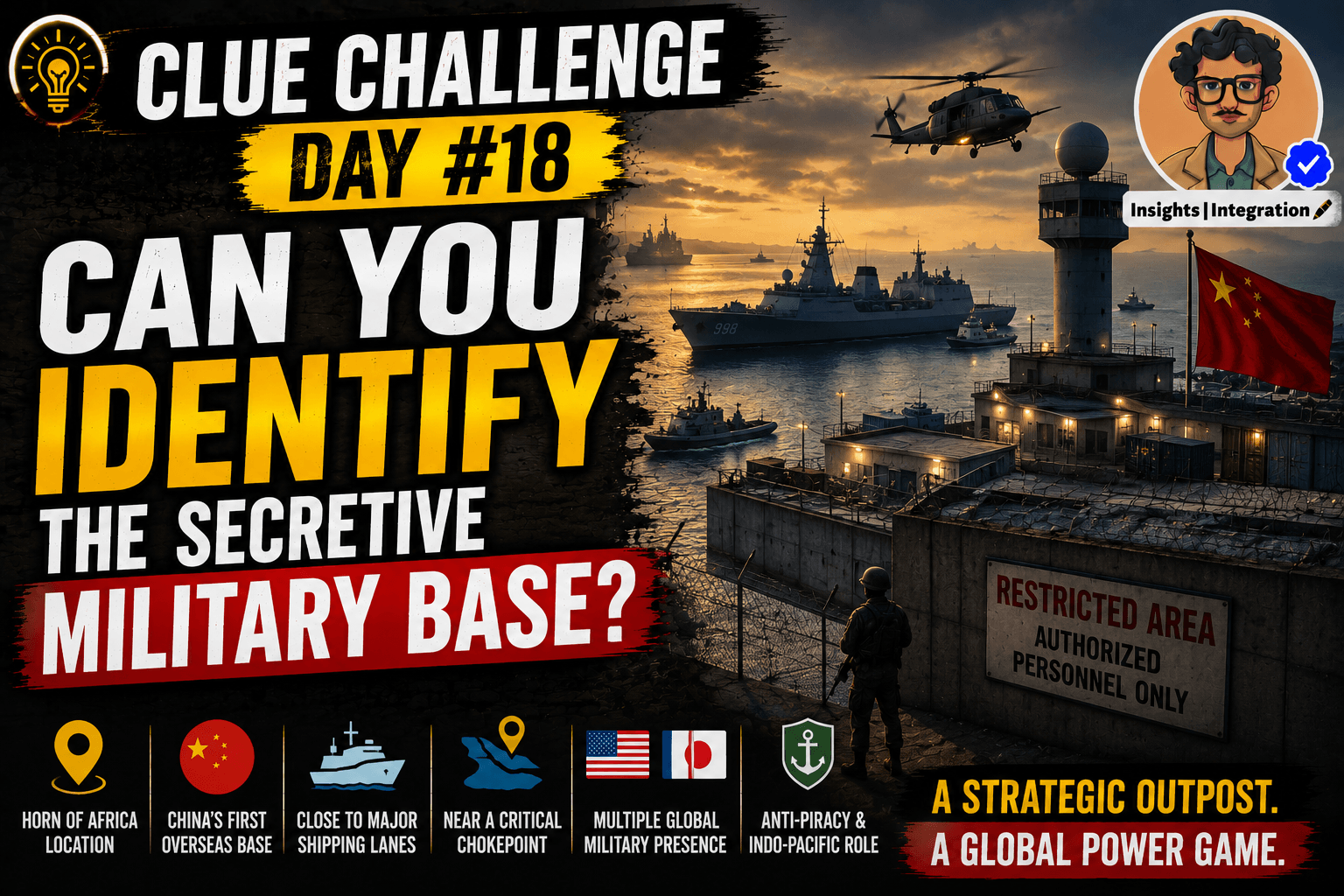
Can you identify the single military installation that has quietly become the epicenter of 21st-century great power rivalry?
The Clue Challenge
Not all wars are fought with bullets. Some are won through geography — by planting a flag at the right port, on the right coastline, at the right moment in history.
Somewhere on Earth, there is a military base so strategically positioned that it hosts rival superpowers within kilometres of each other. Where American, Chinese, French, Japanese, and Italian forces all operate simultaneously. Where a country of fewer than a million people earns its living by renting its soil to the world’s most powerful militaries.
This is not fiction. This is modern geopolitics.
Your challenge: identify this base location using only the clues below.
The Clues
1. A Geographic Chokepoint Unlike Any Other
This facility sits in the Horn of Africa — one of the most pressure-tested maritime zones on the planet. It overlooks the convergence of four bodies of water: the Red Sea, the Gulf of Aden, the Arabian Sea, and the Indian Ocean.
At the narrowest point of the nearby strait — just 30 kilometres wide — lies a passage the ancient Arabs called Bab el-Mandeb: the “Gate of Tears.”
The numbers tell the story of why this matters:
- Roughly 12% of global maritime trade passes through this corridor every single day
- Over 6.2 million barrels of oil transit this chokepoint daily (as of 2024)
- At least 90% of Europe–Asia internet traffic flows through fibre-optic cables laid along the same seafloor
- The corridor handles an estimated $1 trillion in trade annually
Any disruption here — piracy, conflict, blockade — sends shockwaves through energy prices, insurance markets, and supply chains from Rotterdam to Shanghai.
2. History Was Made Here
In 2017, this location entered the geopolitical record books when a rising Asian superpower opened its first-ever overseas military base here — a development analysts described as a decisive break from decades of non-interventionist military doctrine.
This was not just a logistical decision. It signalled a fundamental shift: from regional defence toward long-distance military power projection. Naval analysts at the time noted it gave this power the ability to resupply vessels, conduct sustained patrols, and monitor a strategic ocean corridor from its own sovereign facility — thousands of kilometres from home.
The base became fully operational between 2017 and 2019 and has since expanded its infrastructure, including berthing capacity for submarines and surface combatants.
3. The World’s Busiest Shipping Corridor
Thousands of vessels pass through the nearby waters each year, carrying:
- Crude oil and LNG bound for Europe and Asia
- Electronics and consumer goods from East Asian manufacturing hubs
- Strategic minerals increasingly critical to battery and defence supply chains
- Grain shipments feeding populations across the Middle East and Africa
The region’s importance surged sharply in late 2023 and through 2024–2025, when Houthi militant attacks in the Red Sea forced dozens of major shipping companies — including Maersk, MSC, and BP — to reroute vessels around the Cape of Good Hope, adding 10–14 days and thousands of dollars per voyage to shipping costs. The disruption briefly pushed global container freight rates to multi-year highs.
This base, positioned near the southern exit of that corridor, became even more critical for naval monitoring, escort operations, and rapid-response logistics during that period.
4. Five Flags, One Harbour
Here is what makes this location genuinely unprecedented: it hosts rival military powers within close proximity of each other — a concentration found almost nowhere else on Earth.
Forces operating in or near this location include:
- 🇺🇸 United States — Camp Lemonnier, operational since 2001, now the Pentagon’s primary African base with over 4,000 personnel and a drone operations hub
- 🇫🇷 France — maintains its largest overseas garrison here, dating back to the colonial era, with approximately 1,500 troops
- 🇨🇳 China — the first overseas PLA Navy support base, opened 2017, with capacity for warships and submarines
- 🇯🇵 Japan — established a base in 2011 under its anti-piracy mandate, the first overseas Japanese military post since World War II
- 🇮🇹 Italy — operates a naval support base as part of EU anti-piracy commitments
This makes the surrounding port one of the few places in the world where Chinese and American military facilities are separated by just a few kilometres — a live-action map of 21st-century strategic competition.
5. Anti-Piracy, Drones, and the Indo-Pacific
The base has served as a hub for counter-piracy operations since the 2008–2012 Somali piracy crisis, when Somali pirates attacked over 200 vessels and held hundreds of sailors hostage. At its peak in 2011, Somali piracy cost the global economy an estimated $7 billion annually in ransoms, rerouting costs, and naval deployments.
Today, the facility’s role has expanded into:
- Drone operations and ISR (Intelligence, Surveillance, Reconnaissance) across East Africa and the Arabian Peninsula
- Evacuation logistics — it served as a staging point during evacuations from Yemen (2015) and Sudan (2023)
- Indo-Pacific strategic planning — increasingly linked to deterrence frameworks extending from the Persian Gulf to the South China Sea
- Belt and Road monitoring — tracking Chinese port investments across East Africa and the wider Indian Ocean rim
6. A Tiny Nation, Enormous Leverage
The host country has a population of under 1 million people (estimated 1.1 million as of 2024) and almost no natural resources. Its GDP stands at roughly $4 billion — smaller than many mid-sized cities.
And yet, it earns hundreds of millions of dollars annually simply by leasing its territory to foreign militaries. Estimated annual military rental income exceeds $150 million, representing a significant share of government revenues. It is, in effect, a sovereign landlord to the world’s great powers.
Analysts describe it as one of the most remarkable cases of “geopolitical arbitrage” in modern history — a micro-state that has transformed its geography into a national business model.
Why This Matters Right Now
The Red Sea crisis of 2023–2025 transformed this base from an important asset into a genuinely critical one. With commercial shipping disrupted, NATO partners coordinating naval escorts under Operation Aspides (launched February 2024), and the US conducting strikes against Houthi targets in Yemen, this facility sat at the operational centre of a real-time military and economic emergency.
At the same time, China–US rivalry in the Indian Ocean has intensified. India, watching Chinese naval expansion with concern, has deepened its own ties with regional partners. The question of who controls — or influences — infrastructure around this chokepoint has become a central thread in Indo-Pacific strategy documents in Washington, Beijing, New Delhi, and Tokyo.
Geography, it turns out, has not been made obsolete by satellites and cyberspace. It has become more contested than ever.
Final Question
A Horn of Africa nation. A chokepoint called the Gate of Tears. The first overseas base of an Asian superpower. A harbour shared by five rival military powers.
What is this military installation — and which country hosts it?
Drop your answer before scrolling to the reveal.
Missed yesterday’s challenge?
Check it here → Clue Challenge Day #17: Can You Identify Nation in Crisis?
Answer to Yesterday’s Challenge: DAY #17
(Click above to reveal)
Stay Connected
Hit subscribe on the bell icon or join the WhatsApp channel to get daily clue challenges instantly.
Because the next clue(Clue Challenge Day 19) might just be the one you can solve faster than anyone else.