
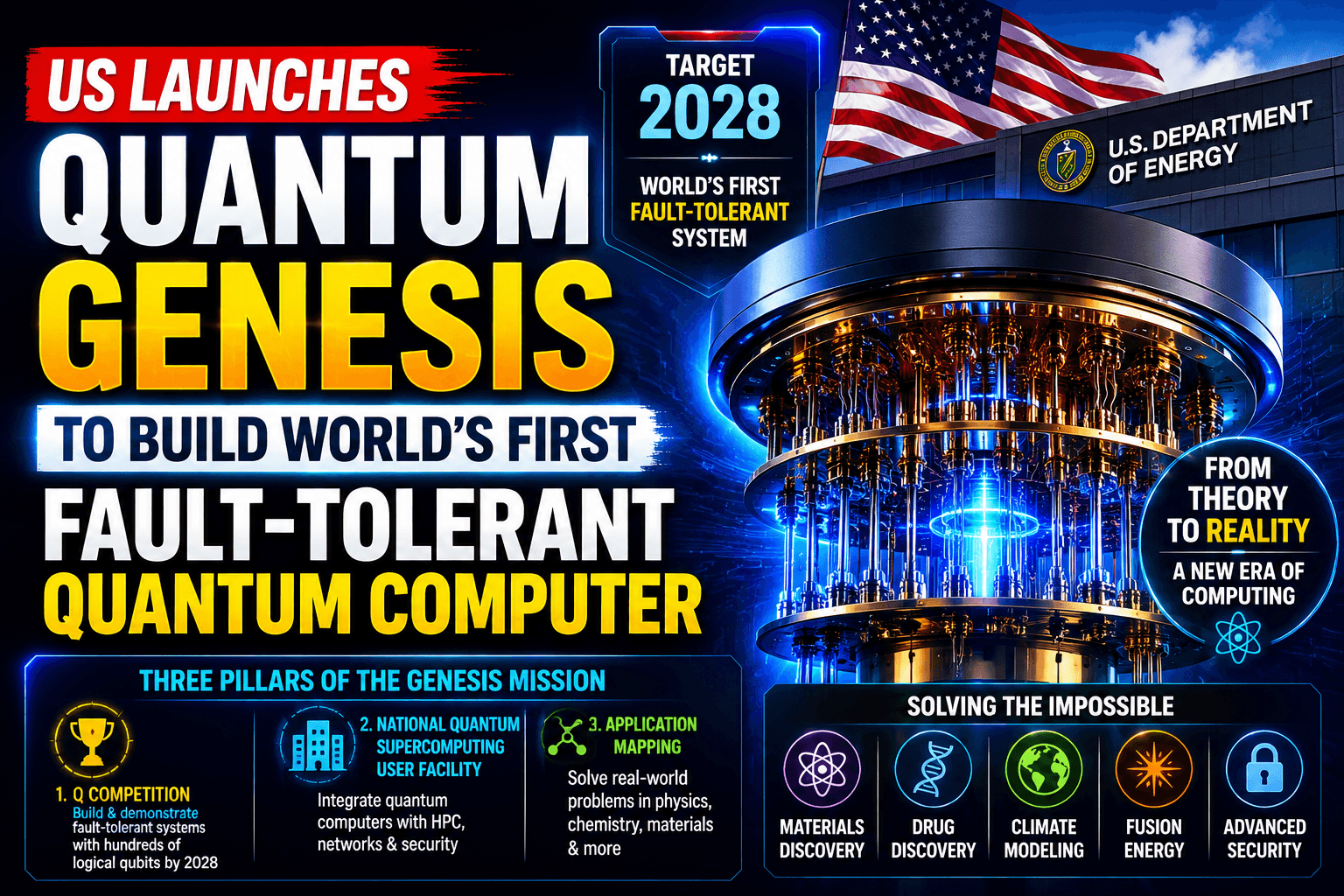
Goal: Build the world’s first fault-tolerant quantum computer by 2028.
What is Quantum Genesis?
- A new U.S. Department of Energy (DOE) initiative.
- Aims to move quantum computing from theoretical research to practical large-scale engineering.
- Forms the core of the broader Genesis Mission to expand national computing capabilities.
Main Objective
Develop a fault-tolerant quantum computer capable of solving problems impossible for today’s supercomputers.
Target Timeline
- Project launched: 2026
- Operational system deadline: 2028
Why is it Important?
The project aims to build quantum hardware that can:
- Solve scientific problems beyond classical supercomputers.
- Accelerate discoveries in physics, chemistry and materials science.
- Create a next-generation computing ecosystem combining:
- High Performance Computing (HPC)
- Artificial Intelligence (AI)
- Quantum Computing
What is a Fault-Tolerant Quantum Computer?
A quantum computer that can detect and correct errors while performing long and complex calculations.
Benefits
- Reliable computations
- Stable qubits
- Large-scale practical applications
- Essential for commercial quantum computing
Three Pillars of the Genesis Mission
1. Q Competition
Engineering teams must build systems with:
- Low-hundreds of logical qubits
- Fault-tolerant operation
- Working hardware by 2028
Applications include:
- Plasma Physics
- High-Energy Physics
- Materials Science
- Molecular Chemistry
2. National Quantum Supercomputing User Facility
A national facility integrating:
- Quantum computers
- Exascale supercomputers
- Energy Sciences Network (ESnet)
- Federal cybersecurity infrastructure
Goal:
- Create a unified HPC + AI + Quantum computing ecosystem.
3. Application Mapping
Scientists and industry partners will identify:
- Real-world scientific problems
- Benchmark applications
- Performance tests for quantum hardware
These use cases will help improve future quantum systems.
Collaboration Model
The project brings together:
- U.S. National Laboratories
- Universities
- Private technology companies
- Government agencies
Why Quantum Computing?
Quantum computers use qubits instead of classical bits.
Potential applications include:
- Drug discovery
- Climate modelling
- Nuclear fusion research
- Advanced materials
- Cryptography
- Artificial Intelligence
- Financial modelling
Summary
- The Quantum Genesis Mission aims to build the world’s first fault-tolerant quantum computer by 2028.
- It is led by the U.S. Department of Energy (DOE).
- The mission marks the transition from theoretical quantum research to practical engineering.
- It includes Q Competition, National Quantum Supercomputing User Facility, and Application Mapping.
- The project seeks to integrate HPC, AI, and quantum computing into a unified national research platform.
- A fault-tolerant quantum computer can detect and correct errors, enabling reliable large-scale quantum computations.