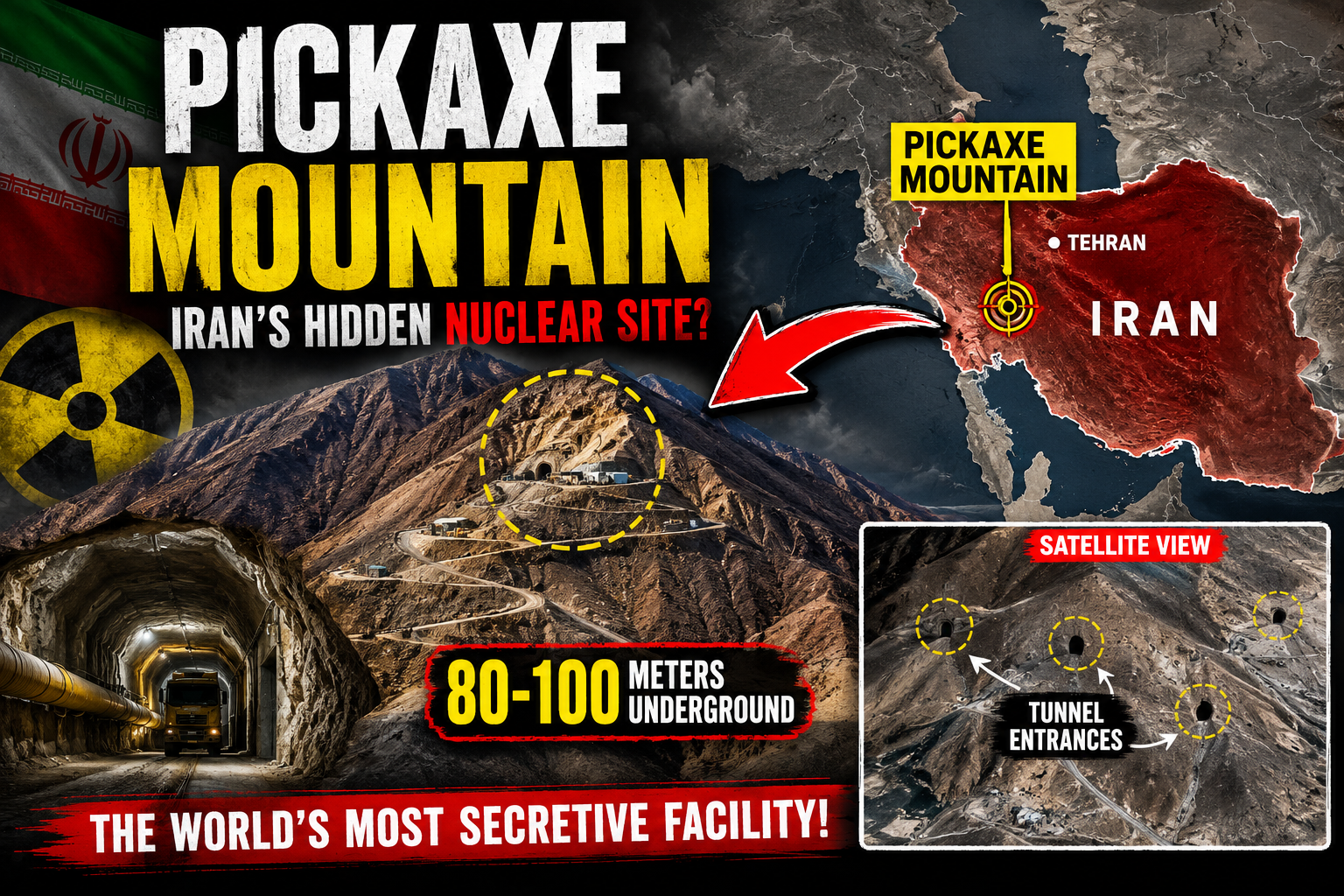
As tensions between Iran and the United States intensified again in July 2026, one remote mountain has suddenly become the center of global attention. Pickaxe Mountain, located near Iran’s Natanz nuclear complex, is believed to contain one of the country’s most secretive underground facilities. U.S. President Donald Trump recently warned that Washington was closely monitoring the site and suggested it could become a military target if the conflict escalates.
But what exactly is Pickaxe Mountain, and why are intelligence agencies around the world watching it so closely?
What is Pickaxe Mountain?
Pickaxe Mountain lies about 220 km south of Tehran and roughly 2 km from the Natanz Nuclear Complex, Iran’s primary uranium enrichment center.
Unlike Natanz, Pickaxe Mountain is not an officially declared nuclear facility. Instead, it is an underground tunnel complex carved deep inside a mountain that has become one of the most closely monitored construction projects in the world through commercial satellite imagery.
The nickname “Pickaxe Mountain” was coined by open-source intelligence (OSINT) researchers rather than by Iran itself.
Why Was It Built?
Construction reportedly began in 2020, shortly after a mysterious explosion—widely believed to be sabotage—destroyed Iran’s advanced centrifuge assembly hall at Natanz.
Soon afterward, Iran announced plans to build “a more modern, larger and more comprehensive facility in the heart of the mountain.” Former Atomic Energy Organization chief Ali Akbar Salehi confirmed that the new complex would replace damaged centrifuge manufacturing infrastructure.
Since then, satellite imagery has shown continuous excavation, road construction, reinforced tunnel entrances, and expanded security zones.
What Makes It Different?
According to the Institute for Science and International Security (ISIS), the underground facility includes:
- Two pairs of massive tunnel entrances
- Extensive security perimeters
- Reinforced portal structures
- Deep underground chambers estimated to be over 100 meters beneath solid rock
That makes it considerably deeper than many known Iranian nuclear facilities.
Security analysts believe the depth was deliberately chosen to protect sensitive infrastructure from future Israeli or American air strikes.
Is It Operational?
No public evidence suggests the facility is fully operational yet.
Satellite imagery analysed through July 2026 indicates that construction is still ongoing. Recent images even show partial backfilling around some eastern tunnel entrances—possibly to strengthen defenses after recent regional conflicts.
The International Atomic Energy Agency (IAEA) has limited visibility into activities inside the mountain.
Iran maintains that no nuclear activity is taking place at Pickaxe Mountain, while Western analysts remain skeptical.
Why Is Trump Talking About It?
Following renewed military tensions in the Gulf, President Donald Trump publicly stated that the United States was closely watching Pickaxe Mountain and warned that any future Iranian nuclear escalation would face a strong response.
Although the underground site was not struck during previous U.S.-Israel operations against Natanz, its strategic importance has made it one of the highest-priority surveillance targets.
Could It Support a Nuclear Weapons Program?
There is no public evidence that Iran is building a nuclear weapon inside Pickaxe Mountain.
However, Western experts believe the site could eventually house:
- Advanced centrifuge assembly
- Uranium enrichment infrastructure
- Nuclear research laboratories
- Secure storage for sensitive nuclear equipment
If operational, the facility could significantly improve Iran’s ability to preserve its nuclear program even after conventional military strikes.
Can the U.S. Destroy It?
This remains one of the biggest strategic questions.
Most experts believe Pickaxe Mountain’s depth places large sections of the complex beyond the guaranteed reach of existing bunker-buster bombs, including America’s most powerful penetrating munitions.
Analysts argue that disabling the site may require:
- Multiple precision strikes on tunnel portals
- Sabotage operations
- Ground forces
- Exploitation of structural vulnerabilities rather than simple aerial bombardment
Its hardened design reflects a broader Iranian strategy of moving critical nuclear infrastructure deep underground to improve survivability.
Why It Matters
Pickaxe Mountain is more than a construction project—it represents the next phase of the global nuclear competition. As Iran fortifies sensitive facilities beneath mountains, military planners face increasingly difficult decisions, while diplomats confront new challenges in verification and transparency.
Whether it ultimately becomes an operational nuclear facility or remains a strategic backup site, Pickaxe Mountain has already become one of the most significant—and mysterious—locations in the Middle East. With U.S.-Iran tensions rising again in 2026, this hidden mountain is likely to remain at the center of international security debates for years to come.