Capuchin monkeys are among the most intelligent primates on Earth. Known for their curiosity, problem-solving skills, and complex social behavior, these small New World monkeys have long fascinated scientists studying the evolution of intelligence. Now, a breakthrough project called CapuchinAI is using artificial intelligence to study these monkeys in the wild, opening a new chapter in animal cognition research.
Why Are Capuchin Monkeys Special?
Native to the forests of Central and South America, capuchins are famous for their remarkable intelligence. They are known to:
- Use stones to crack nuts.
- Select sticks to extract insects from tree bark.
- Learn by watching other monkeys.
- Recognize individual members of their group.
- Form complex social relationships and alliances.
Their cognitive abilities are often compared to those of great apes, making them one of the best animal models for understanding how intelligence evolved.
AI Meets Wildlife Research
Traditionally, studying animal intelligence has been difficult. Laboratory experiments provide controlled conditions but fail to capture natural behavior, while field observations lack experimental precision.
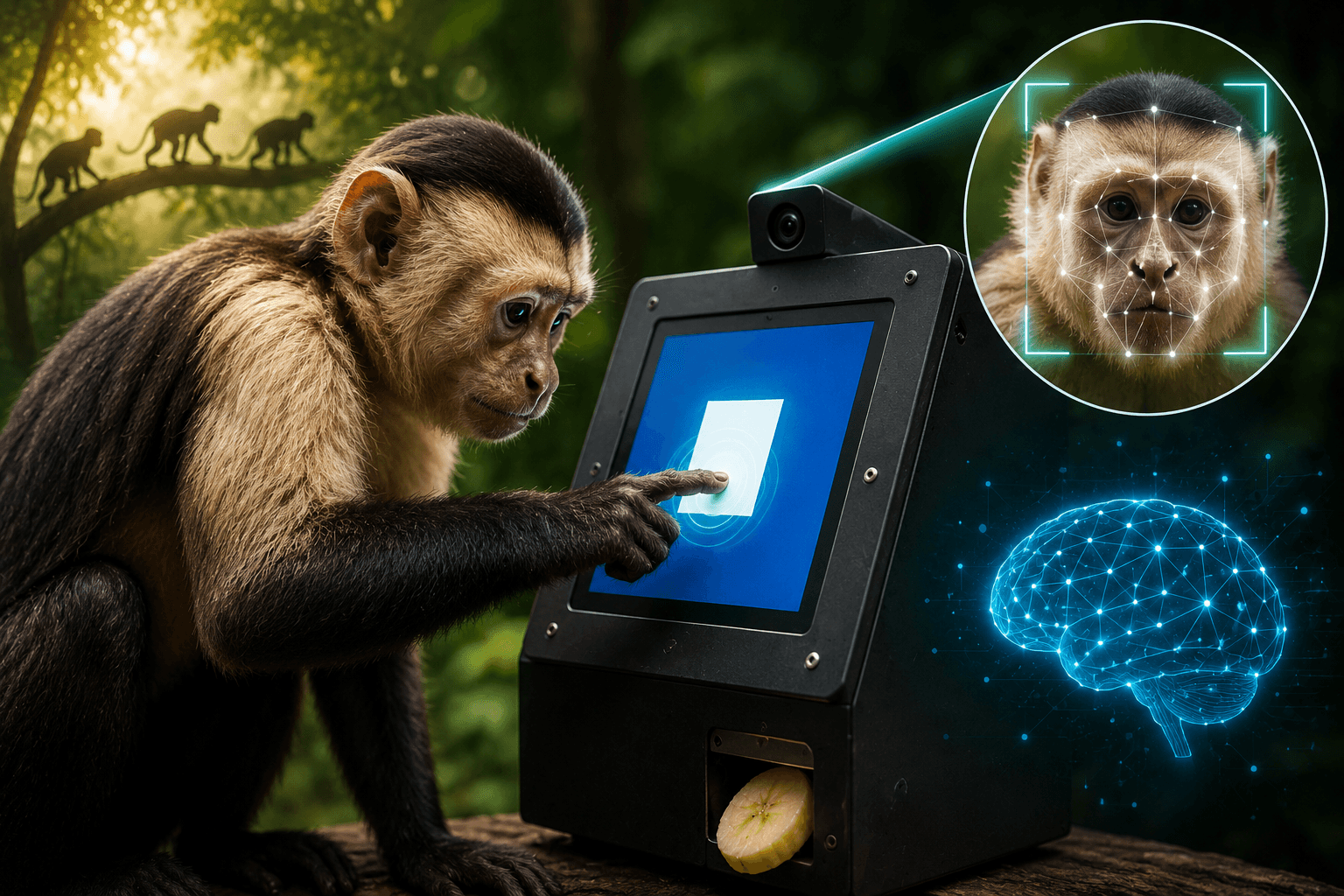
Researchers from Emory University and the Georgia Institute of Technology have now bridged this gap with CapuchinAI, an AI-powered system that combines facial recognition, touchscreen learning tasks, and automated food rewards.
The battery-powered platform identifies an approaching monkey, presents a personalized cognitive test on a touchscreen, and rewards correct answers with a small piece of dried banana.
Field trials in Costa Rica’s Taboga Forest Reserve showed that the AI system identified individual capuchins with 97% accuracy after training on photographs and videos.
How CapuchinAI Works
The system is surprisingly compact and affordable. Built around a Raspberry Pi mini-computer, it includes:
- AI facial-recognition software
- Webcam
- Touchscreen
- Automated food dispenser
- Rechargeable battery lasting about 8 hours
Using open-source AI software, researchers trained the model to recognize individual monkeys. When a known capuchin approaches, the system automatically displays the next task in its learning sequence. New visitors receive a simple training exercise to familiarize them with the touchscreen.
The platform even limits rewards so that dominant monkeys cannot monopolize the machine.
What Did Scientists Discover?
During the pilot study, 16 wild capuchins voluntarily interacted with the AI platform.
Researchers observed clear differences in learning styles:
- Some monkeys mastered the touchscreen almost immediately.
- Others carefully watched experienced monkeys before trying.
- A few even learned to touch the screen using their lips after discovering it triggered food rewards.
One male capuchin named Trompudo became the first monkey to solve the task, quickly realizing that each touch produced a banana reward.
These differences may help scientists understand how personality, experience, and environment shape intelligence.
Why This Research Matters
CapuchinAI represents the first scalable method for conducting controlled cognitive experiments on wild primates.
Instead of relying only on laboratory animals, scientists can now study intelligence where it naturally evolved—in forests filled with social interactions, predators, competition, and changing environments.
The researchers hope the technology can eventually be adapted for other wild primates, helping answer long-standing questions such as:
- Why are some individuals better problem-solvers?
- How do animals adapt to new challenges?
- How does intelligence improve survival and reproductive success?
Conclusion
Capuchin monkeys continue to prove why they are among the world’s smartest animals. By combining artificial intelligence with field biology, researchers have created an innovative way to explore the minds of wild primates without disrupting their natural lives. As AI transforms scientific research, projects like CapuchinAI could reshape our understanding of cognition, evolution, and even the origins of human intelligence.