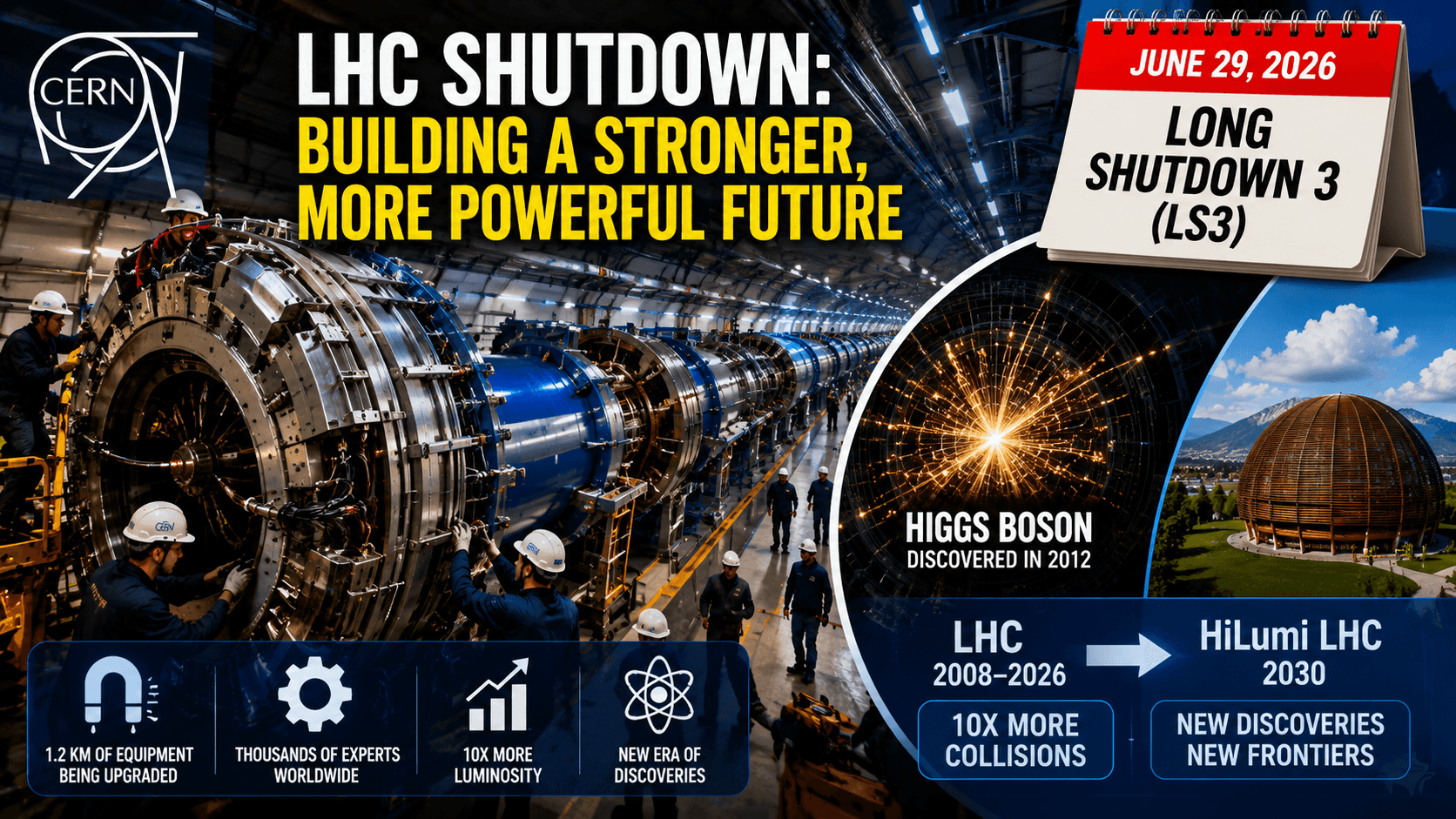
The machine that helped discover the Higgs boson has gone silent.
On June 29, 2026, the European Organization for Nuclear Research (CERN) switched off the Large Hadron Collider (LHC), ending one of the most successful chapters in modern scientific history.
But the shutdown is not because the collider has failed.
In fact, CERN is taking the extraordinary step of dismantling parts of the world’s most powerful particle accelerator because scientists want to make it even more powerful.
The shutdown marks the beginning of Long Shutdown 3 (LS3), a massive four-year engineering project that will transform the LHC into the High-Luminosity Large Hadron Collider (HiLumi LHC)—a machine designed to produce far more particle collisions than ever before.
Why Is the LHC Being Shut Down?
The answer is simple: scientists need more data.
The Large Hadron Collider has already achieved what many considered impossible.
Since its first proton beams circulated in 2008, the 27-kilometre underground accelerator has revolutionized particle physics.
Its greatest achievement came in 2012 when CERN’s ATLAS and CMS experiments confirmed the existence of the Higgs boson, often called the “God Particle.”
The discovery completed a crucial piece of the Standard Model of particle physics and earned the 2013 Nobel Prize in Physics for theorists who predicted the particle decades earlier.
Yet physicists still face enormous unanswered questions:
- What is dark matter?
- Why does matter dominate over antimatter?
- Are there unknown particles beyond the Standard Model?
- What happened in the earliest moments after the Big Bang?
To answer those questions, scientists need far more collision data than the current LHC can provide.
CERN Is Literally Dismantling the Collider
The scale of the upgrade is staggering.
During Long Shutdown 3, engineers will remove and replace approximately 1.2 kilometres of accelerator components, including magnets and other critical systems.
Thousands of engineers, technicians, and physicists from around the world will participate in one of the largest scientific infrastructure upgrades ever attempted.
The project extends far beyond the collider itself.
CERN will also modernize:
- Accelerator tunnels
- Experimental facilities
- Electrical systems
- Safety infrastructure
- Cryogenic equipment
- Research laboratories
This is the most extensive intervention at CERN since the original construction of the LHC.
What Is the High-Luminosity LHC?
The upgraded machine is known as the High-Luminosity Large Hadron Collider (HiLumi LHC).
The key goal is not higher energy.
Instead, it is higher luminosity.
In particle physics, luminosity refers to the number of collisions produced inside the accelerator.
The HiLumi LHC is expected to increase luminosity by up to ten times the original design capability.
That means scientists will be able to observe vastly more particle interactions and collect much larger datasets.
More collisions mean a greater chance of detecting extremely rare physical phenomena that might otherwise remain invisible.
Why This Matters for the Higgs Boson
Ironically, the particle that made the LHC famous is one of the main reasons for the upgrade.
The Higgs boson was discovered in 2012, but scientists still know surprisingly little about it.
Researchers want to measure its properties with unprecedented precision.
The upgraded collider will allow physicists to study:
- How the Higgs interacts with other particles
- Whether the Higgs behaves exactly as predicted
- Potential signs of new physics hidden within Higgs measurements
Many scientists believe the Higgs boson could provide clues to entirely new laws of nature.
The Detectors Are Getting a Massive Upgrade Too
The collider itself is not the only system being transformed.
CERN’s two flagship experiments—ATLAS and CMS—will undergo major upgrades.
The challenge is enormous.
During the previous run, experiments typically dealt with around 60 proton collisions occurring simultaneously.
The HiLumi LHC could generate between 140 and 200 collisions per bunch crossing.
That means detectors must process and filter billions of particle interactions every second.
To cope with this flood of information, scientists are installing:
- New trigger systems
- Advanced silicon trackers
- High-precision timing detectors
- Faster calorimeters
- Upgraded computing infrastructure
These improvements will allow researchers to identify the most interesting events from more than five billion interactions every second.
What Happens Between Now and 2030?
Although the collider has been switched off, CERN’s scientific work is far from over.
Researchers will continue analyzing the enormous amount of data collected during previous runs.
Many discoveries could still emerge from data that already exists.
Meanwhile, thousands of specialists will work on the transformation of the LHC into its high-luminosity successor.
The first stages of accelerator restart are expected around 2028, with full High-Luminosity LHC operations planned for 2030.
The Beginning of a New Era
The shutdown of the Large Hadron Collider is not an ending.
It is a transition.
After nearly two decades of discoveries, including the historic detection of the Higgs boson and the discovery of dozens of new hadrons, CERN is preparing for its most ambitious scientific mission yet.
The next version of the collider will generate more data than all previous LHC runs combined.
And somewhere within those trillions of future collisions could be clues to dark matter, hidden dimensions, or entirely new laws of physics.
The world’s most powerful machine has gone silent—for now.
But when it returns, it may help answer some of the biggest mysteries in the Universe.
Reference: CERN