
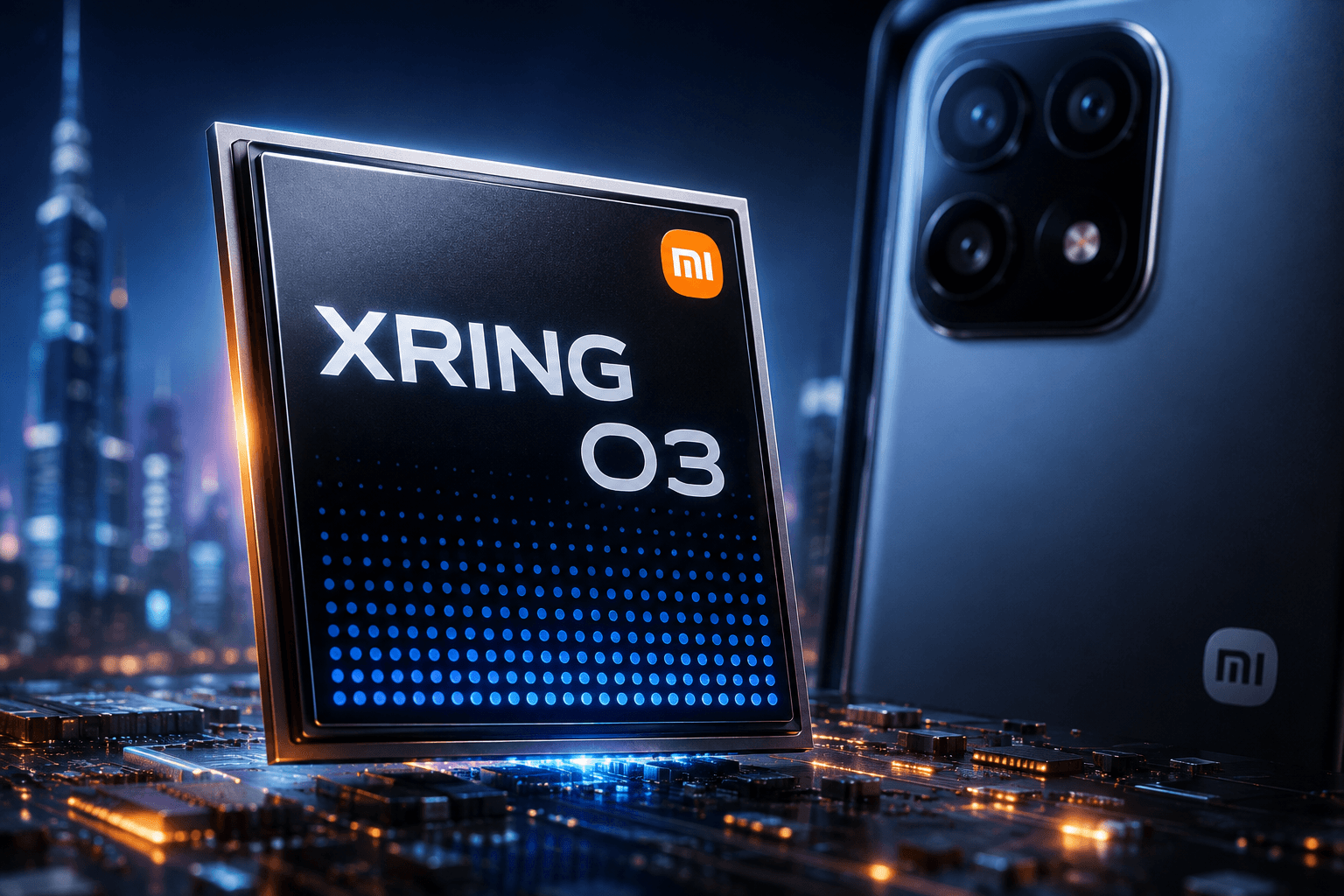
Xiaomi has unveiled the Xring O3, its latest in-house smartphone processor, marking another major step in the Chinese company’s attempt to reduce dependence on Qualcomm and MediaTek.
The timing is significant. As smartphone makers increasingly compete on on-device AI, power efficiency and custom software, designing their own silicon gives companies greater control over how hardware and AI features work together.
What is the Xring O3?
The Xring O3 is Xiaomi’s new flagship mobile system-on-chip (SoC). Reports say it is manufactured by TSMC using its advanced 3nm process, putting Xiaomi’s silicon effort closer to the technology used by leading premium chipmakers. Reuters reported that TSMC will manufacture the chip, citing people familiar with the matter.
The processor reportedly contains 24 billion transistors and a 10-core CPU built entirely around high-performance cores. Xiaomi also says the chip supports LPDDR6 memory, while its integrated GPU and AI processor are designed to deliver substantial gains over the previous Xring O1.
Why is Xring O3 important?
The bigger story is not simply benchmark performance.
Xiaomi is trying to build a vertically integrated technology stack—chip + operating system + AI + devices—similar to the strategy used by Apple and, increasingly, other major electronics companies.
The company says the Xring O3 has crossed 5 million points on AnTuTu in its testing, although benchmark results should not be treated as a universal measure of real-world performance.
The chip’s AI capabilities are also increasingly important. Reported specifications include a dedicated NPU capable of around 200 TOPS, allowing more AI processing to happen directly on the device rather than relying entirely on cloud servers.
That could matter for generative AI features, photography, voice processing and other applications where latency, privacy and connectivity are important.
Xiaomi is building more than a phone chip
The O3 is only part of Xiaomi’s broader semiconductor strategy.
The company has also unveiled the Xring O100, aimed at AI workloads, and the Xring D100, designed for intelligent driving. The D100 is planned for commercial use in 2027.
This signals a bigger ambition: Xiaomi wants its chip-design capabilities to extend across smartphones, AI systems, cars and potentially robotics.
The bigger semiconductor race
Xiaomi’s move comes as smartphone companies seek greater control over critical components amid geopolitical tensions and supply-chain uncertainty.
For consumers, the immediate question is whether Xring can match the efficiency and sustained performance of Qualcomm’s Snapdragon and Apple’s silicon in real-world products.
For the semiconductor industry, however, the message is bigger: Xiaomi is no longer content to compete only as a device maker. It wants to become a serious chip designer too.