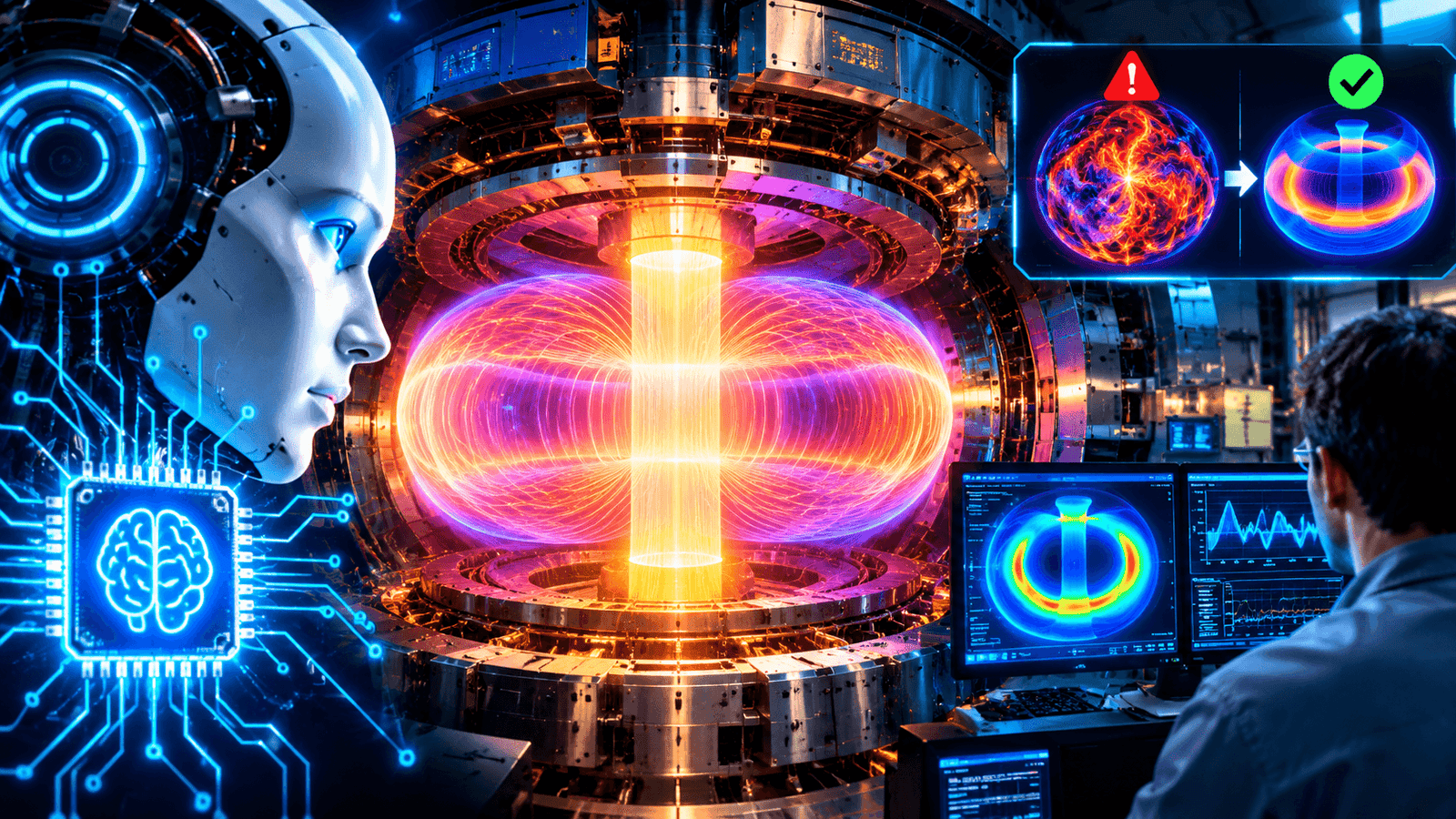
AI fusion plasma control has reached a striking new milestone. Researchers at Princeton University and the U.S. Department of Energy’s Princeton Plasma Physics Laboratory have demonstrated an artificial intelligence framework that can monitor and control fusion plasma in roughly 20 milliseconds—far faster than a human operator can react.
The system, called PACMAN, was tested in five experiments on the DIII-D National Fusion Facility tokamak in San Diego. Its most important achievement may be its ability to predict a dangerous plasma instability before it develops.
How AI Controls Fusion Plasma
Fusion reactors depend on extremely hot plasma being kept stable inside powerful magnetic fields. But plasma can suddenly become unstable within milliseconds, potentially disrupting an experiment.
Traditional computer simulations can take days or months to calculate complex plasma behavior. That makes them useful for planning but impractical for real-time control.
PACMAN takes a different approach.
The framework combines multiple machine-learning models into a continuous control loop. It collects temperature, density and magnetic measurements, predicts what the plasma is doing—or about to do—and then determines how the tokamak should respond.
The entire loop typically operates in around 20 milliseconds, repeatedly making decisions while the experiment is running.
AI Predicted a Fusion Instability 200 Milliseconds Early
One of the most significant tests involved a tearing mode, an instability that can disrupt plasma confinement.
Conventional controllers generally detect the problem after it has already started. PACMAN’s machine-learning model predicted the instability approximately 200 milliseconds before it appeared, giving the system time to change plasma conditions and prevent it.
The framework also controlled heating systems, predicted bursts of energy at the plasma edge, managed fast-particle-driven waves and coordinated all six of DIII-D’s gyrotrons.
Why This Matters for Fusion Energy
The development arrives as the U.S. is accelerating its push to combine AI, supercomputing and fusion research.
In July, Princeton researchers received grants under the U.S. Department of Energy’s Genesis Mission, a national program involving hundreds of projects designed to use AI to accelerate scientific discovery. One Princeton-led project specifically aims to develop AI capable of predicting plasma behavior and improving fusion control.
That broader effort reflects a growing realization: building a practical fusion reactor may require AI that can react at the speed of plasma physics.
Princeton researchers also emphasize that PACMAN does not remove humans from the loop. Hardware safety limits remain in place regardless of what an AI model recommends, while researchers set the objectives and review experiments.
The Bigger Picture
PACMAN is not a fusion power plant—and it does not mean commercial fusion is suddenly solved.
But it demonstrates something important: AI can increasingly act as a real-time control layer for one of the most difficult engineering problems on Earth.
If this approach scales to larger and more complex tokamaks, AI fusion plasma control could become an important piece of the technology stack needed to turn fusion from a scientific experiment into a reliable energy source.