
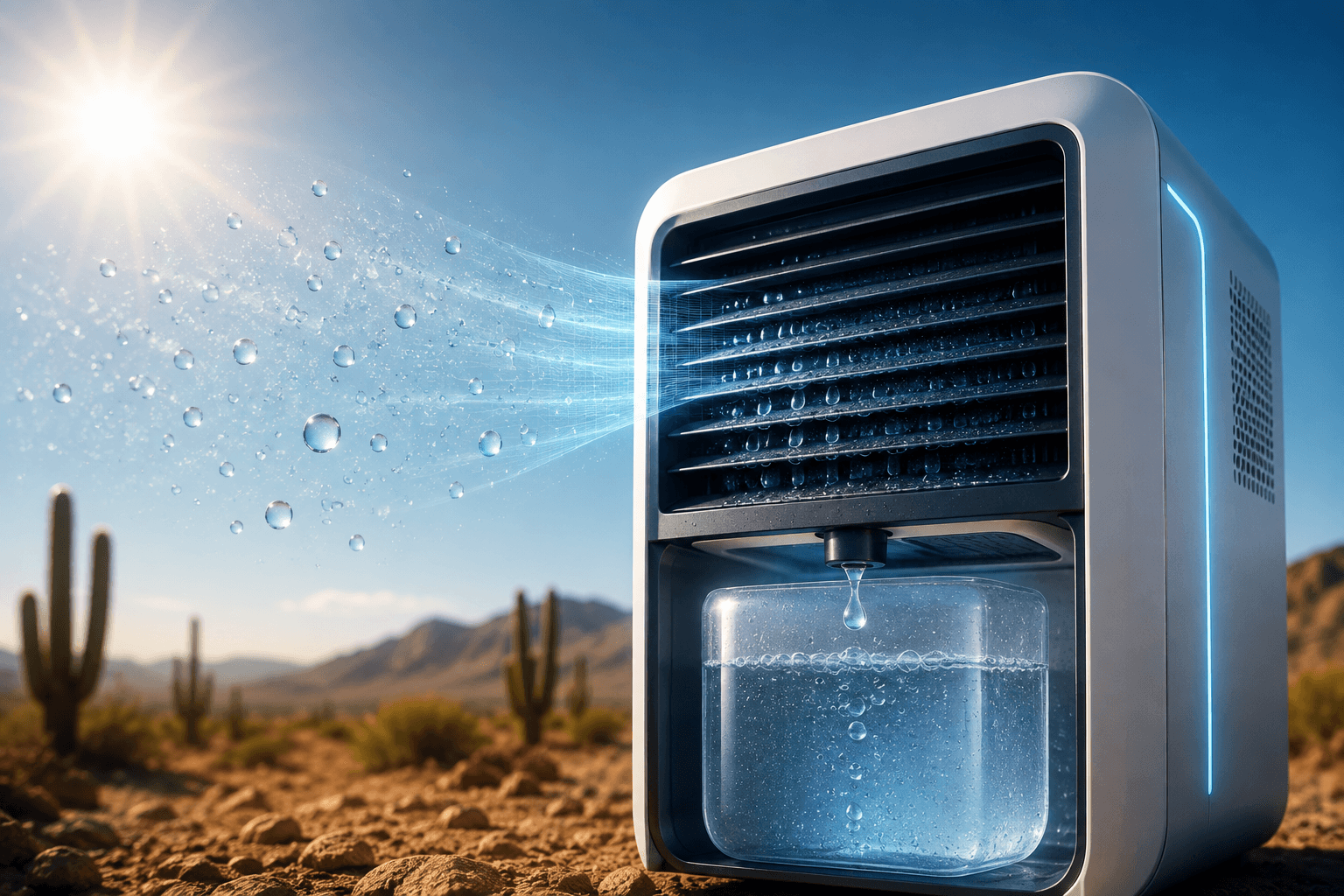
Fresh water is becoming one of the world’s most valuable resources. But there is another source of water almost everywhere around us: the atmosphere.
Atmospheric Water Generation (AWG), also called atmospheric water harvesting, uses technology to capture water vapour from air and convert it into usable water. Once considered too energy-intensive for widespread use, the field is now seeing rapid breakthroughs in advanced hydrogels, metal-organic frameworks (MOFs), solar-powered systems and portable fabrics.
What is Atmospheric Water Generation?
Air contains water vapour even in dry regions. Traditional AWG machines work much like dehumidifiers: they cool air until moisture condenses into liquid water.
The problem is energy. Cooling large volumes of air can consume substantial electricity, particularly when humidity is low.
Newer systems are taking a different route. Instead of cooling air first, sorbent materials capture moisture directly. The material is then gently heated—potentially using sunlight or waste heat—to release the collected water.
A 2026 Nature Reviews Clean Technology analysis highlighted how new approaches could dramatically reduce energy use. Some experimental systems using non-traditional regeneration methods have reported energy requirements far below conventional heat-driven atmospheric water harvesting.
The Big 2026 Breakthrough: Water-Harvesting Fabrics
One of the most striking recent developments came from the University of Texas at Austin.
Researchers developed a portable, solar-powered atmospheric water harvesting system using gel-based fabric. In field tests, the technology produced litre-scale quantities of water across very different climates, including arid conditions.
A dual-module system produced 1.3 litres of water in outdoor tests in Austin, while tests in the Chihuahuan Desert demonstrated productivity of 4.3 litres per square metre per day at around 26% relative humidity.
The research is important because atmospheric water generation has long faced a difficult trade-off: systems were either portable but produced little water, or productive but required large infrastructure.
Why New Materials Are Changing Everything
The next generation of AWG is increasingly a materials science race.
MOFs are highly porous materials that can be engineered to attract and hold water molecules. Advanced hydrogels can also absorb atmospheric moisture and release it under relatively mild heating.
In another major 2026 development, researchers reported a MOF-based composite that reduced the temperature needed to release captured water to below 60°C at the device level. Field testing showed up to a 91% improvement in solar-to-water generation in one continental test.
Researchers are also exploring systems that combine water harvesting with electricity generation. A 2026 study reported an outdoor hydrogel-based system producing 5.31 litres of water per square metre of sorbent per day while integrating thermoelectric power generation.
Real-World Application:
- Gansu Pilot: A facility in Gansu Province demonstrated the technology’s effectiveness in a region with less than 150 mm of annual rainfall, producing 300–500 liters of potable water daily.
- Scaling Strategy: By using a modular design similar to the solar industry, these systems can scale from household units to large community installations.
- Economic Potential: The goal is to provide a local, high-quality water supply that is competitive with expensive, unsafe, and unreliable trucked water in remote, arid regions.
Why Atmospheric Water Generation Matters Now
AWG will not replace rivers, reservoirs or large-scale water infrastructure. Its economics and performance still depend heavily on climate, energy costs and the quality of the harvested water.
But its greatest potential may be decentralised water: disaster zones, remote communities, military operations, agriculture and regions facing severe water stress.
The biggest breakthrough may therefore not be simply “making water from thin air.”
It is making the technology portable, solar-powered and efficient enough to work where conventional water infrastructure does not.