
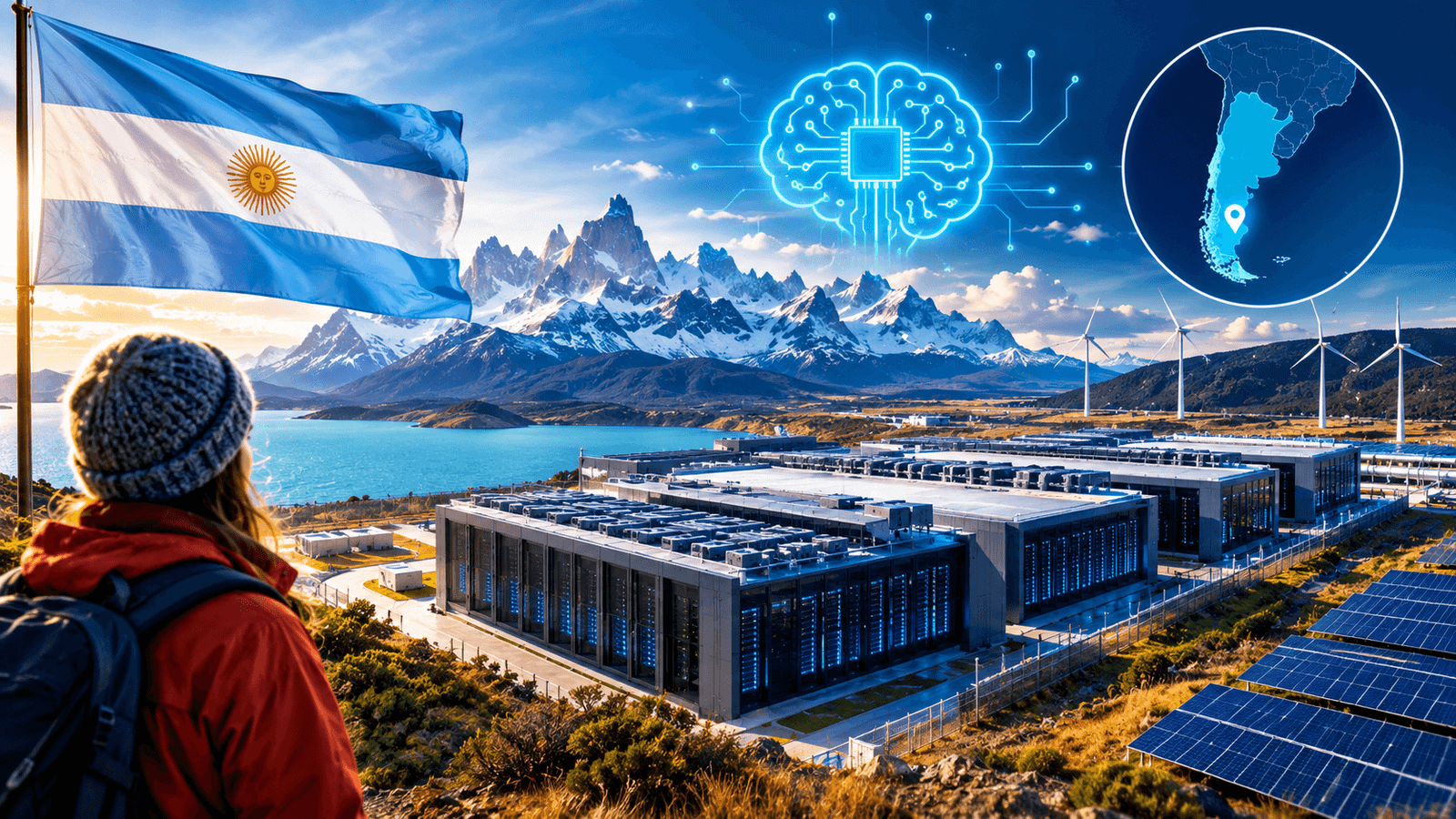
Argentina’s remote Patagonia region is emerging as an unlikely contender in the global race to build massive AI data centers. Its combination of cool temperatures, abundant energy resources and large areas of undeveloped land is attracting developers looking for locations capable of supporting the enormous power demands of artificial intelligence.
The opportunity comes as AI companies and cloud providers race to expand computing capacity worldwide. In the United States, new data centers have increasingly faced concerns over electricity consumption, water use and pressure on local power grids. Patagonia, by contrast, has so far seen relatively little public opposition because large-scale facilities are still mostly at the planning stage.
Why Patagonia Is Attractive for Data Centers
One of the most closely watched locations is Neuquén, home to Vaca Muerta, one of the world’s major shale oil and gas formations.
Energy company Pampa Energía is exploring a data-center project near its Loma de la Lata power plant that could eventually require up to 500 megawatts (MW) of electricity. The company is reportedly discussing smaller pilot deployments of around 20–40 MW before attempting a much larger buildout.
Patagonia also offers strong renewable-energy potential. Argentina’s government has already approved grid access for a 15 MW solar project in Neuquén, highlighting the region’s growing power infrastructure.
The colder climate could provide another advantage. Data centers generate enormous amounts of heat, making cooling one of their biggest operational challenges. Cooler ambient temperatures can potentially reduce the energy required for cooling large server installations.
OpenAI Has Already Put Argentina on the AI Map
Patagonia’s data-center ambitions are not limited to local developers.
OpenAI and Argentine company Sur Energy announced a letter of intent in 2025 to explore a large-scale data-center project in Argentina, potentially becoming the first Stargate project in Latin America. OpenAI said the initiative was envisioned around secure and sustainable energy infrastructure.
Reuters now reports that Argentina is seeing interest from additional developers, including U.S.-based FlexDomes and Poland’s Green Capital, with projects being considered in Neuquén and Chubut. Some proposals could eventually reach hundreds or even thousands of megawatts, although many remain early-stage plans rather than confirmed construction projects.
Argentina Is Building the Digital Infrastructure Too
Power alone is not enough to operate an AI data center. High-capacity fiber connections are equally critical.
Chubut is working with Argentina’s communications regulator on a strategy to develop a regional hub for data centers, telecommunications and AI. The initiative includes plans for Argentina’s second international submarine cable landing point, which could improve international connectivity and redundancy.
Argentina’s investment framework is another attraction. The RIGI regime provides tax and regulatory incentives for qualifying large-scale investments, while technology—including artificial intelligence—is among the sectors covered by the framework.
The Biggest Challenge: Turning Plans Into Reality
Patagonia has the land and energy potential, but building a hyperscale data center requires far more than finding an empty site.
Grid capacity, fiber connectivity, financing, construction logistics and long-term regulatory certainty remain major hurdles. Some investors are also watching Argentina’s 2027 presidential election before committing billions of dollars.
That makes Patagonia data centers an emerging story rather than a finished AI infrastructure boom.
If Argentina can solve its connectivity and power-transmission challenges, however, the region could become one of Latin America’s most important new locations for AI computing—turning Patagonia’s remote landscape into a critical part of the global AI infrastructure race.